

Coalitions can accelerate decarbonisation
Coalitions minimise investment risks and play a key role in achieving decarbonisation.
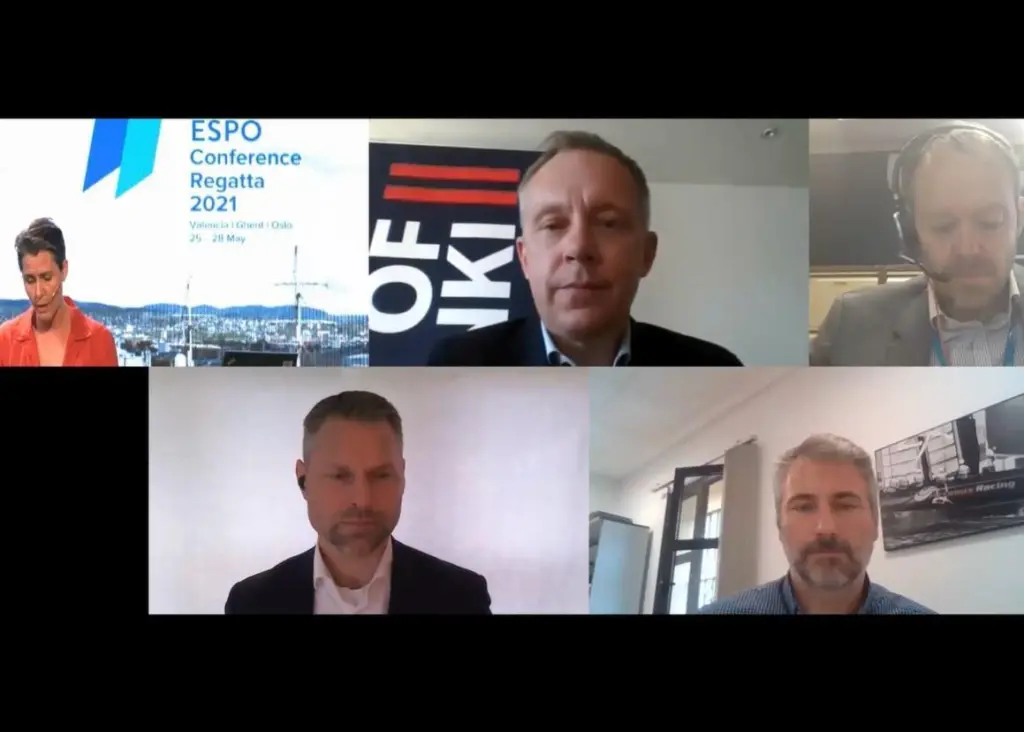
This was one of the key messages on day three of the ESPO Conference Regatta 2021, held at the Port of Oslo in Norway.
Speaking about the value of coalitions, Dr Carlo Raucci, marine decarbonisation consultant at Lloyd’s Register, said: “Building coalitions that minimises the risk that is inevitable is key not only to accelerate adoption, but essential to achieve the overall decarbonisation.”
He spoke about how using new fuels on ships is not only a technical challenge, but a commercial challenge. That is how we can be sure there is an economic case and who is paying for this transition?
To meet zero-emission timeline goals “it is important to build coalitions that maximise the value added impact of sustainable transition,” said Mr Raucci.
Coalitions as accelerators
The conference saw a debate about ‘Coalition Building as fast track to zero emission transport solutions’.
Speaking about the hurdles for supplying alternative fuels and how coalitions can be part of the solution, Cécile Nourigat, Secretary General UPEI, Europe’s Independent Fuel Suppliers pointed out that sustainable biofuels, though able to be deployed quickly, are expensive, and coalitions can help with the deployment of these fuels.
Alternative fuels like hydrogen, ammonia, and bioenergy could benefit from coalition support as they require “large capital investment” to achieve deployment. She added that good industry practise is not yet in place for guaranteeing the quality of fuels.
Lars Erik Marcussen, project manager logistics at HeidelbergCement North Europe, which has a carbon capture facility. “To develop zero emission shipping has to be done as a coalition.”
The company floated a competition to build a zero-emission vessel and got over 30 responses from across Europe. “I think that would only be possible if we were able to collaborate with government facilities as well as with other commercial operators”.
Costa Group is currently working with the Port of Marseille on onshore power supply and alternative fuels and how this helps fast track the greening of the company’s cruise ships.
Bernard Vanheule, EU affairs director at Costa Group, said has a partnership for shore power in place already, and is a partner for the Blue Charter agreement, signed at the end of 2019 by cruise companies and supported by local companies.
“We’re willing to be a leader for innovation and sustainability”. He said shore power may offer opportunities with future hybrid ships using battery technology that would allow its ships to operate in ports with zero emissions.
Stéphane Reiche general delegate, Marseille Fos Port Authority, said the four elements of the Blue Charter include the will to integrate into the port’s OPS programme that will be expanded and the will to integrate into the port’s LNG programme. The port has two LNG terminals.
The third dimension is low sulphur fuel on a voluntary basis (the port hopes to establish a zone soon) and speed optimisation to reduce emissions when entering and leaving port. “It was important to build this in a coalition to have a level playing field between the different cruise operators. Also, it was important to have the charter, so that the port authority and its financial partners do not invest in equipment that is not used at a later stage,” he said. In fact, one of the main reasons for building the collation is to guarantee that the equipment will be used. Government and public support guarantee the business cases which are not yet mature through subsidies into the CAPEX, and guarantee the right tax regime to ensure the right evolution of the OPEX.
The main priority for coalition building should be “sharing information rather than looking at it as competitive,” said Mr Marcussen. Mr Vanheule added that coalition is useful at a regulatory level and a financial level. Ms Nourigat stressed research and development “fact finding” should be prioritised and specifically, alternative fuels because of the size and cost of the challenge, while Mr Reiche said coalitions should look for the business case enablers, e.g. economies of scale, or identifying infrastructure needed for different types of projects.
Creating zero-emission ports
Earlier at the event, Knut Arild Hareide, Minister of Transport, Norway talked about the importance of ports in the energy transition and how they can evolve to become energy hubs and key players in zero-emission logistics chains.
Creating zero pollution ports” is a flagship project in the framework of the EU Mobility Strategy. A second debate focused on what is meant by zero pollution ports, what port authorities can do, what other port stakeholders should do and is policy needed. Participating ports included Valencia in Spain, Helsinki in Finland, Gothenburg in Sweden and Shoreham in the UK.
All four ports aim to have shore power within the next five years, but only the ports of Helsinki and Gothenburg currently use it. Hydrogen is not being used or supplied by any of the ports currently, but all agreed it will be in ports in the future.
On the subject on future ships and emissions reduction solutions, Tom Willis, CEO of Shoreham Port said Shoreham is planning for “a hydrogen-based port” within the next five years. “We think our customers, in terms of shipping lines, and ground transport operations will be predominantly driven by green hydrogen for everything bigger than a car.”
Raúl Cascajo, head of environmental policies, Port Authority of Valencia, said LNG will still be part of the fuel picture for ports in the next five to 10 years. Hydrogen will be introduced as part of the H2Ports project to implement a fixed mobile hydrogen supply station at the port within the next six months to power one truck from the car terminal and one reachstacker from the container terminal. He believes autonomous ships will be in ports within the next decade. “I think it’s enough time to see autonomous ships coming into some of our ports,” he said. driving electrification and energy sources including hydrogen and renewables. OPS will also play a bigger role, he says.
Edvard Molitor, head of sustainability at the Port of Gothenburg, says the port expects to have fully electric ro-pax vessels before 2030 and therefore a very large-scale OPS than currently offered by the port. He also believes there will be more LNG-driven vessels, hopefully with a larger share of biogas blended in, continued use of methanol fuelled vessels, with the aim of using green methanol. Still expects a significant number of vessels using oil, but these are expected to blend in a large share of bio-based oil. He doesn’t believe there will be full deployment of hydrogen-run vessels before 2030, but a number of pilot projects are expected to be running before this date. There will be “a number of different fuels blended in with bio-based and green alternatives,” he summarised.
Ville Haapasaari, CEO of the Port of Helsinki, said the port anticipates a continued mix of current fuels, including LNG, over the next five years, with new infrastructure increasing demand for hybrid solutions to facilitate OPS. As the 2030s approach, he said: “We need to prepare ourselves for hydrogen, ammonia, methanol etc., but I don’t see this in the next couple of years.”
All the ports said they were committed to and regularly engage and cooperate with stakeholders. Mr Molitor highlighted how ports can only do so much on their own premises and stated Gothenburg is working with stakeholders throughout and even beyond the supply chain to extend the reach of emissions initiatives. Mr Willis also noted the COVID-19 pandemic had increased the number of participants in port meetings due to the switch to virtual events.
Mr Cascajo discussed the importance of communicating with local communities around ports about safety and security measures taken with future fuels. He said these measures have already been exercised with LNG and can be transferred to other alternative fuels like hydrogen.
It’s important to acknowledge there will be some dead ends with future fuel development, said Mr Molitor. “We would hope that fewer alternative fuels will emerge” as the winning options as bunker complexity is logistically difficult and each port cannot provide for all these fuels.
Echoing Mr Cascajo’s point about learning from previous experience of implementing fuels that are compliant with regulations , Mr Molitor said that while there are no plans for ammonia at Gothenburg, the fuel could be implemented more quickly than previous fuels using the same process. Mr Cascajo told GreenPort Valencia is exploring the use of ammonia.
Debate chair, Heidi Neilson, chair of ESPO’s Sustainable Development Committee and head of environment at the Port of Oslo, added that Oslo has carried out a risk assessment for ammonia bunkering, the result of which it will share at a future date.
Related Articles
 ALTERNATIVE FUELS GREENPORT
 NEWS
NEWS