

Uber green boats
British ferries have secured funding for a trio of sustainability projects.
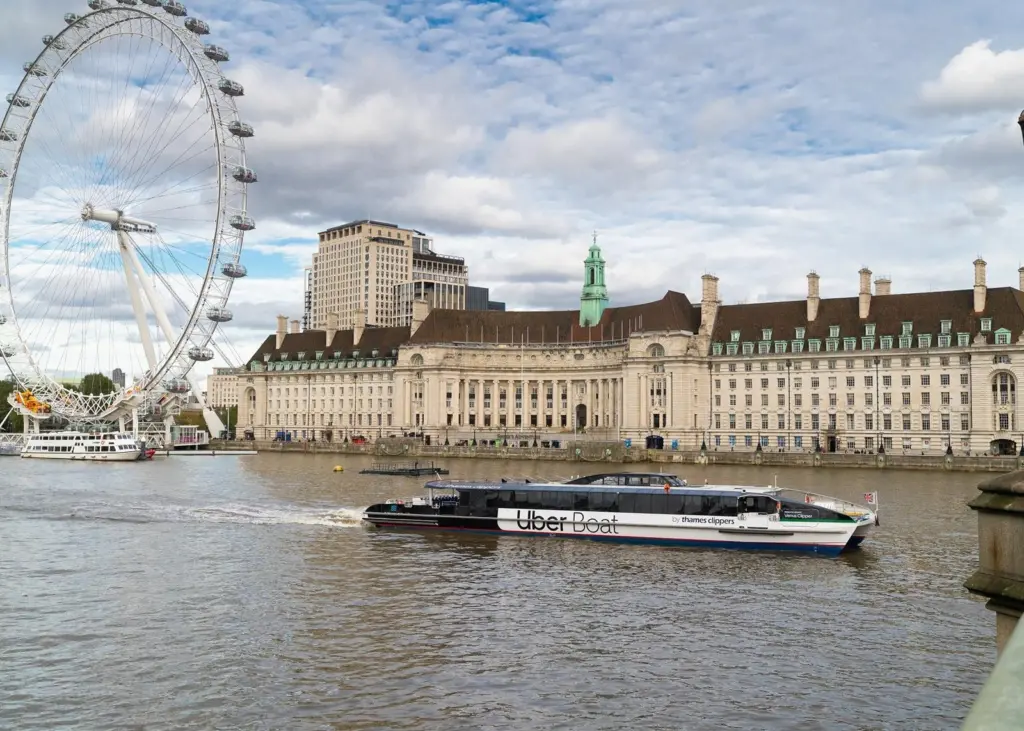
The funding from the UK Department for Transport (DfT) via the Innovate UK Clean Maritime Demonstration Competition, will help London River Bus operator, Uber Boats by Thames Clippers, research and develop green river transport for the future.
“We believe strongly in protecting and preserving the River Thames and the communities close to the river. This means moving as fast as the technology will allow us to viably move away from diesel-powered vessels,” said Geoff Symonds, Uber Boat by Thames Clippers’ chief operating officer.
Green tech focus
The three projects, which focus on new power and propulsion technologies and emissions-reducing solutions, are part of the business’s long-term commitment supporting the sustainable growth of infrastructure and economic development on and around the river.
All of the DfT-funded projects enable research into the future capabilities to design the new generation of river transport; greener, more efficient and advancing the existing technology.
The first called Clipper 2.0 will centre on economical and technical feasibility of decarbonising high-speed public water transport on the River Thames.
Current viable technology only enables its high-speed catamarans to be powered using diesel engines, so this study will look at the feasibility of integrating fuel cell electric drive systems into the catamaran platform for new catamarans and, beyond that, retrofitting the existing fleet where possible.
The project will analyse three zero carbon fuel types – compressed hydrogen gas, liquid hydrogen and methanol – to allow an informed future choice to power the fleet. On this project Uber Boat by Thames Clippers is supported by Mayfair Marine as a hydrogen marine consultant, Class Society DNV for regulatory support and catamaran designers One2three Naval Architects.
Uber Boats’ second project focuses on a cross river zero emissions ferry. Working in collaboration with BAE Systems, Beckett Rankine and Wight Shipyard Co this project aims to position the UK to deliver the best intelligent electric propulsion and power management solutions in the world, supporting the UK maritime industry with the UK Government’s Net Zero 2050 initiative.
It will provide a pathway to implementation of zero emission cross river services on the Thames as well as potential for implementation in other locations in the UK and internationally.
This feasibility study will look at the relationship between power demand, duty cycle and vessel optimisation for more efficient vessel operation. It will help to develop a clear plan for a future prototype vessel that provides operational data to show clear economic and technological feasibility to achieve Net Zero by 2050.
Lastly, Project HOST (Hydrogen and Oxygen South Thames) seeks to enable Uber Boat by Thames Clippers to transition from diesel engines to vessels that use hydrogen fuel cell, batteries and electric motors over the next 10 years.
Project HOST, working alongside Arup, Shell, National Grid and Wight Shipyard Co, will accelerate the deployment of other vessels and modes of transport switching to hydrogen.
The project will invite innovation at many levels to include new technology, supply chains, skills and innovative partnerships. It’s hoped that Project HOST, once delivered, will provide a model for other hydrogen maritime projects to follow.
Related Articles
 ALTERNATIVE FUELS GREENPORT
 NEWS
NEWS