


Shore power systems
Shore power system supply is a growth business spurred on by legislative requirements and standards creating a structured framework for system installation. But it is a question of how much, how soon?
SECTOR ANALYSIS: GREATER PENETRATION NEEDED
The main take-up of such systems to-date has been in Europe, Scandinavia and North America with Asia also recently accounting for more installations. There still remains, however, an awful long way to go to achieve dense system penetration. The financing of installations remains an influential consideration – the case for public sector support on a cost-benefit basis is strong in order to accelerate system usage. Outside of the theatre of fixed route shipping – ferries and cruise ships notably – there is still the problem of system take-up by vessel owners. This is an area that needs further consideration in order to keep the bandwagon of shore power system supply rolling and to increase the contribution it can make to decarbonisation.
ABB: The company delivers shore connection and charging solutions for diverse vessel types. ABB’s onshore offering comprises transformers and frequency converters to synchronise shore¬side power, voltage and frequency with those of a vessel’s onboard system. Connecting cables and solutions available for container terminals and city harbours, with power ratings to meet high-end requirements. System configuration runs from the substation receiving electricity from the local network to the power outlet at the dock. All major components can be accommodated within compact buildings or containers designed to blend into the surrounding environment. ABB delivered the world’s first shore power supply system to the Swedish port of Gothenburg in 2000 and its project portfolio now includes installations in Scandinavia, Europe, North America and Asia. Recent projects include systems for the ports of Incheon, South Korea, Tallinn, Estonia and as the consortium lead to provide shore-to-ship power connection for ferries and cruise ships at the Port of Toulon, France. In the latter context, the solution provided will deliver sufficient energy to meet the requirements of one cruise ship or three ferries simultaneously calling at the port. Vessels can use 50Hz or 60Hz power connections. With solar energy generated from a photovoltaic shelter and an energy storage system utilising lithium batteries, the system deployed with ABB equipment can automatically adjust the energy mix to supply ships through Enedis, the local power network. Going forward, the system will also be able to store excess solar energy production as well as use other renewable energy sources, such as fuel cells. In a development context, ABB notes discrepancies in frequency between ship and shore are driving demand for more intelligent landside solutions.
Cavotec: Cavotec is a high-profile company in the business of shore power system supply having undertaken diverse projects around the world for a variety of ship types. The company describes itself as the total solutions provider for ports and ships. It also claims for itself the record of being the most prolific supplier of shore power systems, supplying systems on a turnkey basis. Cavotec states that it has developed specific shore power solutions for cruise, ferry, ro-ro, container and other specialised terminals. The Cavotec website provides comprehensive information on the shore power options and associated data sheets as well as general information about the full range of services offered to the maritime ports sector.
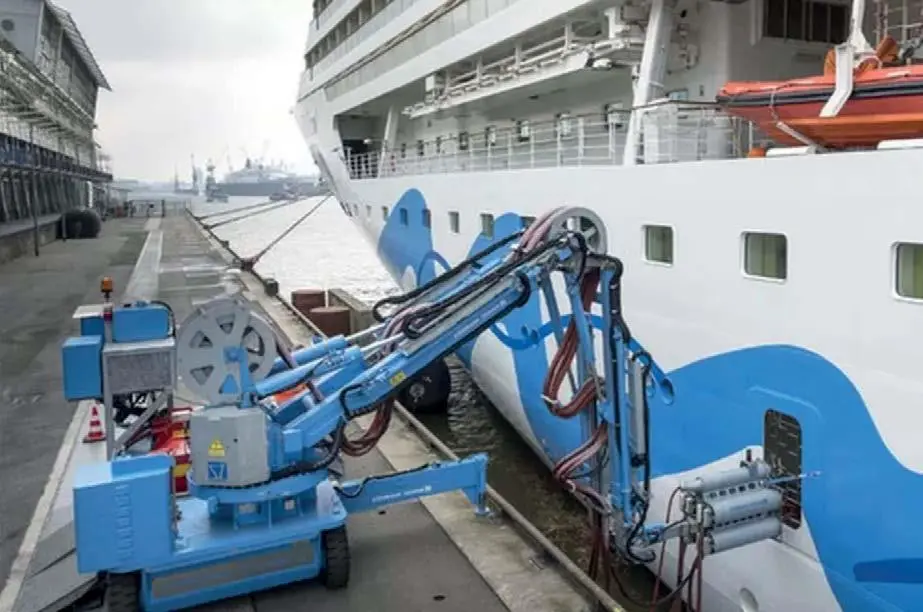
Igus: Igus offers customised energy supply systems for providing vessels at berth with shore power. Systems supplied conform with international standard requirements – IEC 80005-1 for medium-voltage connections and IEC 80005-3 for supply of low-voltage connections. The company’s specialist edge is the development and manufacture of cable management systems to the meet the differing requirements of diverse clients with innovation in the areas of maximising flexibility and manoeuvrability, space saving and storage and ease of handling process. Noteworthy products from igus are its e-chain reel and the igus mobile shore power outlet. The “e-chain reel system” is a mobile shore power connection product (mobile shore power outlet – SPO). It is designed to maximise operational flexibility and core components are: a motorised e-chain reel with special igus chain wound onto it and a special chain with rolling applications attached to the mobile SPO. The mobile SPO can be moved with existing port equipment or via winding systems and can be connected to any stationary SPO offering an extension length of 50 – 60m.
Nidec Industrial Solutions: This company ranks among the first generation of suppliers of shore-based power systems for vessels. It was an early provider of such a system to the port of Livorno and in 2018 was declared the successful bidder to design and construct a “shore-to-ship” project for the port of Genoa. As part of the order for Genoa, Nidec supplied two 6 MVA static frequency converters which, with the overloads required, can reach up to 12 MVA, as well as switchboards and LV/MV transformers, connecting cables for the various devices and required accessory components. The company has also recently announced a second shore-power project for Genoa and a project for the port of Savona with both contract awards placed by the Western Ligurian Sea Port Authority. The Genoa project entails Nidec ASI equipping six berths with shore power. In order to adapt the voltage and frequency of the power supply network to ship requirements, a conversion system consisting of distribution panels, transformers and converters, that will allow the ships to be powered simultaneously, will be introduced. An automation, monitoring and control system will ensure all safety regulations are met at both Genoa and Savona ports. The system to be installed at Savona will be similar to the Genoa one.
Power Systems International (PSI): PSI is a specialist in the supply of shore power frequency converters – providing the technology for the shore system to match the frequency at which a given vessel operates. Fixed shore power frequency converters are designed for use on the public supply grid networks of 50Hz or 60Hz with 3 phase standard input voltages of 208V, 400V, 460V or 575V. The output voltage and frequency will be according to the needs of the ship with voltages and frequencies similar to the input. The shore to ship power converter can be manufactured in sizes of 100kVA to 1,200kVA in an indoors type of enclosure for installation in a substation or power distribution room. PSI can additionally supply the shore to ship power converters in an all-weather outdoor enclosure for installing on the dockside or mooring berth.
Schneider Electric: As well as bespoke solutions, Schneider Electric offers its ShoreBoX shore connection which comprises pre-designed, ready to use systems for providing shoreside grid power to ships at berth. Typically, ShoreBoX consists of a range of standard components organised in different functional modules fully packaged in a single metal enclosure. Features of the system highlighted by Schneider include: a configuration that achieves space and cost optimisation; its scalability and use of an energy management system which Schneider says optimises energy usage and minimises cost as a result. The system tracks and reports all data in real time, “giving ports visibility of energy-source selection, forecasts, simulation, metering and billing. Schneider further notes: “The system also supplies data on the port environmental indicators to make a shore connection investment as green and efficient as possible.”
Siemens: The company offers the SIHARBOR shore connection facility. SIHARBOR is said by Siemens to provide a fast, simple and flexible connection to the ship via a cable management system. The system can meet the different power specifications of ports and power supply companies. Siemens points out that it can “be installed at any port and adapted to any berth topology and power need plus supply all types of vessels ranging from cruise ships to container ships and ferries.” The system utilises a variable frequency converter, the control system and the HMI (Human-Machine Interface). As required, SIHARBOR can be designed as a turnkey solution, from planning through system integration (with all LV and MV products and switchgear for connection to the grid) up to commissioning and service. The system can optionally be installed in a container or in already existing buildings.
Tratos: Tratos is a specialist supplier of cables used for the delivery of shore power. The company has supplied its specially designed and manufactured TRATOSMART AMP and TRATOSFLEX AMP cables for shore power applications with these deployed worldwide including in high profile projects in the USA, China and Baltic sea. The range of products varies and covers different voltages and sections from 3x95sqm to 3×240 sqm and can include screened pairs and even Fiber Optics.
Yara Marine Technologies: This well-known marine systems supplier offers turnkey solutions in shore power installation. Jon Halvard Bolstad Olsen, Strategy & Business Development Director, Yara Marine, has written comprehensively on the topic of the diverse incentives to install shore power in our sister publication, GreenPort, Autumn 2022 issue.
Related Articles
 OPERATIONS
 OPERATIONS
 PRODUCTS & SERVICES