![PortStrategy[GreenPort]](https://www.portstrategy.com/wp-content/uploads/2026/09/PortStrategyGreenPort.svg)





Clouds and silver linings
The dramatic slowdown in the last quarter of 2008 wasnt enough to prevent record full-year results for the giant Benelux ports – but 2009 looks like being a different story. Felicity Landon reports
There are clouds – but there are silver linings too, as the ports of Belgium and the Netherlands contemplate the impact of the global downturn.
Volumes reached dizzy heights again last year, with Rotterdam handling 421m tonnes, an increase of 2.9% on 2007, and Antwerp’s volumes growing by 3.5% to 189.3m tonnes.
The first definitive figures for 2009 will not be available until after the end of the first quarter – and they are not expected to make pretty reading.
At an international press conference in January, Antwerp port authority’s chief executive Eddy Bruyninckx made it clear that a downturn was expected for the first half of the year. And Rotterdam chief executive Hans Smits has already said he would be “happy” if volumes reach 400m this year.
Statistics aside, this year will bring further major developments for the Benelux ports.
Antwerp will get a major boost to its competitiveness from the deepening of the Western Scheldt; the Belgian side of the work began in December 2007 and is already finished. “Now we are awaiting our Dutch colleagues to start the works on their side,” says communications manager Annik Dirkx. “The total deepening of the Scheldt should be finished by the end of this year or beginning of 2010.”
The deeper channel will allow seven out of ten ships that currently have to take account of the tide to enter and leave port at any time, and larger vessels will have a much wider tidal window.
Early this year, Antwerp port authority concluded a market consultation over its plans for the 2,500-acre Saeftinghe site on the left bank of the Scheldt, which has been identified for future container expansion.
North of the Deurganck Dock container terminals, which opened in 2005, the Saeftinghe site is likely to be developed as an even larger dedicated container handling facility; this time last year Mr Bruyninckx suggested 2014-15 as the likely time that this additional capacity would be needed, although timelines are obviously unclear in the current climate.
“The results of the market consultation will be examined in the coming months,” says Ms Dirkx.
Elsewhere in the port, Wijngaardnatie’s all-weather steel handling terminal is due to be operational this month.
Among a series of other investments, Evonik has decided to build a new installation for isobutene – this facility, with a capacity of 110,000 tonnes, will be operational at the end of next year.
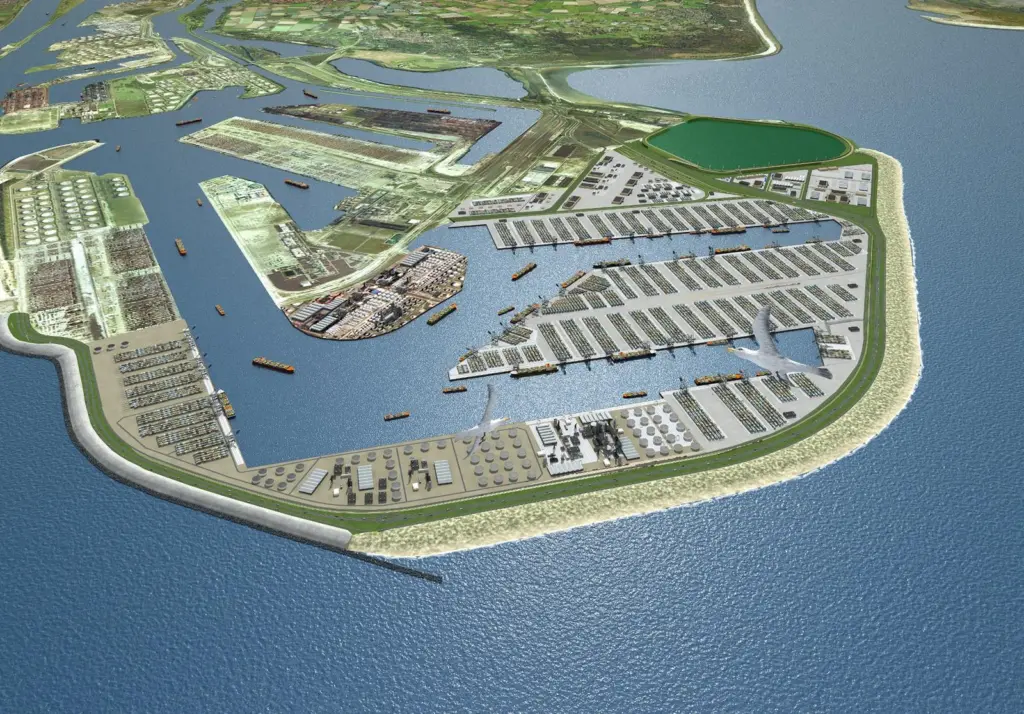
The big news for the Port of Rotterdam last year was, of course, Maasvlakte 2 – construction of this massive port expansion started in early September.
Unfortunately, as port authority chief executive Hans Smits pointed out at the end of 2008, it was around this time that the downturn started, at a rapid pace.
However, he said, he remained positive about the future, mainly because of the huge investment projects at the port – the port authority itself is investing ¢4bn up to and including 2020, and other companies more than ¢10bn, he said.
Rotterdam is “one of the most important hubs of global trade” and if trade decreases, clearly the port follows.
“Certainly, throughput will initially fall very substantially in 2009,” said Mr Smits. “On average, however, we will be able to achieve 100m tonnes per quarter and a five to eight per cent drop. We would be happy if we can achieve 400m tonnes.”
In recent weeks, Huntsman Corporation announced it was suspending design and feasibility work for its planned MDI plant at Rotterdam. But on the positive side, Henry Bath announced that it had rented an additional 26,000 sq m at the Commodity Park on the Maasvlakte.
As for the timing of Maasvlakte 2, port spokesman Minco van Heezen says: “The first facilities are scheduled to come into operation in 2013. We think this gives the economy enough time to restore.”
In a key development, Rotterdam port authority has signed an “Agreement on a Sustainable Maasvlakte” with Milieudefensie (Friends of the Earth Netherlands); studies are going ahead to see how emissions of fine dust, NOx, SO2 and CO2 from the existing Maasvlakte and Maasvlakte 2 can be reduced and the joint aim is to reduce air pollution by 10% by 2020.
The agreement was critical for the port authority because, as a result, Milieudefensie will not take legal action against the construction and use of Maasvlakte 2, says Mr van Heezen.
Related Articles
 PORT & TERMINAL NEWS
 EXPANSION & DEVELOPMENT
 PORT & TERMINAL NEWS