![PortStrategy[GreenPort]](https://www.portstrategy.com/wp-content/uploads/2026/09/PortStrategyGreenPort.svg)






More than a sporting chance
The London Olympics organisers are going for green – and the opportunities for the regions ports and waterways are obvious. Felicity Landon reports on the key role they could play in delivering a ” sustainable” games
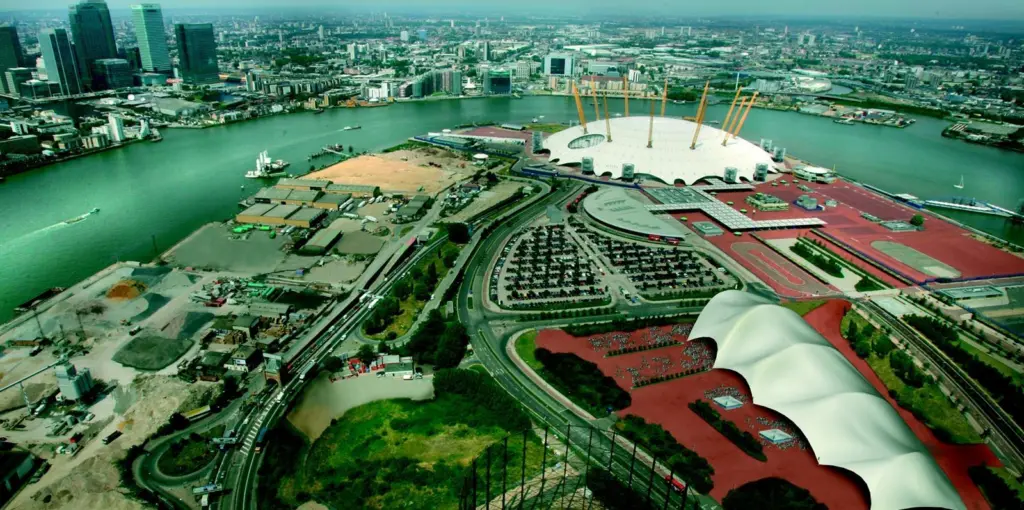
The London Olympics were always going to be good news for the region’s ports and waterways. Tonnes and tonnes of aggregates, construction steel and other materials will be needed to develop the 500-acre Olympic Park and other sites.
Significant imports of everything from equipment to food will have to be handled. Competitors, judges and spectators will need to be transported from one site to another. And even the cruise sector will receive a boost, with a number of cruise lines planning to check in for the Olympics.
But crucially, the Olympic Delivery Authority (ODA) has promised that London 2012 will be a “sustainable” and “low-carbon” games, and that puts the use of water for transport even higher up the agenda.
As Richard Everitt, the Port of London’s chief executive, puts it:
“Fundamentally we have identified – and it’s not rocket science – that the Thames, linked with the waterways serving London, principally the Bow Back Rivers, provide significant opportunities for the Olympics.
“We are working with British Waterways to try to make sure that the potential of the Thames and Bow Back Rivers is realised in terms of providing capacity for bulk materials both to and from the Olympic sites; this will initially be mainly aggregates – cement, sand, etc. , and may also involve removal of demolition materials for reprocessing.
Steel could also come in by water.
“We would expect that would lead on to waste. Waste transfer stations are already well established on the river, so that is something that would be sensible.
“The Transport Select Committee seems to have endorsed this approach, with reference to optimising the use of the waterways for materials access to and from the Olympics site.”
The Thames, which has more than 70 wharfs and terminals along its length, has proved over and over that it can provide an alternative to heavy trucks on the capital’s roads, in particular when it comes to handling construction materials and waste.
“Of course, the important people in all this are the operators and the ODA which will be letting the main contracts – so we have been talking to both of them to ensure that they realise the only uncongested way to and from the Olympics site is likely to be by water, ” says Mr Everitt. “Aggregates are logical on water; a lot of seadredged aggregates come into the Thames and they could then be processed and go on their further journey by barge.”
All of this sounds very laudable but if the ambition is to make the very best use of water then a vital piece of the jigsaw needs fitting in – and quickly. British Waterways is championing a project to install a sophisticated water control system at the Prescott Channel on the Bow Back Rivers (which are part of its network).
There used to be a sluice at the site which controlled the water and made it navigable; the new lock-type control would make the channel non-tidal and allow barges of up to 350 tons to access the waterway from the Thames in a four-hour window and head straight into the Olympic Park area.
The project would cost an estimated £13m and has the backing of English Nature, the Environment Agency and the PLA, says British Waterways spokesman Ed Fox.
The Bow Back Rivers, part of the River Lea Navigation, are partly canalised and partly tidal. They were classified as “remainder waterways” in the 1960s when they weren’t considered to have any particular future, and large stretches are derelict; but “restoration priority” has been in place for the past two years.
“The fundamental challenge we always had was the appalling land use – pylons, fly-tipping, dirty industries, car breaking, etc. , ” says Mr Fox. “Quite often the rivers were the victims of pollution and dumping.
What this really needed was an enormous project for all the local authorities to get involved in and get to grips with some of the major land use issues in the area – clearly we were fantastically excited by the Olympic bid.”
As a report commissioned by Hackney council says: “London has long turned its back on its waterways, but in recent years it has begun to re-acknowledge both its debt to them and the opportunities they provide.”
British Waterways is working with the ODA and the London Thames Gateway Development Corporation on the restoration of the waterways for both commercial and leisure use.
With regard to the Prescott Lock project, says Mr Fox: “There is real impetus to make this happen. It is a genuine and exciting opportunity and all the key stakeholders recognise the benefits.” It is believed the new lock could be up and running within 18 months of a decision being made.
“Using the Bow Back Rivers would obviously give massive environmental advantages and very much fit the aspirations for green and sustainable games – but by having the larger boats it stacks up economically too and looks like being competitive with road, ” says Mr Fox. “As things are at present, the limited size of boat that can be accommodated means more costs in terms of manpower and time.”
British Waterways is also following the “sustainable Olympics” line by looking at the legacy of this work. “The waterway network is a wonderful leisure resource and where appropriate there is still capacity for its original purpose, ” says Mr Fox. “We think in freight terms alone this is the biggest opportunity in our total 2,000-mile network to get a viable 21st century operation up and running – and there is real support for this.”
Related Articles
 PORT & TERMINAL NEWS
 EXPANSION & DEVELOPMENT
 PORT & TERMINAL NEWS