![PortStrategy[GreenPort]](https://www.portstrategy.com/wp-content/uploads/2026/09/PortStrategyGreenPort.svg)





Too big for boxes
Alex Hughes investigates the container weight challenges facing spreader manufacturers
Container manifests clearly state how much a container in transit should weigh – at least, that is the theory. In reality, sharp practice pervades the industry, meaning many boxes are either shipped deliberately over laden or eccentrically loaded to ensure ease of access. The problem is growing and has potentially lethal consequences, but fortunately, solutions are now at hand.
To understand the extent of the problem, it is useful to ask those at the sharp end: the container terminals themselves. However, one major European stevedoring operator contacted by Port Strategy declined to comment, noting that this it not be in its commercial interest to do so. Digging deeper, it transpires that certain geographical areas -with exporters in China most often mentioned – under-declare container weights as a means of boosting bottom line performance by economising on transport costs.
Citrus fruit producers also have a reputation for squeezing the transport industry until the pips squeak. They are often successful, shipping produce in standard palletised boxes year round, albeit forgetting to adjust the weight on the manifest to reflect thinner high season skins, which can result in consignments weighing up to 30% more than they would during the rest of the year.
Then there are scams involving empty containers. Strictly speaking, an empty container is just that: one devoid of content. However, such are the numbers of these now being re-positioned around the globe that some shippers cheekily load these with ghost consignments of scrap steel in the hope that they will be sent to a destination port at a fraction of the cost they would otherwise merit.
Lars Meurling, vice president, product business manager for Bromma Conquip, concedes he has no statistical data to accurately assess the frequency of mis-declaration of container weights, although notes feedback from terminals suggests that it is a serious problem.
This appears to be borne out by a remark made to Port Strategy by Beat Zwygart, chief executive of Lasstec, which produced the industry’s first load sensing solution only three years ago. He says some ports are more affected than others in terms of handling containers with mis-declared weights. But the problem does appear to be growing.
“When we first introduced Lasstec in 2007, it was not easy to persuade terminals to buy into the concept; since then there have been an ever increasing number of calls from within the industry to provide an accurate way of weighing containers before they are moved long distances. Significantly, we have now sold 30 systems and interest continues to grow,” he says.
Insurance companies appear to agree with him. The TT Club, for example, now actively suggests that terminals adopt a load sensing system as part of an accident prevention regime. “They believe that, in a few years time, every crane will routinely be fitted with a load sensor in the way that every car now has a seatbelt,” says Mr Zwygart.
Lars Meurling couldn’t agree more. “Terminals are aware of the consequences of handling overloaded or eccentrically loaded containers: they can result in serious accidents. However, even if this problem were relatively infrequent, counter-measures would nevertheless be desirable. Look at vehicle air bags: despite being rarely deployed, they are now standard on most cars.”
But what exactly are the problems brought about by under-declaring container weight?
Shipping lines cite the example of the Annabella, a feeder vessel sailing between Rotterdam and Helsinki in 2007. Following a night of heavy seas, a stack of seven 30 foot cargo containers in bay 12 collapsed against the forward part of the hold. This resulted in damage to the containers, of which the the upper three contained the hazardous cargo butylene gas. Following the collapse, the vessel was hastily redirected to the port of Kotka where the emergency services attended and specialist contractors were called in to safely unload the damaged containers.
The stack collapsed essentially because those boxes at the top were heavier than they should have been, causing those below to give way.
“There are also others cases involving vessels having to leave behind containers, because those initially stowed were heavier than their manifest had led the shipping company to believe. This means that stowage is affected and can even result in more fuel being used than planned, given that the overall balance of the vessel has been undermined,” says Mr Zwygart.
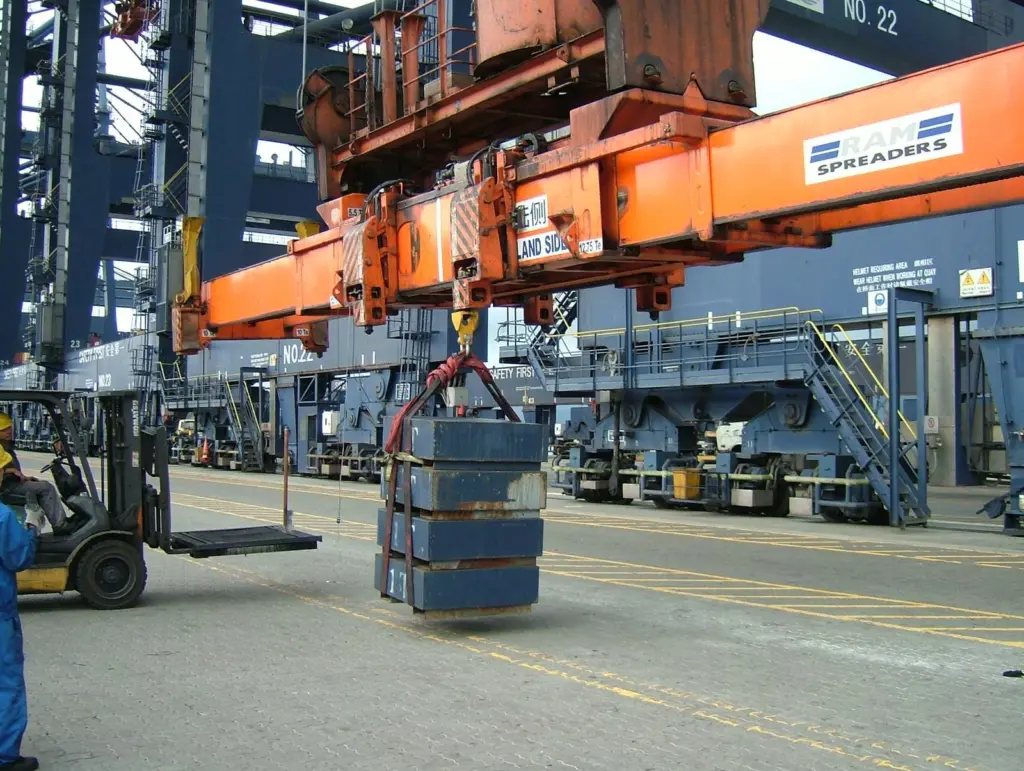
Terminal equipment is also put at serious risk if boxes passing through the system do not match their declared weight. Gantry cranes will shut down automatically if they detect weight as being 5%-10% over what is acceptable. This has serious implications in respect of terminal productivity and can also shorten the life of the twist-locks themselves if they are subjected to loads for which they were not originally designed.
Twist-lock failure can have disastrous consequences. Each year, there are one or two incidents involving snagged containers pulling gantry cranes down onto vessels, although often terminals are reluctant to publicise the real reasons why these occur, often attributing them to generic causes, such as “metal fatigue”.
Mr Meurling suggests that too much weight applied to the twist locks will ultimately add to the structural wear and tear on the spreader structure, causing stress cracks to occur and shortening working life.
Another of the potential headaches faced by crane operators is out-of-balance containers, a condition brought about by eccentric load patterns. Numerous industries are notorious for doing this, usually resulting in a single, very large object being placed as close to the door of the container as possible so that it can easily be retrieved using an FLT when the consignment arrives at the end user.
Mr Meurling explains that this will produce “sway” issues when the box is being moved between ship and shore. “Although crane operators are trained to deal with these situations, not all can be remedied by crane operator skills, because there is a real risk that equipment will fail in such scenarios,” he says.
Lasstec’s Mr Zwygart suggests that if these containers are not weeded out early in the logistics chain, ramifications involving major fines for ports can ultimately ensue. This is because legislation in both Europe and Australia makes it the responsibility of the port to ensure that all road haulage vehicles leaving its premises are correctly loaded. If an out-of-balance load is place on the rear axle of a truck, while it might theoretically be within the acceptable weight range, technically too much weight may be being placed on that particular axle.
In recent times, a Benelux port was found guilty of such an indiscretion and fined accordingly.
Related Articles
 CONTAINER & CARGO HANDLING
 CONTAINER & CARGO HANDLING
 BULK HANDLING