


Keeping up with the neighbours
In 2011, the decision to situate a new box handling facility opposite the Port of São Francisco do Sul raised a few eyebrows, especially since that port is also improving its own facilities for handling containers.

But in spite of any misgivings, the Port of Itapoá opened for business in June last year, having been bankrolled principally by the Hamburg Süd shipping group.
“Given our location on the northern shore of the Bay of Babitonga, we are able to serve all the southern states as well as São Paulo, although clearly Santa Catarina and Paraná are our main markets, especially given our proximity to the cities of Joinville and Curitiba,” says commercial manager, Ricardo Trotti in response to critics.
Indeed, Mr Trotti sees no contradiction, pointing out that port infrastructure in Brazil constitutes a major logistics bottleneck.
“Brazil has incredible economic development potential, but port development is not quite keeping pace. The Port of Itapoá, along with other ports, will help the economy grow. Of course, we do compete with other terminals for cargo, although we also know that the development of one port will also lead to improvements in the other, too.”
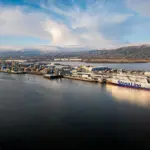
The container terminal at Itapoá consists of two 630 metre long berths arranged on a pier, which has been built some 230 metres adjacent to the shore, which is accessed via a bridge.
“We use a pier, rather than the more conventional linear quay, because it gives us deeper draught – up to 16 metres. At the same time, this has meant that the Figueira do Pontal beach has not been negatively affected,” says Mr Trotti. He adds that the Bay of Babitonga is one of South America’s best sheltered areas for mooring ships. Closure of the facility because of bad weather is therefore much rarer than in other ports.
In its initial phase, the terminal has a capacity of 300,000 teu, requiring investment of $250m. However, expansion possibilities exist to increase the retro-port area, thereby boosting capacity to 2m teu if necessary. This will also require the existing berthing line to be lengthened from 630 metres to 1,000 metres.
Plans also exist to build an adjacent logistics zone.
Both Aliança Navegação and Logística and Hamburg Süd have switched their South American services to the port. Last August, Maersk commenced calls, followed in February this year by the W-MED/MESA joint service and the North Europe-South America SAMBA service encompassing such lines as Maersk, Safmarine, Cosco and Hanjin.
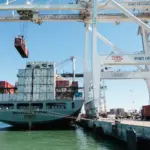
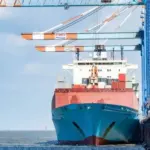
Quayside lift consists of four super-post-panamax gantry cranes, with the stacking yard operated by 11 RTGs. The largest vessel so far calling has been of 8,500 teu, which was operated by Hamburg Süd. While the deep draught capability of Itapoá would be ideal for transhipment, Mr Trotti says that the main emphasis is on import-export traffic at the moment, where reefer traffic has become particularly important.
Business to date has been relatively modest. Since June 2011, around 150,000 teu has been handled, with hopes to gradually increase monthly turnover from the current level of 15,000 teu per month.
“Having a shipping line as a shareholder is a definite advantage,” he says, but stresses that other container terminals in Santa Catarina also have shipping line shareholders and this has “not put off others lines from calling there”.
Related Articles
 PORT & TERMINAL NEWS
 OPERATIONS
 PORT & TERMINAL NEWS