![PortStrategy[GreenPort]](https://www.portstrategy.com/wp-content/uploads/2026/09/PortStrategyGreenPort.svg)






Dust devils
Technology is out there to suppress dust but theres a disconnect between ports and manufacturers, finds Alex Hughes
Dry bulk handling can be the source of serious environmental pollution, since each bulk commodity poses its own set of issues and some of these can be major in nature. Fugitive dust, for example, can contribute to inhalation hazards, generate safety risks and also potentially create explosions.
Many other bulk materials develop fine particles during both processing and handling and these can become airborne very easily. Some of these particles are so lightweight that they may stay in the air for long periods of time, thereby giving them the opportunity to migrate.
The very nature of bulk material handling implies large volumes, so these dust-generating activities have the potential to cover massive areas if not properly monitored and managed.
At ports, the majority of dry bulk handling operations involves the loading and unloading of free flowing dry products to and from ocean going vessels. Both operations necessitate a number of transfer points as well as a discharge point and it is these that are responsible for the main escape of dust out into the environment.
“Airborne dust has to be seen as the main pollution problem in the handling of dry bulk by ports,” says Balan Velan, managing director of Scorpio Engineering. He notes that most stevedoring companies – and ports for that matter – do not have the expertise to provide technical solutions for dust control during bulk handling operations. They rely on makeshift approaches, mostly decided upon by the unloading foreman and his team. More often than not, such measures are ineffective and further reinforce the unfortunate – and what he sees as the incorrect – impression that dry bulk handling cannot be dust free.
Help on hand
Edwin Peterson, chief executive of Dust Control Technology, agrees wholeheartedly, and says the technology is definitely out there to overcome dust pollution.
“Any mitigation techniques need large coverage, although must not use so much water that they will affect the properties or quality of the bulk material,” he says. There is, he adds, no single, off the shelf solution that will serve every application with equal effectiveness.
“The ability to customise according to the application is therefore critical,” he says.
He shares Mr Velan’s concerns that many terminals specialising in dry bulk handling use no dust suppression techniques at all, while a few employ simple wind screens. Sprinklers are slightly more common and have some success, but such equipment cannot control airborne dust and also tends to over-saturate material.
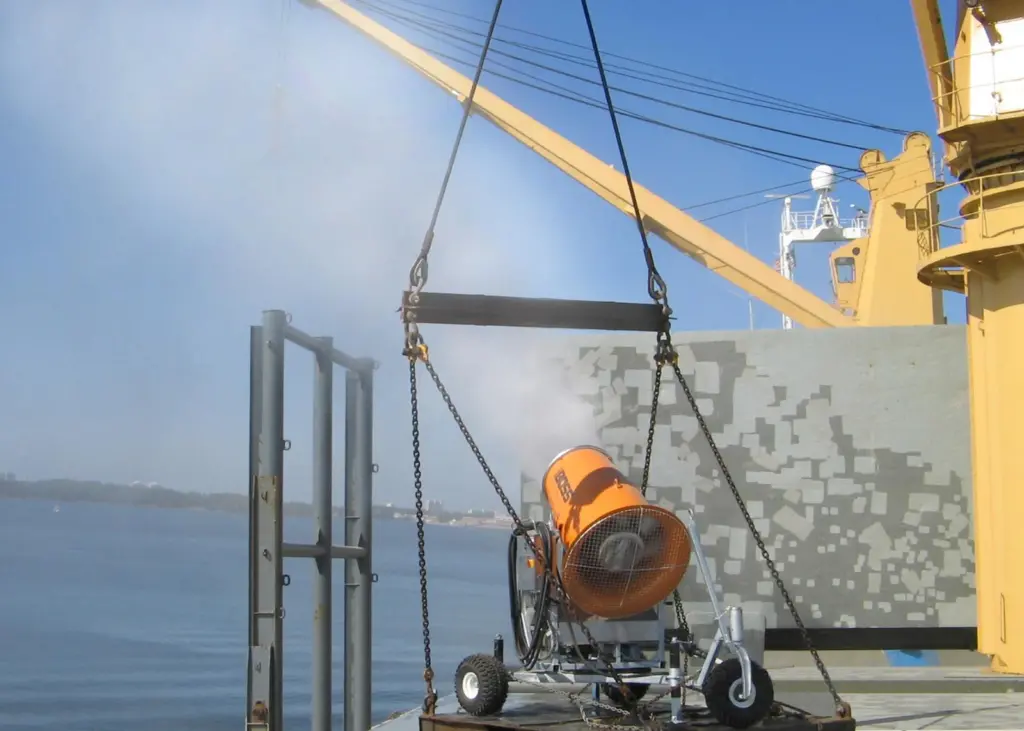
He his experience atomised misting units have proven very successful at controlling both ground level dust and airborne particles, being one of the only technologies available to do this. Atomised misting has been used in numerous port/shipping applications over the last decade or so, he says.
Conveyor and loader manufacturers are also developing upgrades that better control dust, including redesigned chutes, skirt seals, integrated wet suppression, foam systems, dust collectors and other means to contain fugitive material.
“Nevertheless, airborne dust and its migration remains a concern for ports that haven’t yet adopted new dust management techniques,” says Mr Peterson.
Condition senstive
One of the main challenges remains how to deal with both constantly-changing materials and weather conditions. “Only very few manufacturers have had the versatility to develop equipment that can handle this range of variables,” he says.
Mr Velan notes that equipment manufacturers always build in dust control features, but it is only at the discharge points – when the contained product is released, as when a grab opens – that the dust escapes into the atmosphere.
“Special designs are needed to capture the dust escape at these points,” says Mr Velan. “The lack of knowledge in this area by the people responsible for ship loading and unloading is rampant, although the problem can be rectified through the participation of technology companies that have expertise in dust control methods and systems.”
With regards to costs, he points out that the incremental cost of incorporating such technologies into existing equipment is not significant provided it is factored in at the design and bidding stages.
Mr Peterson is somewhat more conservative, pointing out: “Developing new technologies and equipment specifically designed to manage dust comes at a price.”
He does, nevertheless, concede that some equipment at the cheaper end of the range is built using thin metal sheet and lightweight components, often carrying little more than a one-year warranty. Those wanting to pay a bit more can get machines incorporating welded barrels, industrial-grade motors and warranties of up to three years.
“Once the equipment is in place, it’s a matter of energy, water and maintenance. Electric units are the most efficient, quietest, safest and most reliable designs. These direct-drive units offer a simplicity of construction that delivers consistent uptime and longevity, with a minimum of maintenance,” he says.
Mist coat
In terms of new technology, atomised misting seems to be the way forward, having proven very effective in a number of port applications around the world, in climates as diverse as those to be found in Mexico, Ukraine, Florida, Alaska and Panama. Among the newest developments are ring misting units that can be mounted at the end of a conveyor or discharge cute, completely surrounding the material flow and applying dust suppression right at the source.
Tower-mounted units can also deliver increased coverage areas and improved aiming.
“Automation is also becoming more widely used, with material handlers able to start, stop and control units remotely or via user-friendly programmable logic,” he says.
Another innovation – to which DCT has also contributed – has been the development of custom-built, self-contained dust suppression vehicles that carry their own water, onboard generator and dust suppression unit. SEPSA in Mexico built theirs from a used water tanker, while Pece of Mind designed their unit with a generator that’s powered by a power take-off from the truck.
“The most recent development from DCT was the introduction earlier this year of the company’s largest ever unit, able to cover 280,000 sq ft – 26,000 sq m – with a powerful dust-trapping mist,” says Mr Peterson.
Automation station
In addition, he says, automation continues to evolve, delivering easier touch-screen programming and expanded capabilities, including weather stations to monitor current conditions and even make adjustments automatically to accommodate changing winds and temperatures.
As for Mr Velan, he reiterates that good dust suppression technologies are already available, but that these are being improved upon all the time as manufacturers and users gain more experience.
“There is no revolutionary technology in the pipeline, because the handling and control of dust has been a problem for many years and there is already enough knowledge available in the sector to tackle this effectively,” he says, adding that the cost of either retrofits or new equipment is not significant when compared with the operating cost of ship loading and unloading equipment.
“Nevertheless, there is a lack of communication between specialist manufacturers and both ship operators and ports, mainly because of a lack of awareness of what is out there. Training and seminars at ports, involving stevedoring companies would provide much needed awareness and data.”
Related Articles
 CONTAINER & CARGO HANDLING
 CONTAINER & CARGO HANDLING
 BULK HANDLING