![PortStrategy[GreenPort]](https://www.portstrategy.com/wp-content/uploads/2026/09/PortStrategyGreenPort.svg)





Lighting up
Port lighting has moved on, but is large scale replacement a necessary investment? Alex Hughes thinks so
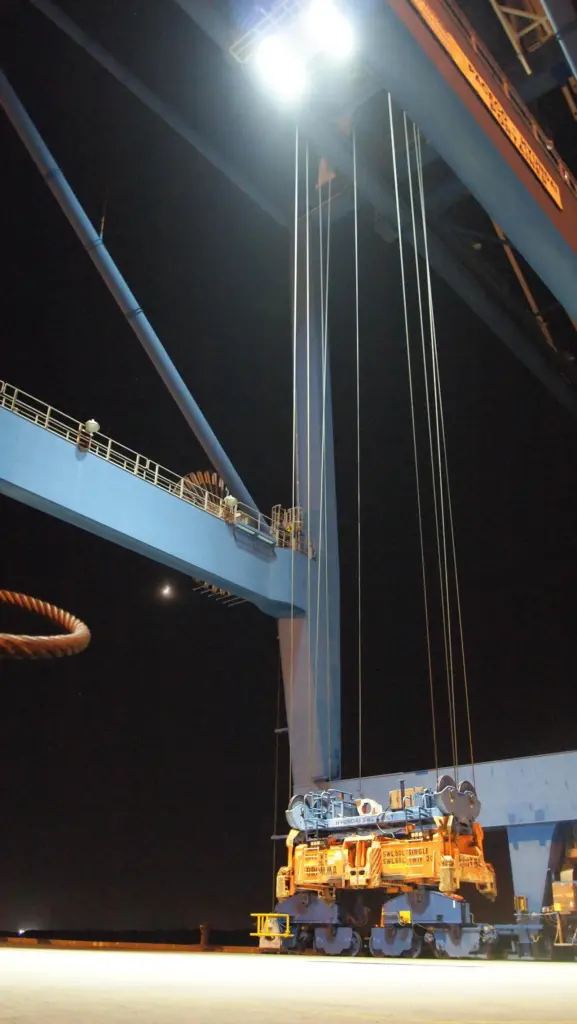
The unforgiving lighting demands of 24/7 port operations means that ports have traditionally been restricted in the choice of illumination suitable for such a harsh and exacting working environment.
Usually, High Intensity Discharge (HID) lamps are the weapon of choice for the main lighting needs. Outdoors, high pressure sodium – SON or SON-Ts – or metal halide floodlights have been deployed, while for outdoor walkways and interior spaces fluorescent lighting has been the preferred choice. All, according to users and manufacturers alike, have their limitations.
“The problem with both of these lamp types is that they contain mercury, which means a special disposal method has to be used. Furthermore, in comparison to new technologies, they have a short life, the more so if they are used on vibrating mobile equipment,” says Yazi Fletcher, chief technical officer of Phoenix Products Company.
Jeffrey Newman, president and co-founder of Global Tech LEC, adds that such lighting is not at all energy efficient. Many existing lighting systems are invariably mounted on copper or iron ballasts, which are reliable, but often ‘over lit’ at the start of life to allow for deterioration, he says. Once installed, they are invariably left until they fail, while most cannot be controlled or monitored.
Moving on
In the past 18 months, Forth Ports has been replacing SON and SON-T lamps at sheds and warehouses it manages at Scottish ports with new LED lights, while at the Port of Tilbury, London, the latest generation of fluorescent lights has been the preferred choice.
Derek McGlashan, Forth Ports’ environment and energy manager, notes that: “In Scotland, we first introduced LEDs in the workshops at the Port of Leith, because the old sodium lights weren’t giving the required light, were slow to re-strike and therefore were not being switched off. In addition, sodium lights give off a yellow light, which makes it difficult to undertake fine work, particularly on electrics during the night shift, as well as being a tiring light to work under.
“LEDs, in contrast, produce a white light from multiple light sources and seems to produce less shadow, giving much better colour rendition, particularly helpful on the electrical bench.”
Thirteen 150w LED units were also installed in the Leith Cruise Terminal, which generated similar positive feedback and resulted in more units being deployed in Shed 3, a dry bulk store. Currently, LEDs are even now being placed outside on masts 14m-15m high to see how they perform, too.
“To date, the really big saving has come from reduced maintenance, particularly in our bulk storage sheds. These mainly store grain and feed products, which generate dust. Because SON lights run very hot, the dust used to burn onto the polycarbonate lenses, leading to a significant reduction in light output. These lenses therefore had to be constantly replaced. By substituting them for LED fittings, we will recoup the capital outlay in two years from reduced maintenance,” says Dr McGlashan. “In addition, we have saved 76% of the previous operating costs through overall energy savings.”
Similar results have been observed at Tilbury using modern T5 fluorescent lights, where actual cost savings have been slightly better than those initially predicted, being in the 50%-60% range.
Cautionary tales
However, LEDs should not be seen as wonder technology.
One trial requiring erection on a 35-metre high pole at an exposed location at the lock entrance to the Port of Leith – on the edge of a quay, next to deep water, where a lot of heavy handling equipment works – failed to generate the spread of light required, prompting Forth Ports to revert to a more traditional solution to ensure staff safety.
Nevertheless, Forth Ports has not entirely abandoned outdoor deployment of LEDs, noting that early signs suggest they work well on masts no higher than 20m. In contrast, Mr Newman is not at all fazed by the outdoor challenge, noting that Global Tech LED has already successfully put LEDs in exposed locations on top of 50m high poles.
Mr Fletcher is somewhat more cautious, noting that the main consideration with pole-mounted lights is that the pole needs to be designed for the extra weight it will have to support and for the wind loading that a possibly larger and heavier LED fixture would need.
“My biggest concern would be retrofitting to an existing pole designed for a smaller and lighter fixture,” he says.
In addition, he notes that lighting fixtures need to be designed for both high and low ambient temperatures.
“Fluorescent lamps are very susceptible to cold temperatures, while HID restart time is longer in high ambient temperatures. In contrast, a well designed LED does not suffer these problems,” says Mr Fletcher.
Outshining
As for the thorny problem of light pollution, Mr Fletcher notes that this is really just “wasted light”. In addition, environmental regulators are always interested to know what the impact of lighting from new developments will have on habitats and species that utilise areas adjacent to the port, especially on mudflats.
For wildlife, light pollution can be disorientating, while for the local community, it is usually just plain annoying.
Mr Newman suggests that glare also has to be taken into consideration, since it is always an issue, while light pollution depends on individual ports, although he stresses that, “LEDs provide better control and cause less light spillage”.
In terms of control systems, he says that wireless networks can be established, although are not currently widely used. Sensors, he insists, work much better.
At Forth Ports, trying to turn unnecessary lights off remains one of Dr McGlashan main obsessions, although interestingly he does not favour lighting control systems.
“Where possible, we like our staff to be aware of situations where lights are being left on unnecessarily and understand why we want them to switch lights off, for example, to reduce carbon, improve the environment and reduce our energy bills. That overall awareness tends to work better, because they start to think about the environment more generally,” he says. “In terms of lighting, education can often be better than automation.”
Fade up
In the workshops maintained by the port operator, the old SON fittings could take up to 40 minutes to re-strike when they had been switched off. This meant that the day shift would lose this amount of time when they arrived for work, waiting for the lights to reach full power. Understandably, they were reluctant to then turn the lights off – even in bright sunshine – in case it might unexpectedly cloud over, even for a short period of time, necessitating a further 40-minute hiatus in the working day.
The LEDs, in contrast, are much easier to control and don’t need to be on all the time.
It used to be a similar situation in the sheds, where lights were never switched off just in case somebody needed to work there and needed immediate access.
Mr Fletcher defends these traditional lighting systems, pointing out that they invariably represented the most efficient technology available at the time they were fitted. Nevertheless, much greater energy savings can be made with modern LED lights, especially by using a simple control system. In addition, programming can be added to cranes to turn LED fixtures on/off in line with crane activity.
“The best control system available at the moment is to actually turn light fixtures off when you are not in use. With LEDs, this is possible because they turn on instantly at full brightness; there is no delay. Day lighting, occupancy sensors and dimming controls are all available; using a simple control system will generate a much faster ROI,” he says.
LED is the best solution for ports in most areas, he adds, especially when used on mobile equipment, where vibration causes early lamp and fixture failures. With energy, lamp disposal, down time and maintenance savings, return on investment is very good with LED. Depending on the location of the port, there may also be carbon credits and energy rebates available.
Payback
A typical ROI period after installing ‘smarter’ lighting could be within one to three years, depending on the system, claims Mr Fletcher.
“ROI is often even more attractive when ports decide to install LED lighting on new equipment purchases,” he says.
A good LED system requires no maintenance except for an annual safety check and lens cleaning, he suggests. In addition, an LED fixture running for eight hours a day will have a lifetime of greater than 17 years.
Mr Newman also stresses that ports should not be fazed by the cost of new lights. “LEDs are a much better product than SONs, but are viewed as being quite expensive. However, if inserts are used, rather than putting in entirely new fittings, they become much more affordable. Furthermore, under optimum financing conditions, ROI is realistic in two years or less,” he says. Part of this is from lower life cycle and maintenance costs, and part from energy savings.
Related Articles
 CONTAINER & CARGO HANDLING
 CONTAINER & CARGO HANDLING
 BULK HANDLING