![PortStrategy[GreenPort]](https://www.portstrategy.com/wp-content/uploads/2026/09/PortStrategyGreenPort.svg)






Gas guzzlers
Ports need to keep an eye on the future to keep pace with LNG bunkering developments, explains Stevie Knight,
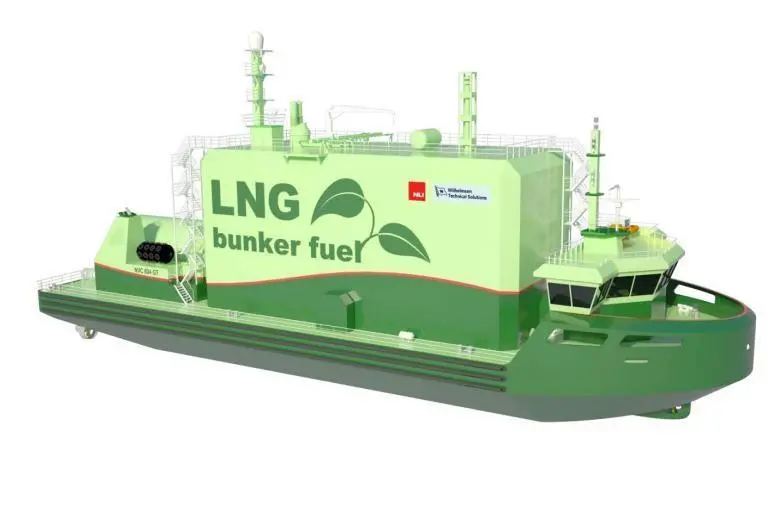
Although liquefied natural gas isn’t a novel marine fuel – it’s already commonplace for the big gas carriers to use it – it is certainly something new for ordinary bunkering operations and port solutions have to be developed with an eye to what may come on the LNG fuel front.
Most ports today looking at LNG bunkering are starting at the thin end of the wedge: ferry hops like Viking Grace’s call into Stockholm; the STQ vessels that are soon to be working the St Lawrence Seaway; and a handful of other European facilities such as Antwerp, Hamburg and Bremerhaven that are looking at making the most of quite contained, short run operations.
Even on this scale there are challenges. Thanos Koliopulos, global special projects manager of Lloyd’s Register points out that since ferries typically have a two to three hour turn around at port “there is the need to offload and load cars and passengers simultaneously with bunkering, which does have a safety impact on jetty operations and lay-out”. Interestingly, the answer for Viking Grace was to move the fill point over to the sea facing side and bunker by barge, “showing that an amount of flexibility is needed in planning both terminals and ships”.
But it’s a knife edge balance where actual profit is concerned. Costs associated with distribution and development of additional infrastructure to support LNG bunkering at ports will likely have an immediate impact on bunker charges. Further, despite a handful of other solutions, many like Stockholm, the upcoming Bremerhaven and STQ’s operation actually replenish by truck. So, availability and distance “can impose a serious premium on fuel prices”, says Mr Koliopulos.
However, things look like changing fairly quickly as demand for these new vessels is exploding, with legislation lighting the fuse.
Two tier
It will divide the market. For the smallish operations, bunkering barges coming in on a regular rotation will probably be the easiest solution, especially if these are managed by a fuel distribution company. David Bull of Ocean Shipping Consultants points out that there are a number of LNG bunkering vessels due to reach the market soon, and this will help to firm up ports’ plans and give them some real sizes and cubic metres to work from; scale after all being one of the ‘big unknowns’ of the whole debate.
However, there’s also the price of success to account for. “Although a port might start off by making LNG available for a handful of regulars, this picture will be changed with the future introduction of LNG-fuelled deep sea operations,” as these vessels need bigger quantities, says Mr Koliopulos. “To give you an idea, a ferry like Viking Grace has around 400 m3 of tanks, but deep water trade could be looking at an average of 25,000 m3 for an ocean-going vessel. Quite a different story.” Without early planning it could, he says, quickly become an intractable knot as larger bunkering vessels will be harder to manoeuvre in small ports, requiring traffic control and dedicated jetty facilities.
For the bigger ports an offshore storage unit might be the way forward: it’s quicker, cheaper and, says Mr Koliopulos, “less problematic as it doesn’t have to fulfil all the country’s land regulations” plus, if need be, it can also be moved. Further, although not as big as an onshore facility it can be flexible, filling up bunkering barges or taking in LNG from ship-to-ship carrier transfers. However, Mr Koliopulos points out that LNG’s very good safety record has mostly been because it’s been largely in the hands of specialists. “If you pass it over to a port that hasn’t the experience of other types of fuel, let alone gas, I am afraid we may well see a rise in safety issues,” he says.
Cost benefits
But what about those ports that might see themselves as hubs? Firstly, the multibillion-dollar price tag of LNG and gas distribution terminals means operations won’t start up with bunkering in mind, despite promising to be a lucrative trade in the future.
As Mr Bull points out: “Rotterdam’s LNG plant isn’t there for the benefit of the port, it’s there to meet the industrial needs of the country behind it,” adding that primacy of the hinterland’s need means that Singapore, while building itself up to be an Asian LNG hub might yet find that the domestic thirst “sucks the whole thing dry” leaving scant pickings for calling ships.
However, as ship-to-ship LNG cargo transfer has become feasible there may be some room for LNG distribution operations to grow: for example Scotland’s natural harbours could see smaller ships taking LNG directly from the carriers and getting it into places such as the Baltic.
So, soon the familiar shape of transhipment may start to be seen across LNG terminals too.
Location, location
Suren Vakil of BMT Consultants India points out that technology and geography can clash. “LNG is both very compressed – to the ratio of 600 to one – and can be extremely flammable under specific circumstances,” so a small escape point won’t stay small, but could ‘blossom out’ very fast indeed.
“A city or crowded facility might find itself in a position where the necessary margins around take-off or bunkering could interfere with the port’s other day to day business,” says Mr Vakil, which may mean putting limits on LNG’s operational windows: STX for example is running a very tight, very studied procedure where bunkering takes place only in the middle of the night.
Obviously if it’s a big import facility the volumes are that much greater and so are the ships. Mr Vakil explains that one of the more intractable elements to the physics is that cryogenic pipelines are needed to keep it in liquid form at -160°C and so while specialist offshore quays might be the answer, if there’s no direct connection to the grid the offtake has to be close to the storage tanks so you are looking at getting bigger ships in very close to the facility one way or another… “The LNG pipework needs a lot of insulation which makes it physically very stiff and hard to manage. On top of this it’s really very expensive and there are maintenance issues to take into account, which means the shorter the pipeline the better,” says Mr Vakil.
So, thrown into the ‘location, location’, aspect is that facilities have to get around difficult terrain. For example, one port that nestles in between rocky outcrops is putting its LNG intake on top of a cliff. “There’s quite a distance for the pipe to travel and it also means getting past obstacles like a road,” says Mr Vakil, “not so easy if you are trying to keep the LNG at its optimal temperature.”
Related Articles
 CONTAINER & CARGO HANDLING
 CONTAINER & CARGO HANDLING
 BULK HANDLING