![PortStrategy[GreenPort]](https://www.portstrategy.com/wp-content/uploads/2026/09/PortStrategyGreenPort.svg)





Light pools
The LEP vs LED debate is causing a storm in port lighting circles as Alex Hughes explains
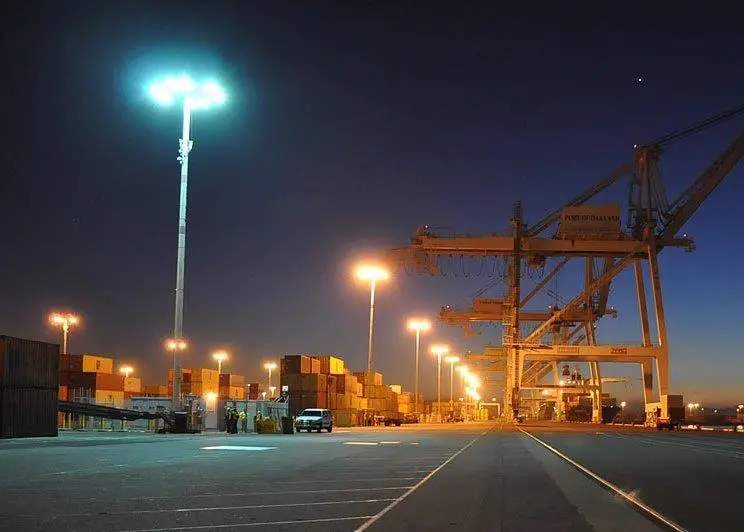
Terminals seeking to cut energy bills often overlook an upgrade to their lighting system. But this oversight could cost them dearly as significant savings can be made here.
Tom Ward, chief engineer at Ports America, who has recently been through such a process at the company’s Oakland container terminal, has some sage advice: “If terminals are looking to either install or replace existing lighting systems, I would advise an open bid against a rigorous specification.
“In the case of a retrofit, I would suggest asking for existing arms and poles to be re-used along with the in situ power supply. Don’t look for greater weight or wind load than existing fixtures offer, but do insist on an illuminance (performance) warranty of at least five years,” he says.
Significantly, when comparing technologies, Mr Ward found that LEP (light emitting plasma) luminaires ticked all the right boxes in respect of high mast lighting. Bright Light Systems, which was involved in the Oakland refit, manufactures both LED and LEP luminaires.
Asked which is best, marketing director, John Chalmers, suggests that it is the application that should dictate the technology. At the main gate, he believes LED is best suited, since it provides the instant-on, directional light source necessary to provide illumination for OCR equipment. On internal port road networks and also in parking areas, either LED or LEP would suffice. For indoor applications, with mounting heights of over nine metres, LEP, offers the best solution, while for heights below this LED can provide adequate illuminance levels at an effective cost, he says.
However, outside, for high mast lighting of 20 metres or more, he advocates the use of LEP, arguing it is a more durable technology for the harsh operating environments found at ports.
Mr Ward points out that, while LED systems provide more lumens per watt at the emitter, an LEP fixture is more efficient, providing about the same lumens per watt at ground level.
In his experience, Tom Ward believes both LED and LEP lights cost about the same to run, while return on investment is similar.
“In studies we have made, there is little difference in either the capital or operational cost of installing replacement LEDs over replacement LEP lights. Running times are comparable, as is energy consumption. However, I prefer LEP for retrofits, as fixtures are much lighter, there is better directional control and wind load is easier to manage,” he says.
Money talk
Mr Chalmers states that, from a purely capital cost perspective, LEP is definitely cheaper for high mast lighting, where the need is to provide high illuminance levels. He explains that, in order to generate 46,000 lumens from a high mast luminaire, BLS utilises just two LEPs. A comparable LED fixture requires 280 LEDs packed in an array to provide the equivalent lumen output.
“As a result, the majority of our high mast customers opting for LEP see paybacks within two to three years,” he says. As for lifecycle costs, Mr Chalmers says ports need to look no further than the L70 industry standard, which requires lights to operate for at least 50,000 hours without any drop off in performance.
Most LEP luminaires, he stresses, have a lifetime in excess of 100,000 hours. Also, if an LEP luminaire does need changing after 50,000 hours, this can be done easily thanks to the overall modular design. Neither the internal optics nor the electronics within the housing have to be touched.
But, in the case of an LED reaching the end of its working life, the entire luminaire has to be replaced. Add together the simplistic design and guaranteed long life of an LEP, and maintenance costs over the whole life of the fixture are less, he says. Furthermore, compare an LEP high mast fixture to a typical 1000 watt HID fixture and ballast, and the former consumes only 540 watts, generating an energy reduction of around 55%.
“By using integrated wireless controls and our lighting management software, our customers can reduce their lighting costs even further, by up to 80%, making LEP the undoubted leader in energy efficiency for high illuminance applications,” he says.
Related Articles
 CONTAINER & CARGO HANDLING
 CONTAINER & CARGO HANDLING
 BULK HANDLING