![PortStrategy[GreenPort]](https://www.portstrategy.com/wp-content/uploads/2026/09/PortStrategyGreenPort.svg)






Power supply
Dave and Iain MacIntyre sift through the facts for a sustained need for biomass handling
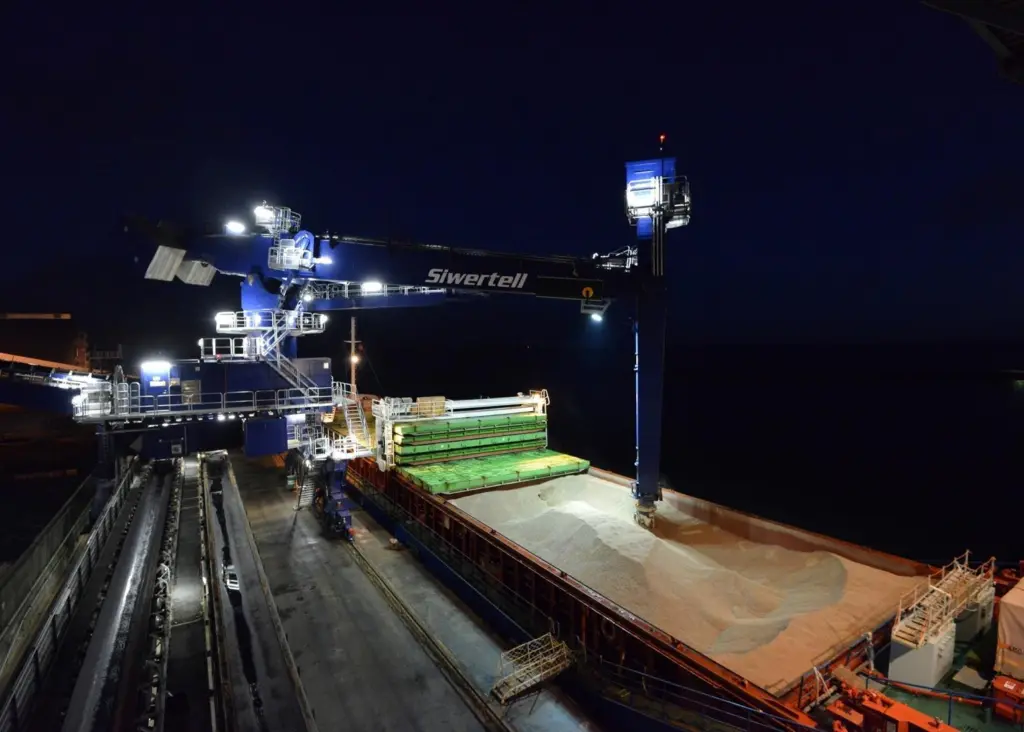
Moves towards ‘greener’ fuel sources for power plants is having a ripple effect for ports, as the storage, loading and unloading of biomass presents challenges both for ports themselves as well as equipment suppliers.
Compared to the traditional coal stock used by many power stations, generators are increasingly looking to renewable resources. The challenges arise from the different nature of biomass, such as wood chips, wood pellets and bark. Tthese need to be kept dry: unlike coal they need covered storage and the dust created during cargo-handling creates a fire risk.
Wood pellets are a highly combustible alternative fuel which, if not stored correctly, can threaten people, product and stores. Self-heating and off-gassing in wood pellet stores is a major hazard to port-side storage.
Added to the difficulties facing port executives is the question of making a call on how permanent the biomass trade will be. One industry source told Port Strategy that industrial pellet users such as power plants often receive government grants for using pellets instead of fossil fuels, and the long-term nature of the trade will rely on such grants remaining in place.
Fully loaded
With loading and unloading equipment being an important link in the supply chain, efficient and energy-saving equipment adds further complexity to this calculation.
Vincent Van der Wijk, product manager for shiploading and unloading equipment for the Buhler Group, says the consequence of market uncertainty is that often only a temporary logistical network is foreseen in which merely “necessary” investments are made instead of more sustainable solutions.
“This, combined with the specific pellet-handling requirements, makes it very difficult for ports to find an optimal balance between needed and optimal investments in the integration of pellet handling within the port’s overall logistics.”
Ports should consult and plan their complete terminal layout to find the optimal cost/benefit solution for the handling of pellets and grains, he says.
Looking at the market for biomass, Mr Van der Wijk says the market for loading and unloading pellets is expected to increase. However, he says there is uncertainty how demand patterns will impact on trading, shipping routes and costs long-term.
Therefore, investments in loading and unloading plant will tend to be cautious.
He says pellets (wood or other material) are the largest part of the “transported” biomass market because of their high energy efficiency and ease of transportation while using existing infrastructure.
Emissions count
From a supplier perspective, Buhler’s presence in the market is through its Portaload and Portalink products. The Portaload is capable of handling wood pellets with medium-to-high throughputs. Its low-dust emission level protects workers and the environment, simultaneously reducing the risk of explosion.
The company’s mechanical unloader, the Portalink, can switch from products such as wheat to wood pellets despite the different product characteristics.
Meanwhile Cargotec’s Siwertell brand won the International Bulk Journal‘s Best Ship Loading/Unloading System Award for a second time late last year.
Per Karlsson, president of Cargotec Sweden Bulk Handling which is responsible for the Siwertell brand, says the company is always exploring ways to develop new markets, and the versatility of screw-type unloaders means they are ideally suited to the rapidly-expanding biomass market.
This year Dong Energy, one of Northern Europe’s largest energy groups, took delivery of a Siwertell type-ST 790-D ship unloader for handling wood pellets and coal at a rated capacity of 800 tonnes per hour, at its highly-efficient combined heat and power station at Avedøre in Denmark.
Handling coal and biomass with the same unloader delivers major operational and economic benefits, including reduced capital investment.
Lars-Eric Lundgren, regional sales manager for Cargotec, says the Siwertell screw-type unloader was chosen for its environmental credentials, including high levels of efficiency and totally-enclosed bulk transfer for dust-free operations.
Block work
Finland’s Konecranes is also a player in the biomass market.
Jari Itäkodes, Konecranes’ sales manager for bulk handling cranes, says that the same modular solutions used in its WTE cranes are applicable to biomass-handling cranes.
“We have developed a special kind of hopper for handling wood chips. A normal hopper is not suitable because it will block. The hopper walls must be vertical.”
The typical weight of wood chips is about 350 kg-400 kg per cubic metre and the moisture level about 30%-40%. The density of peat is a bit lower and the dusty environment requires explosion-proof features at least from the grab.
Konecranes has supplied a couple of cranes to ATEX Zone 22 environments (places in which an explosive atmosphere, in the form of a cloud of combustible dust in air, is not likely to occur but if it does occur will persist for a short period only).
The company says that for biomass energy plants, cranes offer benefits over front-end loaders or conveyors. Cranes need less energy, eliminate diesel fumes from inside the plant, and maximise the available floor space.
Its biomass-handling cranes automatically start the working cycle to transfer material from the reception pocket to adjacent storage. Likewise, the crane automatically starts the working cycle to fill the hopper from the storage after reception of a command from the hopper sensor.
UK innovation
Pete Griffiths, managing director of UK-based Monitor & Manage which specialises in monitoring and managing dry bulk storage automation via temperature and gas reporting, says there is innovation in the type of investments witnessed recently by those delivering services to energy companies with biomass conversion in their portfolio of green energy.
“Those energy companies that are innovating in every aspect of planning, production, transport, storage and biomass combustion tend to benefit from additional governmental support. Those [that] are not innovating enough or who are chronically hampered by end-of-life power stations, correspondingly, tend not meet the Government’s biomass project affordability criteria.
“The loss of ensuing corporate tax relief means projects tend to hit the buffers as private investors do not see enough of a return to justify proceeding. Punitive Carbon Footprint Legislation in the UK is already driving power producers to reduce their carbon footprint and is creating jobs.”
Innovation in the UK biomass handling market includes inflatable storage domes, bespoke biomass railroad wagons, enormous pellet silos as well as cutting-edge fire detection and suppression systems.
“In the port-side storage of biomass where Monitor & Manage operate, we now see increased installation of effective LED lighting in bulk stores as well as increased take-up in the use of wireless technology in temperature and gas monitoring, reporting and alerting.”
First response
Given that there has been a history of accidents in wood pellet transport over the years, Mr Griffiths says significant work has gone into implementing effective solutions to prevent further loss of life, but he still issues a warning.
“As more and money is circulated in this industry there is a risk of short-term profit-taking and greed creeping in. Standards are important in aspects of production, transport and storage.
“Auditing adherence to these standards will ensure that the causes of port-side personnel injury or loss of products and stores through fires are almost eliminated.”
He adds that wireless is the only option in high-turn environments: “it’s so easy to use whilst making port side biomass storage safer and more efficient.”
Related Articles
 CONTAINER & CARGO HANDLING
 CONTAINER & CARGO HANDLING
 BULK HANDLING