![PortStrategy[GreenPort]](https://www.portstrategy.com/wp-content/uploads/2026/09/PortStrategyGreenPort.svg)





A question of magnitude
How can, or should, ports be designed with climate change in mind, ask Felicity Landon and Stevie Knight
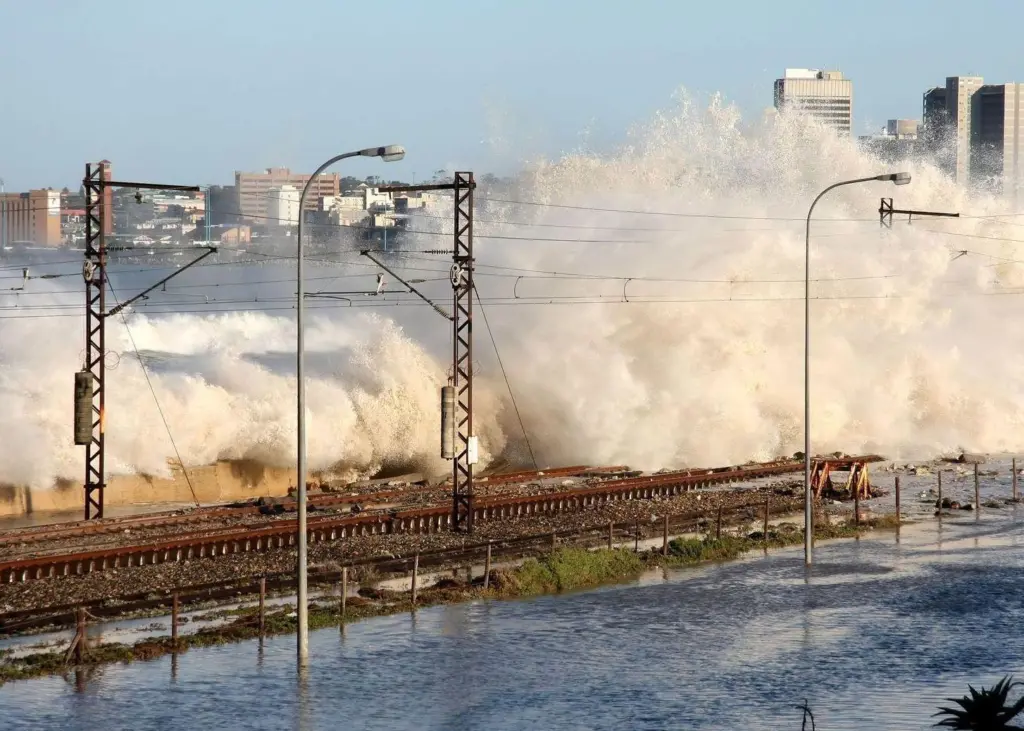
The sceptics may be a little thinner on the ground these days and the concept of climate change more generally accepted – but in terms of certainty, it seems that’s as good as it gets.
When it comes to the impact of future climate change on ports, it is, says Simon Ward, a question of magnitude. If you are designing a new port, or planning to extend an existing one, then while the general risks are understood, there is certainly no consensus on the scale of what might be to come.
So how can port planners and designers work that into their blueprint? Dr Ward, associate director – ports & marine at AECOM, based in Sydney, recently gave a presentation on ‘Port infrastructure challenges in a changing environment’.
“People say storms are going to get more severe. I went and did some digging around and expected to find some clarity. But actually, there seems to be a division on that,” he says. “There is no real certainty that storms are going to get worse – maybe we are just seeing natural variations.
“As for sea level rise, there are a lot of climate change models giving differing predictions – there is an awful lot of variability. All suggest that sea level rise will increase and accelerate. The magnitude remains uncertain.”
Forward curve
When typically designing a port for a design life of 50 or 100 years, planners have to assume sea levels will increase by ‘X’ amount, allowing for wave activity and overtopping, says Dr Ward. “At some point toward the end of its life, there may be increased risk you will get more overtopping.”
For all ports, it is a frequency thing: “It might happen more often but then go back to normal. At what point do you decide it isn’t working, the down time is too much and you need to relocate or fix what you have?”
A lot of climate change effects are localised, he points out, and also it isn’t just what the sea level is doing. “It is also what the land is doing – for example, subsidising through natural processes.”
The sea level rise is certainly everyone’s focus because it appears to be the dominant one that affects ports, says Dr Ward. Increased wave and storm surge activity, increased downtime due to flooding and inundation of terminal areas, buildings, service ducts and other infrastructure, surface water drainage capacity and structural damage could all be significant impacts.
However, he says, many in his audience sat up when he began to talk about the impact of climate change on maintenance.
“When the sea level goes up, there can be elements of your structure not previously exposed to corrosion but now at risk. Also, the rate of corrosion becomes increased because of the higher temperature and higher salinity. Higher levels of maintenance intervention will be required.”
Building higher
For new terminals, building quays higher is an obvious measure – ‘but it is still based on broad assumptions, unless there are site specific studies’. Also, deeper water generates larger waves. “You should allow for the increased impact of water levels on wave breaking – maybe breakwater designs need looking at.
“And even if you can afford a new port and design the level accordingly, the hinterland behind it and all the connections are still vulnerable. Assuming that your connections might be inundated, then you are going to need larger storage areas to hold containers, etc., and I don’t think that’s typically factored in.”
Ben Lieberman, senior port planner at US-based consultants Louis Berger, agrees: “It is known that sea levels are rising but nobody knows how much how fast. There are models to predict, but there is a margin of error. So does another metre (quay height) give you some assurance? It puts you in better shape, but you would have to do an analysis of what it would cost to raise it in terms of concrete, piles, etc. However, it is of course easier to design it in the beginning than go back and retrofit.”
How much attention is being paid to climate change issues in port design? It can’t be avoided in new developments, says Mr Lieberman, because the banks or others providing the finance will insist on adequate consideration of such issues.
“Whether it is addressed effectively is another matter – because we don’t know ‘how much’. And if you are talking about the modification of existing facilities, then obviously you are constrained by the existing design.”
Tide truths
One truth, of course, is that while ports are affected by sea level rise, they are also inherently designed to deal with fluctuating water levels. Again, it’s just a matter of magnitude.
“Everywhere you have ports you have tides on a daily and monthly basis and storms too,” says Mr Lieberman. “Loading and unloading systems are designed to work with fluctuating water levels within a certain range, whether it’s adjustable ramps for ro-ro ships, flexible hoses to load and unload liquid bulks or quay cranes with the reach to cope with ships moving up or down in the water as they are unloaded or loaded.
Some ports have a very significant range of tidal variation and have more sophisticated and robust systems for dealing with this.
“I believe the biggest danger for ports is not disturbance to shipping operations, as long as the sea level fluctuation is within the range of tolerance, but when beyond that you have flooding of staging and cargo storage areas. Imagine coastal flooding and acres and acres of new cars or warehouses full of forest products under feet of water. Port storage and staging areas and infrastructure are relatively low-lying and therefore vulnerable.
“Potentially you could raise up certain areas by a couple of feet – but you are not going to be able to raise access roadways or rail lines.”
Niek Veraart, director of environmental planning at Louis Berger, says: “The banks are requiring appropriate insurance for climate change risk but the thing that’s missing here is that it isn’t just the port area that’s affected. You can have a port that is resilient but the road and railroads to the port, and energy supplies, don’t fall under the same requirements. If your links are not resilient, then the port isn’t resilient either. If regional links are severed, the port may be taking in cargo but can’t get that cargo to where it needs to be.”
Talking point
Overall, then, the message is one of unpredictability. The priorities, says Mr Veraart should be regularly reviews both short and longer-term, and very close communication between ports and other infrastructures managers and authorities.
“It used to be that a port suffering typhoon or flood damage would get everyone involved to help them survive and rebuild following the ‘freak’ natural incident – but things are changing,” says Greg Fisk of BMT WBM.
“With predictions of more extreme weather events associated with climate change, if that same port gets hit by a calamity and cries for help, relief agencies and banks may be more likely to say, ‘You knew it was going to happen, the data is out there – so why didn’t you do something about it before?’”
He says “there’s an element of certainty” about climate change events: “Now the likelihood is that something is going to happen – even if we don’t know exactly when.”
Ports are on the front line in more ways than one. “Ports are at sea level and sea levels have been projected to rise,” points out Dr Douglas Daugherty of Environ International Corporation, adding that taking climate change seriously is a purely pragmatic approach as the evidence has been building for some years “no matter what is driving it”.
Mr Fisk agrees: “Sea ports are very exposed to extreme weather, it closes them down for hours or days, high winds mean they can’t use the cranes, flooding stops operations and many are seeing an increasing number of major, climate-related incidents.” It’s not just ‘bad’ weather: some areas are seeing a rise in the number of scorching days that make work on exposed wharfs problematic.
South Africa lag
However, in emerging economies like South Africa, the response is lagging says Dr Andrew Mather of Ethekwini Municipality’s Coastal Policy department.
This is despite a catalogue of changes that have already impacted port running: “While SA’s ports have been designed to reduce the wave energy coming in from the southern Indian Ocean, a change in swell direction has meant that many ports are facing increased penetration,” he says. “Loading at Cape Town is being affected by increased south-easterly winds, and the incidence of ‘long waves’ that synchronise at a particular frequency has resulted in disruptions to offloading and ships breaking their moorings at Port Elizabeth and Ngqura.”
He adds that looking further forward, most eastern-coast ports are facing increasing sedimentation rates since many are on estuaries or rivers. “Less frequent but heavier rain is washing bigger slugs of silt into the channels,” he explains.
Despite this, the ports prefer to deal with it on a day-to-day basis rather than admit other measures might be necessary. “The ports are worried it will put a huge price tag on what they do; the state is worried about adding any kind of financial burden to the economy,” he explains. However, the fairly recent refusal of an Environmental Impact Assessment (EIA) for a Durban development because of the absence of an adequate climate change element has forced the port authority to rethink and now more complete studies are underway.
In other places ports are already acting on the implications: UK ports are required to have a climate change risk assessment and adaptation strategy in place and in Australia such a risk assessment is part of the EIA for new developments. The growing awareness means that ports will have to start to act soon, even if ‘the big storm’ is a way off. “Realistically, it means starting work on an adaptation plan, especially as soon a port won’t so easily be able to invoke Act of God, Force Majeure, or other clauses without showing that they did all they reasonably could do,” says Mr Fisk.
It’s a fact of life that budgets have a habit of trumping anything other than quantifiable costs, so both Mr Fisk and Dr Daugherty point out that what’s required is a consistent analysis that presents the costs of each mitigation strategy against risk: this comes from evaluating the potential costs or consequences with the likelihood of an occurrence (as a percentage).
Four elements
Dr Daugherty explains that assessment at the Port of San Diego, for example, took four elements onboard: commercial operations, recreational, ecosystems, and safety, and overlaid them with key infrastructure, and, importantly, the effect of storm surges on predicted higher water levels to come out with something solid to put on the bottom line.
But there’s also a third element: the snowball effect, and ports need to be ready to catch potential difficulties before they proliferate. For example, Mr Fisk explains that Queensland’s recent floods in 2011 filled the Port of Brisbane’s approach channel and berths with silt. “One of the first issues in trying to get the port re-opened was where the dredged material should be placed, as it hadn’t had time to go through the usual environmental approval procedures. Following this experience, the port has proactively obtained approval for an offshore disposal site that has sufficient capacity such that if they are faced with the same situation again the port can move on flood mitigation dredging of the channels and berths straight away.”
The UK’s Felixstowe port identified ‘priority’ climate change vulnerabilities including disruption to cranes, pilotage services and last but not least, power supplies. Investigations unveiled an interesting knot that needed to be unpicked in order to keep things moving: high voltage lines are vulnerable to extreme winds while increased risk of flooding could also put on‐site power at risk. Further, a sea level rise combined with a storm surge could result in quays being overtopped; this in turn would also cause the shutting off of power supplies to the cranes.
But it is all long term, so how do you stop the agenda getting buried under day-to-day operations? “It’s a matter of embedding ‘triggers’ for action in the port adaptation plan and salting away a little bit of money,” explains Mr Fisk. “You decide both on your adaptation strategy and your tolerance levels and tell people, ‘we will absorb this much impact, but if disruption rises to a certain point then we will take action’.”
Although it need not be a major diversion from existing risk assessments, Mr Fisk admits smaller ports may not find it easy to go it alone and in Australia some are co-funding research with local authorities. Dr Daugherty adds there a lot of relevant data out there already, and suggests collaboration with research institutions such as universities. However, while a port may be lucky with detailed information that can be drilled down, it may have to rely on more ‘grainy’ data that might not show up the true extent of the vulnerabilities, having to extrapolate to identify its own points of action.
Dr Daugherty explains it is much better to be upfront about the imprecision of the information. “All predictions become more confident with a closer horizon. So while we can say with some certainty what will be happening by 2030 and have a pretty good understanding of 2050, by their nature, longer term scenarios are always going to be more difficult to predict and need updating.”
In South Africa the uncertainties are that much greater, says Dr Mather: “We haven’t got long datasets like the northern hemisphere to compare with.”
He adds: “I see many ports following the same processes until things fail or they get a clear signal of some kind. Everyone is anxious about spending money… but if we do get a calamity we will be biting ourselves on the back.”
Related Articles
 CONTAINER & CARGO HANDLING
 CONTAINER & CARGO HANDLING
 BULK HANDLING