




SICK helps launch “trouble-free” operations
Germany-based SICK is making container terminal operations “trouble-free” with a new range of sensor solutions, launched at TOC Europe.
The first of the new products is the Advanced Object Detection System (AOS), which uses cutting-edge LMS511 and LMS111 tow-dimensional laser measuring sensors to reduce the risk of accidents from boom collision and crane-to-crane collision.
It comes with preconfigured fields for warning, slow down and stop and includes evaluation features such as blanking of objects and reference contours. SICK says the sensors increase the reliability of the systems and allow 24/7 operation even in bad weather conditions.
The AOS is currently being used on all of DP World’s 69 cranes in its new Jebel Ali Terminal 3 for boom collision prevention on the STS cranes and pathway collision prevention on all STS cranes and ASCs.
To maximise efficiency, DP World also uses LMS5111 laser measurement scanner for truck/vehicle positioning and POMUX KH53 linear encodes for automated and precise positioning of the trolleys.
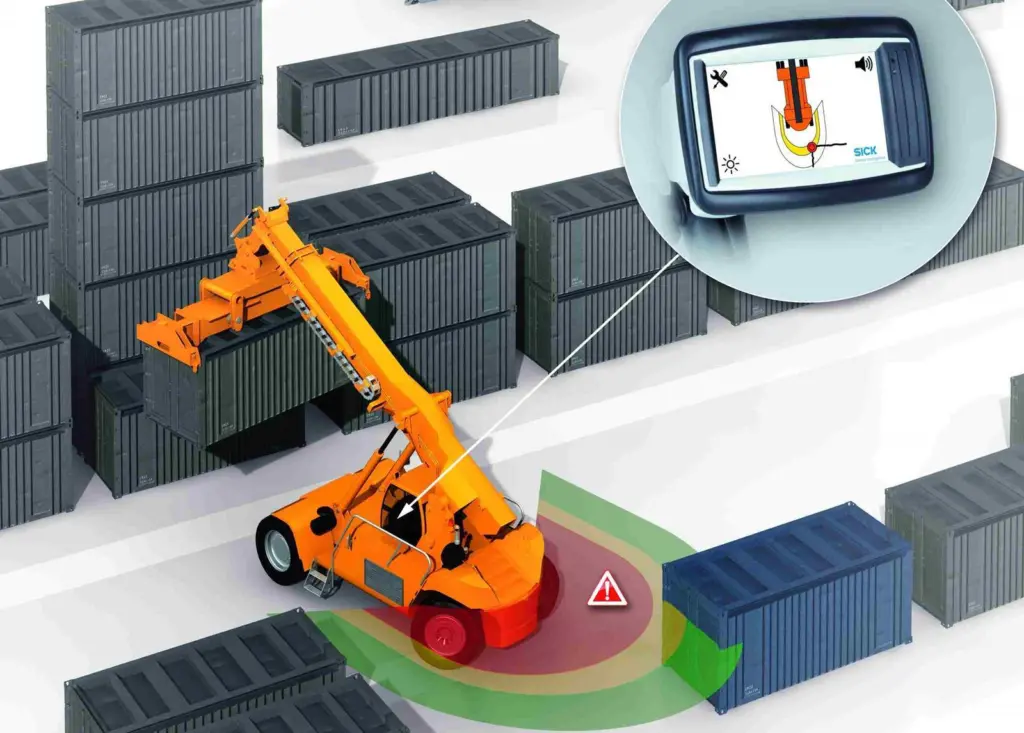
A new Reach Stacker Assistance System (RAS1200) has also been developed to provide operator assistance in critical manoeuvres while reversing. In case the reach stacker is approaching an obstacle, the system alerts the operator automatically via an alarm and a graphic display of the obstacles’ relative position to the vehicle.
It works both day and night, covers the whole rear of the stacker and measures distances and analyses whether the situation is dangerous or not.
SICK is to retrofit Yilport Holding’s reach stackers and other large cargo handling equipment at its terminals. Yilport has also ordered the SICK boom collision prevention system for its new 23-wise Japanese-built STS quay cranes and the pathway collision prevention system for its new RTGs.
Related Articles
 OPERATIONS
 OPERATIONS
 PRODUCTS & SERVICES