


Pulling in all directions
Larger ship sizes are placing increased pressure on tugs services, explain Dave and Iain MacIntyre
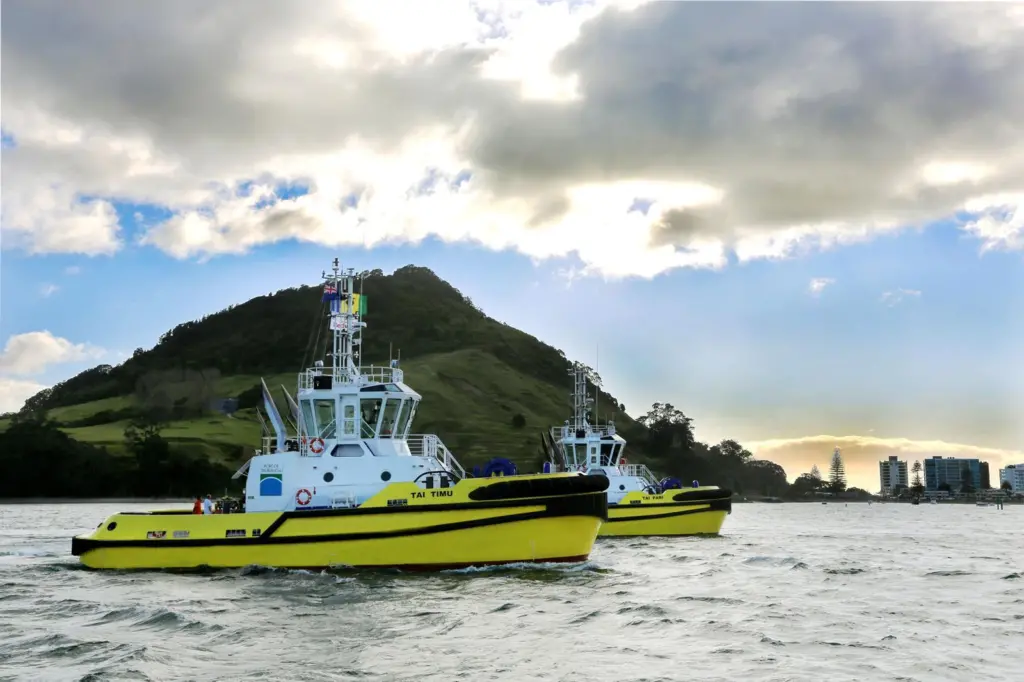
In a time of increasing vessel size and more onerous environmental constraints, port executives have to make decisions on hardware that could well be operational in their port for a generation or even two.
Tugs factor high in that hardware decision ranking, with ports faced with the dilemma of whether to maintain an in-house tug fleet or to contract this service out. Two New Zealand ports have recently gone through this very exercise.
Phil Julian, manager operations for the Port of Tauranga, says his port’s decision to invest in new tugs was driven by several factors, “the main one being that the existing tug fleet simply did not have sufficient bollard pull to provide a comfortable margin of safety for large vessels that we are expecting. Indeed, the size of large vessels that are already calling has increased significantly over the last few years.
“This had the existing tug fleet working at its limits and was placing constraints on our operation. In addition to this, our fleet was relatively old and one tug was due for replacement due to age and usability.”
Tender terms
Tauranga modelled wind and tide effects on existing and expected vessels. This gave minimum required bollard pull to safely manage vessels within environmental parameters. Planning was done well ahead of the tugs being needed and approval was granted by the board three years prior to the completion of dredging to accommodate larger vessels.
Tauranga set the terms for tender by describing the outcomes it desired including speed, bollard pull, configuration, noise levels, manning and delivery time. “We left it to the yards to propose how they would achieve these. With the final two short-listed providers we did provide more specification such as brand of engines and propulsion units. This was for standardisation with existing tugs.”
Environmental characteristics played a part in the decision-making.
“The tugs were built in accordance with IMO emission criteria. Practically, the ability to easily start and stop the vessels, even for short periods, between operations greatly reduces fuel use. The larger kilowatt engines also provide equivalent bollard pull as existing tugs at a significantly-reduced fuel consumption,” says Mr Julian. The new tugs will have a life expectancy of 25 years.
As to why Tauranga prefers to be an owner-operator, Mr Julian says that model gives maximum flexibility: “We feel this allows us to offer the best service to our customers.”
Auckland decision
Competitor Ports of Auckland has been through a similar exercise, with its new tug, Hauraki, entering service in September.
Head of communications Matt Ball says a replacement was needed for a tug which will be scrapped after serving 43 years. “Over the last few years the size of vessel (of all cargo types as well as cruise ships) calling into Auckland has increased incrementally. Discussions with shipping lines indicated that this incremental increase would continue, therefore it was logical to assume that a more powerful tug would be needed.
“We chose the specification of the Hauraki based on increasing ship size, the manoeuvring characteristics of the vessels calling in Auckland, the windage areas involved, the close proximities of our berths and our approach to risk management of the port. All these factors played an important part in our decision.”
The Hauraki has a much higher bollard pull and the latest alarm systems and navigational systems that alert the operator to deal with difficult situations. In addition, her main and auxiliary diesel engines comply to IMO MARPOL Regulation 5 Annex IV on NOx (nitrogen oxides) exhaust gas emissions.
Auckland started looking for a new tug over two years before it signed the contract. Damen was chosen from several contenders after consideration of quality of build, time frame of delivery and cost.
“We plan to have Hauraki operating for a minimum of 25 years, though she could well outlast our expectations as she is a good build and has all the latest technology incorporated,” says Mr Ball.
Team game
Auckland also chooses to operate its own marine team, whereas many ports worldwide have contracted marine services. Team members are cross-trained in various aspects of marine skills required to run the marine department, with most having at least three skills or more.
“That means we have a lean, efficient team with a great deal of operational flexibility which allows us to offer a better service to customers.”
Mr Ball says this works well with the Marine Operator Safety System (MOSS) put in place last year by Maritime New Zealand, for monitoring operator procedures and safety of craft.
“We feel that having our own teams gives us greater oversight and control of training and safety processes than would be the case if we used contracted services. We are able to upskill our team members easily and we have much better transparency in reporting near misses and hazards with our present arrangement.
“Keeping the tug services ‘in-house’ also means [we are] able to offer a ‘one-stop shop’ where customers only need to deal with the one entity which makes us more responsive and flexible in regards to late changes in shipping arrivals and departures.”
Design features
When it comes to tug designs, ports demand a variety of features. Johan Sperling, vice president Crowley Marine Solutions, says the requirements asked of its naval architects Jensen Maritime are varied but common elements are bollard pull, tonnage limitations, length, fuel capacity, crew size and visibility.
“Power requirements keep going up with ships getting bigger. A new thing that we all have to really deal with as related to engines and power is the new Tier 4 regulations [emissions standards set by the US Environmental Protection Agency].
“These rules make it harder to keep tugs small in size so we do see a trend towards larger tugs. EPA has really pushed an aggressive agenda out there and information is still being generated for us naval architects. This means that we are often working with less-developed vendor information which can be a real challenge when engine rooms have limited space available for the design to grow or change.”
In terms of propulsion, he says most customers are investing in z-drives, a type of azimuth thruster: “We have also seen that the z-drive technology is getting better and more affordable with time.”
Mr Sperling says the biggest challenge is to make a large tug be able to act like a small tug. “Between naval architects refining hull forms, propulsion manufactures upping their game and engine manufacturers improving response time, we are able to keep up with the challenge.”
For port executives calculating the tug requirements they will require, Mr Sperling says the best way forward is to team with the industry. “Invite both operational people and naval architects to the table when you discuss the requirements. This way you get a much broader view on what the industry can and cannot do.”
Damen highlights environmental demands
Netherlands-headquartered Damen Shipyards is a specialist builder of tugs with its new ASD 2913 Michel design attracting attention.
The company’s Gorinchem tugs products director Coen Boudesteijn says power aligned to compact size is a favourable advantage for the ASD 2913, which is built with extra plate thickness and fendering as well as superb manoeuvrability.
The entire Damen ASD tug series is designed according to Bureau Veritas classification and Lloyd’s Register requirements as well as IMO regulations.
Each generation of tug has its own innovations to handle different challenges, such as in a port operation or in coastal towage. In the case of the ASD 2913 series it has a new towing bitt design with stainless steel rope guidance as well as improved rubber rendering to push 80 tonnes.
The ASD tug series is built on stock in the standard version with the possibility for owners to further customise their tugs with hydraulic crane, special winches, second radar, and other add-ons.
“Our philosophy is to be consistently innovative to ensure a wide range of benefits which the design of this new tug underlines,” says Mr Boudesteijn.
As to the factors Damen finds customers are prioritising in their tug orders, he says this depends on the types of jobs that the tug operators handle as well as the operating area and local conditions.
One clear trend is that environmental characteristics are becoming a prevalent selling point, “especially with regards to latest developments in diesel engine technology. At Damen we are always thinking ‘green’ with better thermal insulation and double windows just a few examples of ways to lower power consumption,” Mr Boudesteijn says.
Related Articles
 OPERATIONS
 OPERATIONS
 PRODUCTS & SERVICES