![PortStrategy[GreenPort]](https://www.portstrategy.com/wp-content/uploads/2026/09/PortStrategyGreenPort.svg)





Rising to the occasion
Israels Haifa has no qualms about meeting its competition head on. Michael Mackey reports
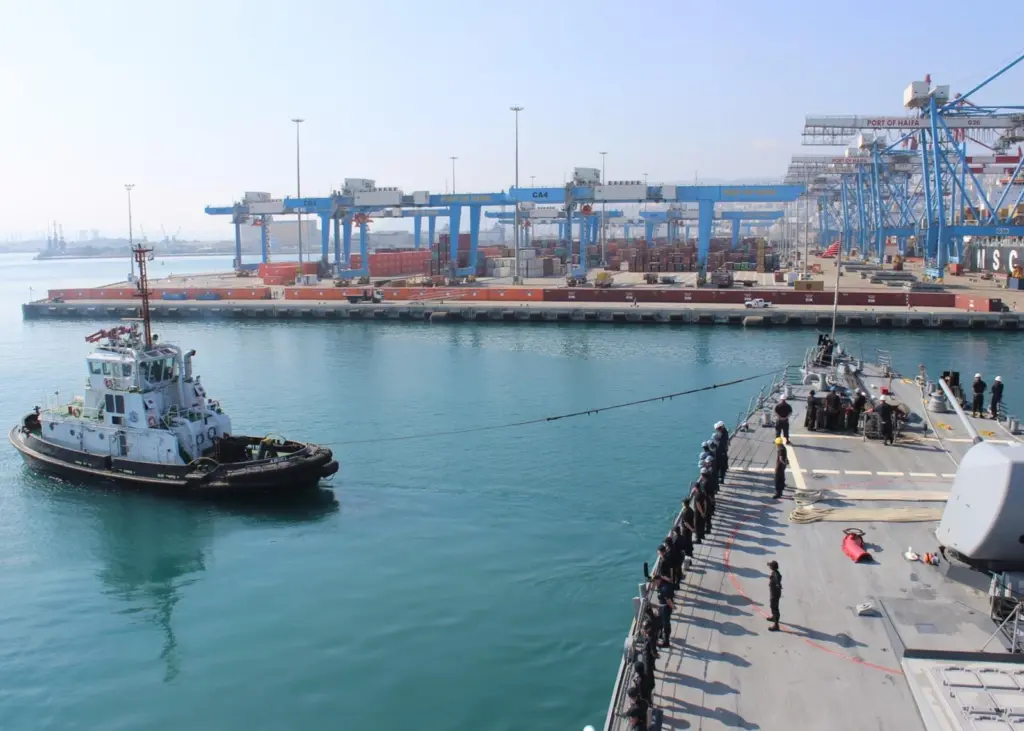
Haifa has a multi-pronged strategy to deal with the challenges of upcoming competition. New ports operated by Terminal Investment Limited (TIL) and Shanghai International Ports Group, are part of a government backed move to stir up a sector where powerful unions and central planning hold back development in a country where container growth is expected to be 40% in the coming five years.
For Haifa the immediate challenge is the nearby Bayport terminal, expected to start operations in 2021. With a total 1,500 meters of quay length, a 78 ha surface and a 17.3 meters draft, Bayport new terminal is designed to handle annual container throughput of 1.86 million teu.
TIL’s Hadarom Container Terminal at the Southern Port of Ashdod, a touch smaller at 63Ha but designed with 20,000 teu vessels in mind, it also offers Haifa stiff competition.
As a first step the government, the Port of Haifa Company and the trade unions are in ongoing but so far not successful negotiations to allow changes, according to Mendi Zaltzman, chief executive of Haifa Port Company.
“There is not any sign yet, it puts a little shade about on our expectation for this year,” Mr Zaltzman tells Port Strategy.
This year, Haifa expects some modest growth on its 2015 throughput of 1.2 million teu, 45,000 cars and 24,000 tonnes of general cargo and is looking to 1.35m teu, according to Zohar Rom, Haifa’s head of marketing. “It’s more than the Israeli economy is growing,” Mr Rom added.
Haifa’s optimism is underpinned by its calls from the big lines. The M2 alliance currently calls westbound and is expected to add an eastbound stop, according to Mr Zaltzman. MSC’s Indus service, meanwhile, might help access trade from the slowly emerging giant of India.
Buy local
More immediately, Haifa is looking to the regional market with some links being developed. “Its quite attractive for Jordanian cargo to go through Port of Haifa,” said Zaltzman.
There is a good trade with agricultural products from Eastern Turkey, which are now starting to go via Haifa in trucks with Turkish drivers. The alternative route via the Suez Canal and the Jordanian port of Aqaba is expensive and time consuming.
“The potential is more than 1,000 trucks a week but the actual numbers are closer to 100 trucks a week because it’s a security issue, not something that depends on the port,” said Mr Rom.
Haifa is prepping its own infrastructure to cater to that and in anticipation for peace in the wider Middle East.
More cranes are a part of this investment. Haifa is installing two new Kocks- ship-to-shore cranes in its Carmel Terminal and three new Konecranes rail-mounted gantry cranes in the terminal area. This will give it nine STS cranes and fifteen RMGs, Mr Rom tells PS.
It is also currently building a 17 lane spiral gate to ensure the safe but fast flow of goods through technology to keep pace with its competitors. “Everything will be automatic,” says Mr Rom. After entry, the truck will pass through a drive-through x-ray examination point. The road then widens to nine, separate lanes, taking in an advanced digital portal with a system of sensors to capture the truck’s license plate as well as that of its trailer.
An additional camera records the container’s number and if it contains unusual materials such as dangerous substances. A special sensor will examine the drivers details and a final check will include a passive sensor for radioactive radiation. At the main gate the access road widens to 17 lanes.
The few seconds that pass between the portal and the main gate may be short for the driver, but they are packed with activity for the Navis terminal operating system that, during that time, will process all the data collected.
Haifa is moving one step further with its digitisation this year, with implementation of a general cargo TOS, and installation of the Navis billing system. “Then we shall be fully computerised and the state of the art,” Mr Zaltzman concluded.
Related Articles
 CONTAINER & CARGO HANDLING
 CONTAINER & CARGO HANDLING
 BULK HANDLING