


Gothenburg goes even greener
The Port of Gothenburg, a pioneer of shoreside power, is continually striving to reinforce its green strategy with important initiatives, including the introduction of gas recycling systems and the launch of its Railport concept
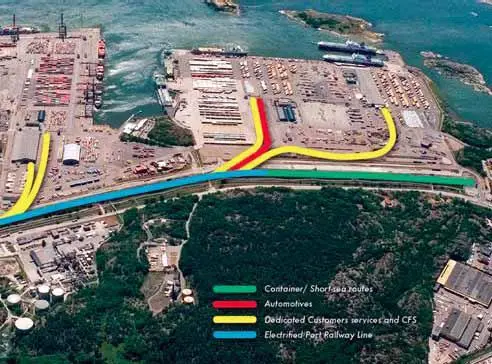
The Port of Gothenburg is Scandinavia’s leading port in terms of tonnage and TEU throughput. It is also at the forefront of World Ports Climate Initiative which is working to reduce carbon dioxide emissions and improve air quality across the world’s port facilities.
The port has offered cold ironing facilities since 2000. In co-operation with Stora Enso, one of the world’s largest paper companies, cold ironing was made available to maintain the company’s strict environmental requirements at all stages of its production – a good example of how the cargo supplier can influence the port infrastructure to benefit the environment. The benefit of using shore side power supply is that no auxiliary engines, running on diesel or heavy oil, need to be used, keeping emissions and noise in the port area to a minimum, thus creating an improved working environment both for crew members and dockworkers. The positive effect on the environment is also felt by the immediate residents.
Running all the functions on a cargo vessel with electrical power requires a high output. Not only lighting, but also functions such as heating, hot water, fans and engines need to be supplied. During an average stopover in harbour, a ro-ro vessel connected to the electricity supply uses between 5,000 and 20,000 kWh, which corresponds roughly to the energy consumption of four average-sized houses over a three-month period. Vessels have previously used shore side electricity supplies with low voltage, but in order to run all of the units aboard, several heavy cables are required. In practice this involves a complex and time-consuming process, as well as equipment which takes up a great deal of space both in the port and aboard the vessel. Offering vessels a high voltage electricity supply through one high voltage cable with approximately 25 times the output of a standard 400V cable of the same dimensions, makes this operational stage both quick and simple.
Dramatic reduction of emissions
The total environmental benefit depends on factors such as the vessel’s time in port, which fuel is used and the power of the engines. On average, a ro-ro vessel visiting the Port of Gothenburg emits 25 tonnes of carbon dioxide, 520 kg of nitrogen oxides and 22 kg of particles if it is not provided with shore side electricity. Currently there are two quays at the ro-ro terminal that can offer shore side electricity, and six vessels operating for Stora Enso (three Transatlantic and three Wagenborg) regularly use these connections. Stena Line also has one quay with high voltage supply which it uses regularly.
If the entire ro-ro terminal were provided with this shore side power and, assuming that all vessels used it, substantial reductions of emissions would result. It is estimated that these emissions would decrease by approximately 31,000 tonnes of carbon dioxide, 510 tonnes of Nitrogen Oxides and 12 tonnes of particles annually. This means that the annual carbon dioxide emissions from shipping in Gothenburg would be cut by 10%.
Realistic environmental benefit
It is important to take into account how the electricity required for shore-side power is produced, and compare it with the emissions from the bunker oil or harbour diesel which would otherwise be used. Studies have shown that, irrespective of how the electricity is generated, the use of shore side electricity has a lower total environmental impact than using auxiliary engines. In order to ensure that electrically connected vessels are as environmentally sound as possible, the Port of Gothenburg utilises two local wind turbines. Through a close collaboration with Gothenburg Energi Nät AB, the Port of Gothenburg helps influence the development of the local electricity network right from the planning stage, and in this way continues to work towards the positive development of energy supplies to cargo vessels in the port.
Benefits of shoreside power
Apart from achieving a much better working environment in the port, the environmental benefits are the great driving force. Studies show that society is the big winner. At a rough estimate, the social costs involved are reduced by 15–75 times the cost of the system.
From 2010 the EU’s sulphur directive will come into force, which means that vessels have to use diesel with a 0.1% sulphur content when they are in port. This will involve markedly higher fuel costs for the ship owners, so shore side electricity will also be a more attractive option from a financial viewpoint. It is entirely possible to adapt existing vessels to use a shore side electricity connection.
Currently there is no international standard therefore few vessels are adapted to use the technology. The ISO and IEC (international standardisation organisations) are expected to bring out new standards for shore side power supply in 2009. Shore side high voltage electricity is a new technology which is still under development.
One challenge is that different parts of the world use different frequencies. In the USA and Japan they have 60 Hz, whilst the rest of the world uses 50 Hz. Once the ISO and IEC standards have been finalised, everything will be in place for everyone to be able to use a compatible technology, which will expedite development.
In 2006 the Swedish government promised tax exemptions on electricity supplied to vessels using shore side connections. Bunker oil is exempt from tax, and as shore side electricity involves a lower environmental impact, tax exemptions would be welcome. Unfortunately no decision has yet been taken on this. It is hoped that the question is raised again, as it would entail lower costs for customers using shore side electricity. The Port of Gothenburg aims to be able to offer all vessels shore-to-ship electricity supply, but the initial focus is on the ro-ro terminal, as these vessels are best suited for electrical connection.
Gas recycling
The loading of petroleum products, particularly petrol, gives rise to environmentally hazardous emissions of volatile organic compounds (VOCs) which are also hazardous to health. Whilst there is already a gas recycling system for loading into road tankers and rail tankers, vessels have, in the past been loaded without recycling. In Gothenburg around 1.4 million tonnes of petrol are delivered by vessel each year. With the good level of extraction achieved with gas recycling facilities, emissions linked to the loading of vessels could be reduced from around 300 tonnes to just 25 tonnes per year.
The Port of Gothenburg has worked on projects together with Preem, Shell, the Swedish Environmental Protection Agency, the County Administrative Board, the Explosives Inspectorate, the rescue services and members of the Swedish Ship owners’ Association, to find a solution for gas recycling for vessels.
The Port of Gothenburg has three gas recycling facilities of the absorption type. Each user has access to its ‘own’ facility and four quays are served by the systems. The facilities are highly efficient, with an extraction level in excess of 90 per cent. In consultation with the authorities it has been decided that the emission limit for the systems be set at 10g/Nm3, a low level but perfectly attainable with the technology that has been chosen. Without extraction the gas could contain up to 1,000g/Nm3.
The three gas recycling systems, with a capacity of 1,500, 2,000 and 2,400 cubic metres per hour respectively, cost around SEK 65 million. This figure also includes the cost of new and adapted connections to the vessels. The total cost is around SEK 30 per kilo of reduced emissions. The facilities are owned by the Port of Gothenburg although two of them are leased to Preem and Shell. This model has also presented Preem and Shell with far-reaching potential to design systems based on their specific wishes.
Rail Port
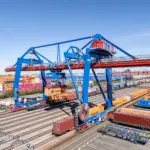
Rail Port Scandinavia is an integrated rail shuttle system linking the Port of Gothenburg with a large number of important consumption and production centres via Rail Port terminals (full service terminals with frequent rail connections to the Port of Gothenburg) all round Scandinavia. The port takes care of transhipping, goods handling takes place on the spot.
The rail shuttle system is based on cooperation between the Port of Gothenburg, the Rail Port terminals, several rail operators, goods owners and the National Rail Administration.
This cooperation means that the logistics of sea and land can be efficiently linked in an environmentally sound way.
The railway is an increasingly important link in the transport chain. Since 2002 alone, rail transport to and from the Port of Gothenburg have increased from 6 to 24 daily shuttles. About half of the containers transported now go to and from the port by rail.
In instigating the Port of Gothenburg as a hub for the Baltic region, Norway and the Oslo area make up a very important catchment area. A new shuttle to Norway as a result of co-operation between the Port of Gothenburg, Green Cargo and H. Strøm/Rail Terminal Drammen will enable the system to be developed further, with transhipment in Drammen for onward movement by rail to other destinations, including Trondheim.
Specific customers, such as Maersk Line have opted to transport a larger portion of goods by rail. This year Maersk will carry around 75 per cent of the total goods volume by rail. Just a few years ago the split between rail and road was quite different as recently as 2005 the split was approximately 50/50.
“In our case the choice of transport is governed by customer delivery requirements. Although rail is not as flexible as road, it does have less impact on the environment and it is more cost effective. And that’s extremely positive,” says Patrick Berggren from Maersk Line In 2008 alone, transporting freight by rail led to a reduction in carbon dioxide emissions of 48,000 tonnes compared with transport by road. This is equivalent to driving 10,000 times around the world by car.
Table 1: Environmental impact factor: Difference between train and lorry*
Fuel, diesel: 19,800,000 litres
Carbon dioxide: 48,000 tons
Nitric oxide (NOX): 420 tons
Hydrocarbons (HC): 17 tons
Particles/dust (PM): 9.4 tons
* Calculations made by Sebastian Bäckström, WSP Analys & Strategi. The estimate is based on emission data for Swedish intermodal goods trains presented in the report: Environmental Estimates for Intermodal Transport Chains – Detailed Methods of Calculation and Relevant Standard Values, WSP report no. 2009:6. In 2008, 201,000 container units were transported by rail to and from the Port of Gothenburg. All figures 2008.
Related Articles
 ALTERNATIVE FUELS GREENPORT
 NEWS
NEWS