


Focusing on efficiency
Transferring containers from quayside crane to yard crane – using automated technology – is the key to Kalmar’s new Autoshuttle
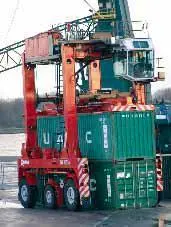
Kalmar has strengthened its portfolio of automated container handling machinery by launching the Kalmar Autoshuttle – an automated selfloading vehicle able to pick, place and transport containers between ship-to-shore (STS) and yard stacking cranes. “Only two to three Kalmar Autoshuttle units are needed to serve one STS crane,” said the new President of Kalmar Pekka Vauramo at the press conference where the new Autoshuttle was presented, “compared to five to seven AGVs – resulting in faster, more efficient terminal operations.” Vauramo explained that the advantages include the decoupling of vessel and yard operations, reduction of traffic congestions, better space utilisation behind STS Crane, higher buffer capacity in front of yard stacks and the elimination of a second STS trolley due to the buffer zone created on the quay. “The new Kalmar Autoshuttles will also help solving some social problems we have today,” he continued. “The container terminals are developing very rapidly and face the fact that not many young people are willing to work in this field. So our new container handling technique will be mainly used in new terminals, not taking away existing jobs, but helping to solve the future labour problems”. Like its manually operated counterpart, the Kalmar Autoshuttle is capable of handling 20ft and 40ft containers, as well as two 20ft boxes in twin lift operation with load ratings of 40 tonnes (single) and 50 tonnes (twin). The Kalmar Autoshuttle also features an enhanced PLC diagnostics system. The onboard automation system controls the Kalmar Autoshuttle according to the routes specified by the Terminal Logistic System. The automated vehicle continuously measures the distance and direction travelled with odometric information like wheel revolutions and steering angles. Navigation of Kalmar Autoshuttle is based on patented Magnetic Measurement System (MMS) technology. The unit’s position is formulated but he magnetic markers embedded in the terminal surface and MMS sensors located on the Kalmar Autoshuttle’s side frames, also providing the vehicle’s navigation information. Fine positioning of the spreader is achieved by intelligent sensor technology installed on the spreader. The unit can also be remotely controlled when required. The Terminal Logistic System (TLS) controls the operations and the execution thereof. It provides simple and comprehensive interfaces to the Terminal Operating System, translating its orders and planning into concrete job assignments for the terminal’s equipment fleet. TLS has a distributed network architecture, controlling equipment locally and so ensuring a robust system. The negotiation/ contract protocol used for the assignment of equipment to jobs is the basis of its flexible operation. In combination with the distributed architecture, it accommodates the scalability and extendibility of the network and terminal operations.
www.kalmarind.com
Table 1: Autoshuttle paramters:
|
Capacity |
50 tonnes (twin) / 40 tonnes (single) |
|
Max driving speed |
30 km/h |
|
Max hoist speed |
20m/min (empty / 13m/min (40t) 9m/min (50t) |
|
Max lowering speed |
18m/min |
|
Deceleration in normal driving |
0.8 sq m |
|
Deceleration in fault stop |
1.25 sq m |
|
Minimum turn radius in Automation control |
9000mm (from vehicle centrepoint)
|
Related Articles
 ALTERNATIVE FUELS GREENPORT
 NEWS
NEWS