
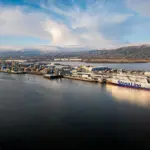

Developing port cities –sustainably
In the face of major global economic and environmental challenges, AIVP – the International Association Cities and Ports – underlines its role in strengthening the port/city relationship.
The present global financial crisis shows once again that international trade in goods and services plays a major role in shaping the economic and social face of the world. Beyond the economic events that we are experiencing today, the strategies of alliance and competition among countries, regions or cities to turn economic flows to profit are increasingly determined and complex. Decision makers, whose job it is to formulate policies capable, in the medium or long run, of satisfying collective needs, have more and more difficultly understanding and anticipating those strategies. The upsets in the banking world should not, however, make us forget the environmental crisis – or crises – that are on the horizon. Many decision-makers feel a profound unease, compounded by their growing realisation that our natural resources are mismanaged, limited and subject to natural regulatory mechanisms whose complexity we are only just beginning to grasp. They are at once aware of the global challenges involved in development and the protection of environmental resources and powerless before individual and collective self-interests; the solution is to join forces to better manage our resources and needs. As part of that effort to improve resource management, we must seek new social equilibriums, capable of bringing everyone a better quality of life and of creating jobs. This entails adopting international standards and setting up effective organizations that can make themselves heard and exert influence on the global players. Port cities are the advanced posts of globalisation. Worldwide economic movements transit through those cities, alternately benefiting and destabilising them. They are beginning to organise individually by associating, in the context of common and joint strategies, cities, ports and their economic and social partners. Port cities are also collaborating in the framework of various local, national and international networks so that they can more effectively and durably manage the impacts of the global economic players’ strategies on their communities and on their economic and social development. Joined together in the International Association of Cities and Ports (AIVP/ IACP), the cities, the ports and all their economic and institutional partners firmly intend to:
– work together to find solutions for the sustainable development of each and of all;
– cooperate with the national and international organisations seeking to devise rules to protect the earth’s natural resources and at the same time improve its populations’ quality of life;
– become initiators of proposals to promote a new political, economic, social and environmental approach to global economic trade and to the management of port cities, growing at an ever faster pace.
– establish a privileged relationship with global maritime operators competing in the race for ever huger ships.
Link between the Port and the City
A privileged observer of the mutations of port cities since 1988, the International Association of Cities and Ports (IACP) actively participates in the mobilisation of all the local stakeholders and operators in order to implement these new innovatory strategies. The Association was founded in France in the port-city of Le Havre in 1988. Chaired currently by the Lord Mayor of the Spanish port city of Bilbao, Mr Iñaki Azkuna, the Association includes today nearly 200 ports, cities, business firms or public organisations. The IACP international network covers now 38 countries all over the world. The active members of IACP all share the same will: to improve the dialogue between the cities and the ports and to advantage exchanges of experience between port city communities. In fields as diversified as the issues of urban development at the city port interfaces, territorial development policies, sustainable development and the environment, the particular economies of port communities… the stakeholders in port cities wish to exchange their respective know-how so as to be able to advance better into the future. Joint city – port development projects are at the centre of the work of IACP. To fulfill their mission for the diffusion of knowledge about port cities and exchanges of experience, IACP possesses a documentary resource centre and, since 1988, has been organising international conferences and numerous specialized seminars that, over the years, have become international references. By taking part in the publication and diffusion of Guides to Good Practices for city-port interface spaces, IACP’s aim is to incite the stakeholders of port cities to engage further in close city-port dialogues, more than ever necessary for the future of each port-city.
Today IACP is:
– 195 member organisations including Rotterdam, Marseilles, Barcelona, Montreal, Buenos Aires, Antwerp, Abidjan, Dalian, Sydney, and so on
– 38 countries represented on all continents
– 11 international conferences
– recognition from international bodies
– a specialised information department
– a spread of expertise through an international network of experts and researchers
Twenty years after its foundation in Le Havre, IACP has demonstrated with the 11th international Conference that it is pursuing its mission in the service of new port-city dynamics ever more actively, with an ever denser network of members. Over 370 delegates coming from 55 countries gathered together last June in Stockholm in Sweden, to get up to date on the strategies of sustainable development to implement in port cities. The event was resolutely in the continuity of the work of the previous IACP conference of Sydney (November 2006) and of the Charter for the Sustainable development of port cities which stemmed from it. The question of “living together” between the port and the city was central in the speeches and debates. The difficulties to reconcile a competitive port development with the demands of the urban populations in terms of the quality of living and mobility on a space often more and more highly constricted were somewhat vigorously underlined. If the Sydney Charter of 2006 laid down the fundamental principles of sustainable development for port cities, the Stockholm conference will have permitted to note that numerous port cities have now passed onto the stage of concrete actions. The search for a more active solidarity between port cities, perhaps in wide maritime regions following the example of the Baltic, or by combining competition and cooperation as in the Adriatic, seems however to be an indispensable condition in drawing up common or joint strategies for a more efficient dialogue with the international maritime operators. From being economic partners, the latter are nowadays more and more invited to become partners of a responsible regional development and to become stakeholders attentive to the improvement of the living conditions of populations and the durability of the natural environment. For more information about the Association, please visit: www.aivp.org
Related Articles
 ALTERNATIVE FUELS GREENPORT
 NEWS
NEWS