



New feeder for nickel refinery
AUMUND Fördertechnik has developed a new Hybrid Feeder for ERAMET’s Sandouville-Le Havre nickel refinery in northern France.
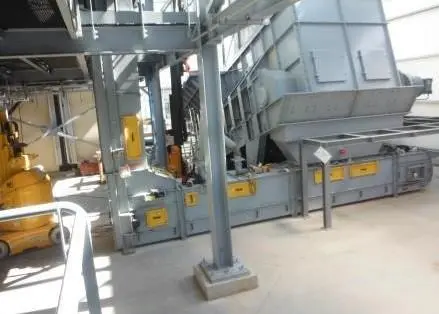
The manufacturing company, part of the AUMUND Group, came up with the product, the AUMUND BPB-SLP Hybrid Feeder, to tackle the difficulty of handling nickel mattes, which the refinery, located in Le Havre’s industrial and port zone, turns into high-purity nickel metal and salts.
The machine combines the technical characteristics of a Samson® Material Feeder and a heavy-duty AUMUND BPB-SF Arched Plate Conveyor, with AUMUND saying that the combination of these machines was the key to realising a spillage-free process.
Due to having lateral chains, the feeder has a lower overall height and a slightly wider machine, with a centre distance of 7.2 metres, a chain width of 3 metres and a belt width of 2.6 metres.
It is closed in with a dust cover and has a top-mounted filter, plus a slewing grate, cleaning brushes and catching strips for fine, spherical bulk material.
It limits the amount of material able to enter the feed chute at any time to a maximum of 33 tonnes, and has a waterproof belt surface and robust, tractor-type chains because of the material’s high densities.
Additionally, the hopper has a hydraulically-swivelling grate for the interception and removal of foreign bodies that have found their way into the material delivery containers.
Nickel mattes are extremely hard to handle as they have nearly-perfectly-spherical particles, creating challenges for operators regarding the mattes’ reception, interim storage and onward transportation.
New Hybrid Feeders have since been sold by AUMUND, four of them by the company’s US division, to full-service design firm M3 Engineering & Technology Corporation, which bought them for the Continental Gold Buriticá Project in Antioquia, Colombia.
Three of these four feeders are identical and will be positioned underneath the filter press, while the fourth will receive tailings from a front-end loader via a lateral hopper – and, unlike the other three, has a hydraulic drive.
The machines will be supplied this year and are anticipated to be commissioned by mid-2019 at the latest.
Related Articles
 OPERATIONS
 OPERATIONS
 PRODUCTS & SERVICES