



A community feel
Port Community System operators are looking to expand their influence far beyond the port itself. Michael King reports
Port Community Systems have been around since the 1970s. But both their hinterland reach and the multi-functional ambition of developers are now advancing with some urgency.
At their simplest, Port Community Systems (PCS) are data interchanges allowing ports and their users to exchange data. But some developers are now looking to expand their use far beyond the ports themselves either horizontally to multiple ports in a single country, or vertically by seeking to expand PCS systems so they can incorporate Port Operating Systems (POS) and even Terminal Operating Systems (TOS).
The basic concept of a standard PCS is that data is entered directly into the system by the party which “owns” the information and this data is then stored centrally, removing the need for data to be communicated to all individual parties. So if a vessel arrival time changes, for example, a PCS removes the need for multiple one-on-one faxes, e-mails or phone calls to be made to update interested parties so that each party can store the data in their own individual system. Instead, the data on the centralised system is simply updated and the system then sends the various actors notifications of changes.
“Of course such a system can only work when all involved parties actively participate in the system and see the benefit of such a system,” says Tom De Smedt, sales manager at Belgium-based Phaeros Group – which developed its Harbour View PCS product for the port of Ghent over 10 years ago and now supplies systems globally. “The concept was – and still is – that various players in the port industry would be sharing information, particularly related to vessel calls, with each other through a centralised system,” he adds.
Rather than establish a PCS for an individual port, some look to link multiport networks as a way of cutting costs and optimising operations. One of the more advanced systems in operation is found in the Netherlands, where Portbase acts as neutral information fulcrum for all logistics information at the ports of Rotterdam and Amsterdam, which jointly own the non-profit company.
Portbase chief executive Iwan van der Wolf believes that the system strengthens the international competitive position of Dutch ports and is as vital a part of the logistics infrastructure as physical capacity such as rail tracks and cranes. Around 2,000 companies based in the Netherlands and abroad are currently connected to the system and they represent over 7,500 users able to access 34 information exchange B2B and B2C services.
A single PCS for two of Europe’s largest ports allows the use of common standards and processes, thereby optimising the use of employee resources and saving time and money for the maritime industry, says Mr van der Wolf.
“Portbase has direct links with the in-house systems of a large number of customers,” he adds. “At the same time, these customers can use our web-based services for data entry or status updates. For customers that do not have large in-house systems, the web-based services provide easy access to all the functionality needed.”
India is also exploring the establishment of a national PCS but Mr De Smedt points out that there are negatives as well as positives to such an approach. “There are certainly benefits as to having a single system for a whole country – data can be exchanged quite easily as it will presumably be stored centrally and will be in a standard format, and the users of the system do not need to learn different systems to work with,” he says.
“On the other hand, setting up a system for a single port is already quite complex, so doing so for an entire country and trying to meet everyone’s requirements is a very time-consuming and challenging project.”
Phaeros is increasingly being asked for custom-designed systems. For example, Harbour View was recently rolled out at the Port of Melbourne in Australia, where it is mainly used for port management, while Phaeros will also supply the Port of Rijeka in Croatia with a Harbour View variation geared to the exchange of EDI messages.
The company is also looking at expanding its PCS line vertically. As ports look to replace outdated systems and turn to software vendors, authorities that operate their own terminals are keen to incorporate diverse cargo operations into the PCS – in effect adding TOS or POS capability into the traditional PCS function.
To that end, Phaeros has developed Cargo System for terminal management as well as modules for invoicing. “Our invoicing system, BillSys, is capable of storing the contract details and tariffs and will retrieve the operations data from the underlying port and terminal management systems in order to calculate all the applicable charges and generate the invoice,” says Mr De Smedt.
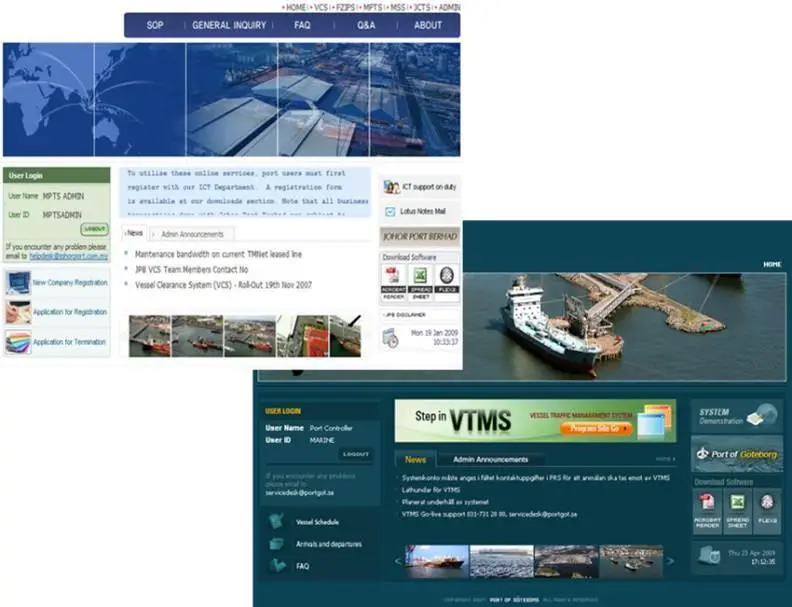
Korea-headquartered Total Soft Banks’ TSB PLUS (Port Logistics Unifying System) product is now also being developed to add additional functions to its core “web-based single window” PCS concept which was first released in 2007.
TSB claims PLUS is now not only a PCS but also a comprehensive marine logistics system with add-ons which can also stand alone, such as a vessel clearance application, and marine service and cargo management systems. TSB believes PLUS can cope with a port’s entire business process.
In the first half of this year, PLUS was chosen as Busan Port Authority’s new PCS, and previous contracts have seen the system installed at Johor port in Malaysia, Gothenburg in Sweden and Port Sultan Qaboos in Oman.
“In terms of efficiencies, PLUS allows users to proceed with the whole work process through a standardised and unified gateway accurately and rapidly, thanks to its concept of ‘a web-based single window’,” explains a spokesperson. “It saves costs and time and enhances the quality of service and allows flawless interface with internal legacy or external systems.”
Portbase is also improving existing and developing new services, including the launch this year of a suite of services to facilitate the filing of exports for customs. A programme to renew the existing platform to allow for a more open system to “better connect the communities from our supply chains and support the on-carriage sector and connected hinterland terminals even better” is also underway, says Mr van der Wolf.
Even he admits there are limits to the spread of PCS use, however. He believes that eventually most ports in Europe will have their own PCS, or be part of a national PCS, but thinks it unlikely that a pan-Europe system will ever come into operation – although he can envisage more cooperation between non-competitive ports.
“The majority of the national B2G flows and the majority of the legislation are still on a national level and the differences between the countries are too large to use standard services,” he says. “Besides, in a large number of countries the PCSs are considered as strategic assets of the ports and it is therefore difficult to implement this in competitive ports.”
Related Articles
 NEWS
NEWS
 CONTAINER & CARGO HANDLING
 OPERATIONS