CABS: ON A JOURNEY

Achieving efficient crane cab design to match today’s pressurised work environment is a big challenge. John Bensalhia examines how key suppliers are responding.

Brieda DYCS cabin

Crane cab design is advancing as the pressure is ramped up for increased effi ciency in the cargo handling process. Making the work process straightforward, comfortable and safe for the crane operator represents a highway to boosting efficiency levels: facilitating good visibility, posture, ease of access, communication procedures, climate and other key design elements, all come into the mix to achieve a state-of-the-art operating environment.

A PEMA Information Paper (www.pema.org) authored by Siro Brieda, Owner, Brieda Cabins and Daan Potters, BTG Special Products BV, highlights the main concerns in terms of health: awkward posture; inadequate heating; risks of insufficient ventilation, excessive noise, and vibration. “Beyond its personal cost, poor employee health also has detrimental effects on operational safety and productivity,” underlines Brieda. “An increased focus on safety will reduce staff injuries and equipment damage costs,” he additionally points out.

DESIGN CATALYSTS

Crane manufacturers are ensuring that cabins are more userfriendly than ever before, providing a safe, clear and comfortable experience for operators. As an example of a modern product in January 2021, DP World’s Mannheim trimodal container terminal saw the delivery and installation of a new crane cabin from Teichmann Cranes.

The unit requested is reportedly larger and more advanced in design, providing higher levels of comfort and ease of use for the operator – key requirements nowadays. “Trends include new technologies to improve the operational safety, visibility and ergonomics and driver environment, as well as the ability to customise the cab for local requirements,” says Kalmar.

Digitalisation, hardly surprisingly, is an important part of the new technology resource. This includes open interfaces and the ability to allow for new technologies, as well as introducing new driver assistance functions for semi-automation. Not all attention, however, is focused on newbuild cranes and their respective cabs – cab upgrades are also receiving attention.

Konecranes notes that utilising the latest technology, cab upgrades can play an important part in achieving an improved performance. Typically, this would be done as part of a broad-based crane upgrade but can also be done in an individual context.

CLEAR VISION

One of the key issues raised in the PEMA paper with respect to driver safety is vision. Drivers in ship-to-shore (STS) cranes are required to look downwards during operation, but the driver’s angle of vision is relatively limited because of the height of the crane.

Vision inside the cab is equally as important as the external view. The paper particularly recommends that monitors should be within 45 to 50 degrees from the driver’s eye level in order to avoid strain. Also, important system indicators should be positioned in the driver’s immediate forward and downward line of vision, not to the side of the cab. This is more efficient with regard to alerting the operator regarding any crucial system information that may require action.

Konecranes’ OPTIMA cab design is configured with clear vision in mind. The OPTIMA cabin includes large, lowered, corner post-free windows. It also provides the driver access to sightline vision for major working areas outside, with views of the outside environment located at the front, sides and rear of the cabin.

Kalmar’s safety features to ensure safe load handling via good vision include camera functions around the crane, with overall cab design focusing on minimising operator blind spots. Where blind spots exist (e.g. with obstruction by masts), the position is minimised by using mirrors or cameras.

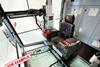
“Cab design is focused to widen the visibility for the driver in the operative zone of loading/unloading containers, installing a fixed floor glass, certified, laminated 40mm thick and with internal sliding grids,” says Brieda. “In this way there is no need to have internal and external safety bars that reduce the visibility. The new solution also improves the general safety in the terminal, because the driver does not have any structural obstruction in his vision field during the manoeuvres.”

FINE TUNING

While speed is good news for increased productivity, a faster moving item of equipment can mean higher levels of vibration inside the cabin. “ISO 2631-1 Mechanical Vibration and Shock,” which provides guidance on human exposure to whole body vibration, should be considered a benchmark in this area when drawing up specifications for crane cabs, suggest Brieda and Potters.

They additionally highlight the merit of incorporation of shock or vibration absorbers in crane cab design. “Working on a crane with reduced biomechanical stress improves the driver’s cognitive function, increasing the safety level inside the terminal,” they state.

Brieda’s Dynamic Control Station (DYCS) is designed to alleviate these problems and is fully usable for various types of cranes including ship-to-shore container, mobile harbour and overhead units. In accordance with the European Standard EN 1 1005-3/4/5 and ISO 11226, the DYCS’s structure features a shock-absorbing system that has been tested under tough stress conditions. It also includes support for the driver’s forearm due to the innovative function of the joystick.

A Brieda DYCS cabin can be installed or retrofitted to an existing cab thanks to its universal floor attachment point. In addition, adjustment of the control boxes can be performed by an electric device for all required directions. Safety and comfort extends to a clean, pollution-free working environment. Brieda expresses the importance of cabins featuring adequate air conditioning and heating, with sufficient warmth across the glass floor to prevent the risk of moisture. Furthermore, crane cabins must be positively pressurised with clean air to keep out pollutants.

Ease of operation is an important factor for Kalmar. “Automatic gantry steering solutions enabling the crane to follow virtual rails are a common option these days, making the operator’s work less demanding. Truck positioning and lift prevention systems are also popular choices to increase efficiency and safety at work,” says Kalmar.

Driver posture is another important factor. A good cabin seat ensures that the operator does not suffer from discomfort or unnecessary strain on the back or the neck. Metagro’s Ergoseat NG-H is an example of a chair that aims to offer the crane operator a healthy working posture. It is designed to be suitable for all kinds of body build and offers extra visibility in its ceiling suspension design plus a 10-degree downward tilt for an unobstructed view.

Another facility of the Ergoseat is a 10-inch colour touchscreen that allows the operator full control and faster remote support, resulting in reduced cabin downtime. The Ergoseat is part of a cabin package provided by Metagro for the ongoing, large-scale, expansion at Abu Dhabi Ports’ Khalifa Port. The strength of the support for instrumentation and other systems in the cab is another example of the fine detail of contemporary design.

Brieda points out, for example, that it offers strong adjustable supports for CCTV monitors, HMI systems touch screens, communication systems, etc. This is one measure designed to facilitate the optimum arrangement of cabin configuration and provide for the installation of new technical solutions, which are cognitively efficient and able to operate with total control and safety.