


Chinese Bottlenecks persist
Impediments to the cargo pipeline performing well, from iron ore producer to steel manufacturer, are not all, about what is happening at the exporter end in Australia.
The Chinese infrastructure still leaves a lot to be desired – last year 25m tonnes of China’s total 2004 iron ore imports of 206m tonnes, was identified as sitting stockpiled in Chinese ports awaiting rail movement. Invariably, this was after spending many days offshore waiting for a berth to discharge.
No end is in sight to this problem, indeed it may well get worse before it gets better in the short term. Some analysts suggest that China’s railways are now handling only around 30% of their potential demand with limited investment coming in to rectify this problem. Alternatives have been developed, such as the recent initiative by the Ministry of Communications deploying 1.5m dwt of shipping to transport raw materials along the coast but such measures are merely stop-gap and really don’t get to grips with the heart of the problem.
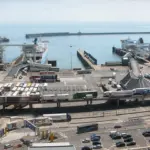
Where this latter aspect will really be tackled is in China’s ports, and here, promisingly, there are signs of real progress.
The country is making significant progress in developing Capesize berthing facilities, albeit still difficult to keep pace with demand.
Two ports in northern China developed for accepting Capsize dry bulk vessels are Dalian, offering a 20m draught, and Bayuquan at Yingkou with 17.3m. Caofedidian offers a third facility, comprising two berths with a combined throughput capacity of 30m tonnes/yr and with channel depths of 25m.
Three other northern Chinese ports, Tianjin, Yantai and Rizhao, have been handling Capesize tonnage for some time and all have recently been dredged to confirm Capesize operations without lightering.
Down south, the lightering and part loading of vessels is fairly standard practice, although Fancheng, Huangpu, Zhenjiang and Shekou can all accept Capsize vessels under varying conditions.
All this represents progress, just 10 years ago China possessed only one Capesize berth at Beilun near Ningbo.
There is, though, no scope for complacency in China-linked iron ore logistics. Even with the major price hikes that have taken place another big increase in iron ore imports is forecast for China this year; around 256m tonnes this year and as much as 375m tonnes in 2010 according to John Kearsey, Executive Director of Shipbrokers Simpson, Spence and Young speaking at the recent Coaltrans Conference in Shanghai.
Underpinning this trend, Chinese steel production has almost doubled in the last two years and is expected to further increase by 60m to 70m tonnes this year up to around 330m tonnes/yr. The only way is up, for the time being at least!
Related Articles
 EQUIPMENT
 PORT & TERMINAL NEWS
 PORT & TERMINAL NEWS