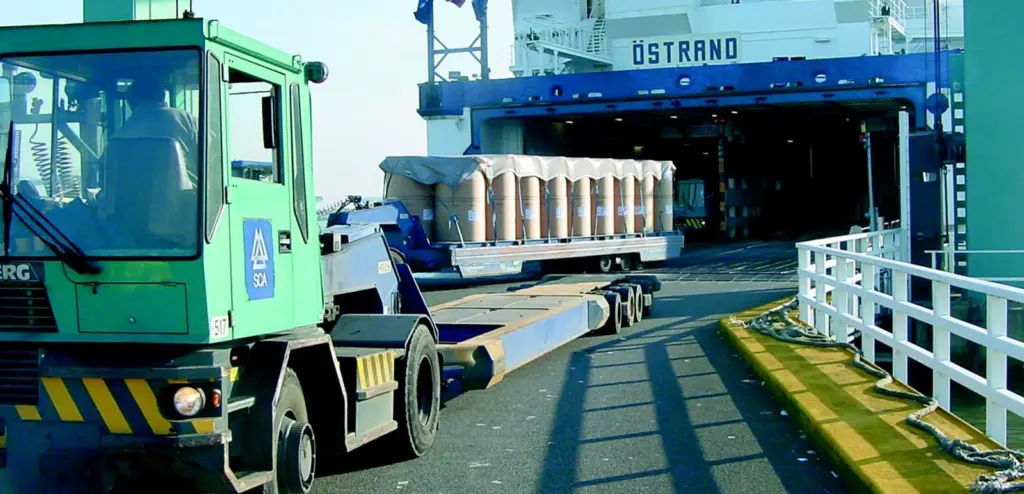
SCA Transforest has established a reputation as an innovator in the forest products handling sector introducing, for example, the cassette/ro-ro system as early as 1996 and later the so-called “slide-loader” automatic container stuffing system.
“One could say that SCA Transforest has become a market leader in the Nordic countries as far as forest product logistics is concerned, ” notes Bob de Lange, md of subsidiary Interforest Terminal in Rotterdam. “Indeed, the main driver behind this was, and is, the competitiveness of the market for paper as a whole and the very real need of our customers to be seen to be leading the market in terms of quality in the overall supply chain.”
In Rotterdam, incoming traffic, which mostly consists of paper reels, with some palletised board and pulp, arrives mainly by short and deepsea vessels, although other deliveries, some of which are already containerised, are also made by rail and road. After initially warehousing these consignments, the main processing undertaken by Interforest is essentially one of containerising them, before despatching either by barge (50%) or truck (50%) to deep-sea terminals at Rotterdam or Antwerp, although some is also despatched as breakbulk in specialised ro-ro or open hatch vessels.
“If we look at the way paper reel handling in particular has changed in recent years, we now have a more systematic approach to the whole logistics chain with increased mechanisation and containerisation, not to mention an enhanced intermodal transport component. Data management has also come to the fore and data-control has changed out of all recognition, with radio LAN networks now linked to barcode scanning and truck-mounted computers, ” notes de Lange.
However, most significant of all, he stresses that the cost of distribution has not really increased in real terms over the last ten years, in spite of strong increases in wages and the cost of machinery. “This is because of the massive gains we have made in productivity, which have made handling faster, cheaper and helped retain the integrity of the products.”
While de Lange concedes that virtually all stevedores in the industry now offer comparable services in terms of handling, the big difference nowadays lies in Interforest’s approach to shipping products between Sweden and the UK and European continent, which requires specialist equipment and highly trained employees.
NO ROOM FOR NON-SPECIALISTS “If you want to be active in this market today, you have to be a specialist; there is no room for non-specialists, ” he emphasises, noting that there is still room for improvement in the overall logistics chain. Interforest, for example, is introducing a new generation of intelligent clamps, cleaner engines and soot filters, as well as more electric-powered FLTs. Within Europe, the emphasis is on ever greater use of intermodal transport, which implies larger size trucks for ever larger reels and heavier loads.
“There is an awful lot more we can do! We have to avoid using lessthan-trailer-load as much as possible in order to maximise payloads;
reduce the amount of handling we do by better forecasting; improving the information flow in the chain; integrate data and processes; train our stevedores to a higher level; and, perhaps most importantly of all, reduce the cost of handling.”
With reference to equipment purchasing, de Lange explains that this is assessed by the parent company, which nowadays insists on joint purchases. He cites a group order placed this year with Kalmar for terminal tractors and another with Linde for FLTs as examples of this leading to big savings. However, equipment does not necessarily have to be multi-purpose in order to justify an initial outlay in capital, since most of the group’s equipment undertakes a steady work flow, with very few machines under-utilised.
Significantly, Interforest acquired most of its equipment, including FLTs, terminal tractors, its entire fleet of reachstackers and even its gantry crane, on operational lease with maintenance undertaken on site. “The decision whether to buy or lease is determined by the group as a whole and is balance sheet related. We seek complete packages, including finance, maintenance and customising, but we take care of our own insurance, ” says de Lange.
SMALL BUT INNOVATIVE New Zealand’s North Island east coast port of Tauranga, owned by Port of Tauranga Ltd, generates an annual throughput in the region of 11-12m tonnes. Currently, five stevedoring companies compete for traffic, of which Independent Stevedoring Limited (ISL) is the second largest. Competition is therefore fierce and innovation a necessity.
ISL md Hans Axt stresses, in global terms, his company is not a major player in the forest products handling business. In a good year, for example, it reports traffic of around 75,000 tonnes of wood pulp, 20,000 tonnes of board, 200,000 tonnes of sawn timber and 100,000 tonnes of MDF.
One of ISL’s major customers is Tasman Orient Line which operates a mixed fleet of 11 breakbulk carriers into and out of destinations in Asia. As Axt observes, ‘conventional’ breakbulk liner operators nowadays have to fight very hard to stay afloat, with container rates continually eating into their margins.
“At ISL, we have been able to help customers stay ahead by introducing innovative and flexible ways of handling mixed breakbulk volumes in the most efficient manner possible. To do this we needed to develop ideas that were cost effective and also introduce handling devices that were reasonably easy to operate; this is especially true in the handling of value-added forest products, ” he stresses.
Since start-up of the company in 1997, the stevedore has handled reasonable volumes of newsprint reels, although all of this is now containerised at source. Nevertheless, it was decided that a requirement still existed to lift individual reels in the port, so ISL developed its own reel lifter, using as its base a multi-purpose Jensen Sling. This new product does not use wires as its ‘belly bands’, but rather webbing. This protects the reels from being damaged by the wires ‘biting’ into the belly of the reels. Even more significantly, up to four three-tonne Kraft Liner Board (KLB) reels at a time can be hauled up by the ship’s gear using this method, therefore helping to cut turnaround times.
“Since introducing this new device, we have handled good volume of reels and we have already partially recovered the costs of developing the reel lifter, ” reports Axt.
Initially, ISL was also unable to afford very expensive off-the-shelf pulp clamps for lifting unitised pulp. One of its employees therefore developed what was has become known as the “Cowdrey Clamp”, essentially a lifting frame which minimises damage to the outside wrapping when clamping pulp units. Each clamp costs around US$1,000 compared to US$17,000 for an existing hydraulic clamp, figures which speak for themselves.
Unfortunately, as Axt concedes, volumes of reels handled have dropped of late, since the shipper has changed policy and now loads value-added paper products such as pulp and paper directly into the holds of its chartered log carriers at the expense of Tasman Orient Line vessels. To make matters worse, this work is done by the shipper’s own stevedoring company.
Axt further notes that, because paper products are invariably shipped as relatively small consignments on liner vessels, the stevedore is always faced with significant difficulties in terms of finding the best areas on board in which to stow these value-added products, especially given that they are carried in older, multi-purpose vessels.
“Tasman Orient Line has to compete with large container carriers and so is limited as to what vessels it can charter given the enormous increase in rates over the last year or so. Sometimes, the vessels are not totally ‘box shaped’ and that creates problems with stowing packets of MDF or other fragile forest produce. Therefore, to ensure that handling can take place efficiently and relatively damage free, which is far from easy, it requires a lot of skill and experience, ” he emphasises, adding that this has been accumulated by ISL employees, who can therefore make a vital difference in ensuring that cargo is correctly and economically stowed.