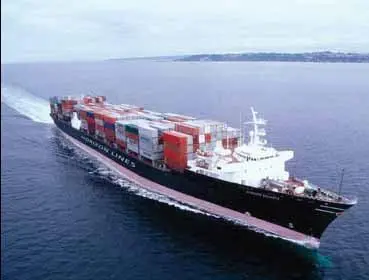
In early 2007, the company took an active interest in the “Casper” (Computerized Analysis of Ship Performance) hull performance monitoring service offered by Propulsion Dynamics, Inc. (PDI) of Long Beach, California, and subsequently entered into a contract for monitoring and optimising the timescale for propeller polishing. Casper takes measurement of bridge and engine room data, using the ship’s existing instruments and converts this into a precise figure for speed and fuel penalties due to fouling of the underwater portion of the vessel. The vessel chosen for the first trial was the 23,500 horsepower steam driven Horizon Reliance, a 46,000-deadweight ton containership built in1979. The vessel plies its trade between Los Angeles and Hawaii, a return voyage of four days, and when fully loaded sails at a speed of 22 knots, burning fuel at the rate of 128 tons per 24-hour period. Casper was initiated immediately after the vessel’s propeller had been polished, and quickly began to build a profile of the hull/propeller performance. The first results indicated that polishing the propeller after four months, rather than the previous six-month period would improve its performance, Ed Washburn, Horizon’s supervisor port engineer in Oakland, California, said, ‘We are very pleased with Casper. By accepting its recommendation we are conserving around one ton of fuel every day, the equivalent of $530 at today’s price and, more importantly, reducing the greenhouse gases discharged into the atmosphere by 1.12 per cent. In January this year, a Casper system was initiated on a second vessel, the Horizon Spirit, the same class as Reliance, and operating the same route. By adding a vessel of similar class, further optimisation of propeller polishing intervals can be validated and adjusted between vessels. ‘The optimal intervals for propeller polishing seem to be based upon daily consumption, fuel prices in connection with propeller composition, and port water contamination level; therefore, it will vary between vessels,’ according to PDI’s Daniel Kane. Looking to the near future, Washburn anticipates that Horizon would also trial Casper on one of its diesel driven vessels to optimise propeller efficiency. He also expects that the PDI service would be used to investigate factors relating to the hull. ‘It would be of interest to us,’ he said, ‘to learn what results are obtained by different levels of shot-blasting – down to white metal, full surface blasting, or just spot-blasting
Horizon benefits from fuel and emission savings
As a principle feature of its efficiency programme, Horizon Lines has long adopted a policy of polishing its vessels’ propellers every six months, and of dry docking for cleaning and repairs twice every five years.