A number of companies have emphasised the advantages of the pneumatic unloader during the very final stages of rest unloading, but based on data from accurate simulation together with operational experience, the mechanical unloader appears to have the edge where high capacity unloading is required.According to Buhler Group statistics, a supplier of both mechanical and pneumatic continuous ship unloaders (CSU) systems, a mechanical unloader will maintain a higher than average throughput – of more than 400t/hour – and in real terms will actually finish unloading earlier than a pneumatic system.
The main difference between the two systems boils down to a simple matter of physics, according to Barac Bieri, head of product marketing, Grain Handling, Buhler Group. He says, for example, to reach 400t/h unloading capacity requires either a 600t/h pneumatic solution or a 450-500t/h mechanical solution. This is because the pneumatic solution loses throughput the moment the suction pipe is extended – which is most of the time during unloading operations. Therefore, a higher peak capacity is needed in order to reach the same average across the vessel. Subsequent conveying for the pneumatic solution would also require a capacity of 600t/h and 450t/h for the mechanical version.
Taking in to account terminal operator’s energy and labour costs and the varying levels of operator skill, mechanical solutions generally have an advantage over pneumatic solutions for high capacity and high unloading amounts, especially above a throughput rate of 300t/h-400t/h. Therefore, Buhler only recommends pneumatic solutions for average throughputs below 300/h-400t/h. In such cases, the pneumatic solutions are viable mainly because of lower initial cost. For requirements of high capacity and high unloading amounts, chain unloaders have been proven to be the better alternative, says Mr Bieri.
Indeed, the Grain Handling business unit of the Swiss company is supplying four mechanical Portalink ship unloaders to the Middle East. To date, this market has been dominated by pneumatic unloading systems, but as energy costs rise, system efficiency is becoming increasingly important. The specific energy consumption (kilowatt-hours per metric ton of material unloaded) of the unloading process relates directly to the total cost, which is made up of the raw material price, the shipping costs, and the unloading costs. A mechanical unloader is said to achieve a higher average capacity in unloading a complete ship, says the Buhler Group.
While both types of systems meet stringent environmental considerations, agribulk experts have claimed that the pneumatic system offers between 5% and 10% more energy efficiency than that of mechanical equipment under similar working conditions on smaller sized vessels. Hold clean-up is also better with the pneumatic version, however any benefits here are offset by the high unloading rate of the mechanical version when increased ship sizes and payloads come into play.
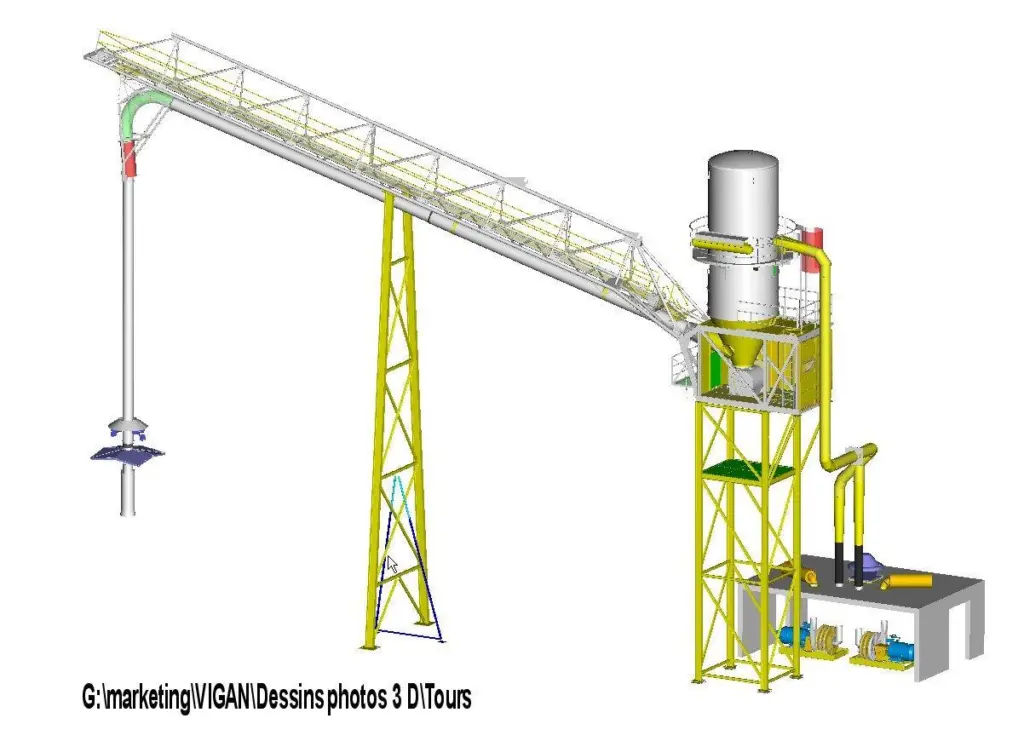
Alain de Visscher agrees. The commercial director at Vigan Engineering, the Belgian bulk unloader specialist which recently received significant orders from South Korea and Pakistani interests for its SIMPORTER systems, says that mechanical performance is good down to the bottom of the hold but a minimum height of material of 70cm to 100cm is necessary to enable the product to be picked up. This means a lower clean-up efficiency, compared with pneumatic types.
Although the system selection has often been led by the port’s operational scope and factors such as ship size and weight, types of cargoes to be unloaded, and equipment maintenance and repair considerations, a deciding factor is, increasingly, energy consumption. In a recently published paper that outlines Vigan Engineering’s thinking on the pneumatic versus mechanical debate, Mr de Visscher says that energy consumption can vary considerably, especially with older pneumatic machines which were consuming up to 3kWh. However, newer systems that incorporate frequency inverters have brought this down to between 0.9kWh and 0.7kWh. “This is a most significant cost reduction. It means a much lower peak energy amperage (power consumption) when starting the electrical motors which also reduces energy costs,” he says.
With mechanical systems, energy consumption varies according to the technology. Twin-belt unloaders, for instance, use to have an energy consumption of between 0.2 and 0.3kWh, while the screw and chain type systems are between 0.4 to 0.6kWh, says Mr de Visscher.
“When computing the energy cost for the various systems, many parameters have to be considered such as the average efficiency or average uploading capacity (including the hold cleaning). No conclusive figures on this average efficiency between the systems can be easily established because for single equipment, it will vary according to many factors, such as hold dimensions, the skill of the operator and the number of auxiliary equipment for hold cleaning, for instance,” he says.
The Technical University of Munich’s (TUM) Stephen Kessler and Stefan Rakitsch however, recently addressed the advantages/disadvantages of the systems in a presentation entitled Aspects of Energy Efficient Use of Port Installations, given in September.
In their paper, they compare the power consumption of chain, screw, belt and pneumatic-type CSUs and found that, based on an annual unloading volume of 900,000t of grain, with energy costs based on ¢0.1kWh ($0.13), a daily tie-up cost of ¢39,500 ($50,156), and with 90% equipment reliability, mechanical systems were much more energy efficient.
The average energy efficiency of a pneumatic system was only 60%, compared with 80% for a chain type, 75% for a screw type and 65% for a belt type system. While power consumption per tonne was about 1kWh for both the screw and pneumatic types, the chain and belt-based systems were found to each consume only 0.4kWh/t. Their research found that the total annual operating cost of a pneumatic unloader (taking the above factors into consideration) was some ¢5.11m ($6.49m). This was roughly ¢500,000 ($634,885) more than a belt type unit and ¢1m ($1.27m) more than for screw-type system. The chain-type system was the cheapest to run at ¢3.8m ($4.8m). Unloading costs per tonne showed similar traits: ¢5.7t ($7.2) (pneumatic), ¢5.2t ($6.6) (belt), ¢4.6t ($5.8) (screw) and ¢4.2t ($5.3) (chain).