
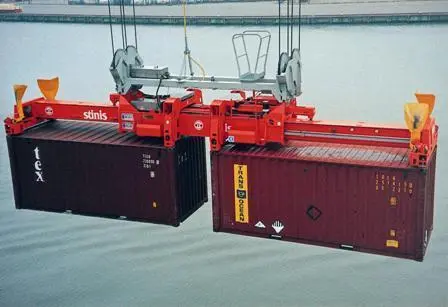
When the first containers were being shipped between Europe and America in 1967, Stinis sold its first container spreader. Two decades later, a fully automated container spreader, the Stinis Autotwist (main picture), was introduced. Several thousand units of this spreader type are in operation all over the world, while hundreds are still being produced and sold on a yearly basis.
In 1997, Stinis introduced the Long-Twin spreader into the market. The simple and robust design, for which Stinis holds the worldwide patent, has drastically changed the logistics of terminal operations. This spreader concept, which has become the industry standard, ensures a smooth operation for the separating twin-lift part under quay cranes, yard cranes and straddle carriers. At this moment, hundreds of Stinis Long-Twin spreaders are in operation worldwide under the most extreme conditions, to the full satisfaction of our customers.
Another innovative breakthrough in the container handling business is the Stinis Split-Headblock. The Stinis Split-Headblock can be equipped with either one or two spreaders and handle two 40ft containers simultaneously. This equipment has been successfully in operation at various terminals in Europe for more than two years. Now the situation in the container handling business has significantly improved, compared to several years ago, orders for more units are expected within a very short period of time.
The reasons why customers prefer Stinis equipment
Stinis is an innovative family owned company (founded in 1830) that has been a trendsetter in container handling equipment since the early days of containerisation.
All telescopic spreaders are manufactured in The Netherlands from high quality Swedish and German steel and are based on the mono-beam construction. The telescopic beams, with their completely machined bottom and side-plates, are absolutely maintenance free. In addition, the beams provide the crane operator a better view on the containers being handled. Also, boxes to store stacking fittings can be mounted easily to the mainframe.
Stinis spreaders have a modular design and only first class standard components that are available and are used world-wide. This guarantees the availability of these components and also the interchange ability between the different types of Stinis spreaders. The spreaders feature very short telescoping times with only 18 seconds from 20ft to 40ft and only 5 – 6 seconds from 40ft to 45ft. The unique design of a dual steel belt covered with industrial rubber (including a slow start / stop system) ensures simultaneous telescoping and has proven its reliability in more than 1500 spreaders that are in operation worldwide.
The design of the telescoping beam locking device, that guarantees telescoping to the exact positions, has successfully been incorporated in more than 2000 spreaders that are in operation under a broad variety of conditions worldwide. Stinis’ powerful, over-dimensioned flippers and actuators were introduced in 1979. The feedback from the terminals is that they are robust, reliable and that they have improved the productivity of operations by 5 to 15%. At the same time the downtime and repair / maintenance costs have been reduced.
Due to the over-dimensioned flippers in combination with the actuators and the unique configuration / position of the flippers on our Mobile Harbour Crane spreaders, our MHC spreaders are standard equipped with only four flat flippers. Of course if desired we will supply MHC spreaders with six flat flippers. The automatic greasing system (standard on STS spreaders and optional on other types) has been installed on more than 2000 spreaders. It has been proven to reduce downtime, as well as maintenance cost, and at the same time increasing spreader reliability.
Stinis’ floating double collar ISO twistlocks (Patent pending) have a new model “nut”, which increases the lifetime significantly. The present life time is more than 400,000 moves for RTG / RMG application and more than 200,000 moves for twistlocks in the end beams under high speed ship-to-shore cranes. The optional Stinis Active Shock-Absorbing System (Patent pending) reduces the noise, when the spreader lands on a container and during the lifting hereof. Additionally, the impact on the spreader during landing is decreased by almost 50%. The system can be switched on and off.
Stinis in the future
Stinis experienced an excellent year in 2011, with orders from new customers like ADPC at Khalifa Port in Abu Dhabi for a total of 33 units of ship-to-shore Long-Twin and straddle carrier Long-Twin spreaders. Also, the new German container terminal in Wilhelmshaven has chosen Stinis as supplier for the Long-Twin ship-to-shore spreaders. The railway terminal there will be equipped with full electric spreaders. Deliveries will start early next year. The Long-Twin STS spreaders for both Khalifa and Wilhelmshaven port are prepared for operation under the Stinis Split-Headblock that handles two 40ft containers at the same time.
Other new Stinis customers are located in Los Angeles (USA), Barcelona (Spain) and in Durban (South Africa). Also the ECT Delta Terminal in Rotterdam (The Netherlands), one of Stinis’ largest customers, has ordered another 48 spreaders with deliveries starting in November 2011. These spreaders are a mixture of single lift- and Long-Twin STS spreaders, RMG- and Automatic Stacking Crane spreaders.
Stinis has almost 25 years of experience with spreaders for Automatic Stacking Cranes, as the first spreader for this type of crane was delivered in 1988. Other existing Stinis customers that have expended their spreader fleet are HHLA in Hamburg (Germany) 11 units, and Eurogate also from Hamburg with 26 units. Additional Stinis equipment that is selling in large quantities are Mobile Harbour Crane spreaders (both single – and twin – lift) that have been ordered by customers mainly in Europe and the Far East and the different versions of the Electrical Over Height Spreader (fixed 20ft, 40ft, or telescopic units).
The Stinis electrical overheight spreader remains another popular choice for ports. Having been developed as the successor to the Stinis mechanical overheight, the electrical overheight spreader is in operation with many terminals across the globe. It’s a product that can be used under ship-to-shore cranes, yard cranes and reach stackers – another benefit is that it can also be used in combination with other spreader brands without any major changes having to be made to the main spreader.
The use of Stinis spreaders will improve port operations. Simultaneously, the downtimes of the spreader and crane, repair and maintenance costs and cost of ownership are reduced.