Ghana has experienced rapid container traffic growth in recent years, with volumes peaking at close to 895,000 teu in 2015. While traffic edged back to 840,000 teu in 2013, further substantial growth is expected and extensive expansions of the existing container facilities is now in hand to cater to burgeoning volumes.
Facing the Gulf of Guinea, Ghana’s two main ports are located at opposite ends of its 540 km long coastline. At the eastern end, Tema, the larger port, lies some 28 km by road from the capital, Accra. Takoradi, at the western end, is situated some 225 km by road from the capital. Both ports are owned and operated by the Ghana Ports and Harbours Authority (GPHA).
Protected by two breakwaters, Tema has a 240m wide entrance channel with a minimum water depth of 12.5 m. On average, the port receives some 1,650 vessel calls per year, mainly from containerships, general cargo ships, tankers, ro-ros and cruiseships.
In addition to handling domestic trade, Tema serves as an outlet for Ghana’s landlocked neighbours, Burkina Faso, Niger and Mali. Over the last five years, this traffic has increased due to civil unrest in neighbouring Cote d’Ivoire which has led shippers to leave the main port at Abidjan.
Tema’s bounty
In 2015, Tema handled 782,502 teu of which some 80% was handled at Meridian Port Services (MPS) Container Terminal, a modern kitted-out facility; containerships visiting other berths in Tema must use their own gear for the transfer of containers between ship and shore.
To cater for the growth of container traffic in Tema, GPHA began a major programme in 2002 to upgrade port services. The GPHA plan included the exchange of its powers as port authority acting as the operator at a new container terminal, for those of landlord authority only. This exchange was completed on the granting of a concession to private investors to build, equip and operate a new container terminal, which was awarded in 2007 to MPS for a 20-year period.
MPS is a joint venture between APM Terminals (35%), Bolloré Africa Logistics (35%), and GPHA (30%). APM Terminals is currently the largest port and terminal operating company in Africa. Bolloré Africa Logistics, a specialist in the privatisation of container terminals, operates in 14 African container terminals.
Located at the existing Quay No 2, the MPS Container Terminal comprises a 574 m long quay frontage with a 11.5 m draft alongside. The terminal is equipped with five ship-to-shore gantry cranes and three mobile harbour cranes, all supplied by Konecranes.
Covering an area of 24 hectares, the MPS container yard has a storage capacity of nearly 20,000 teu and is equipped with 13 rubber-tyred gantry cranes (RTGs) and 23 reachstackers, also supplied by Konecranes. Stacking containers 1-over-5 high, the RTGs are all-electric, 16-wheel cranes with a lifting capacity of 40 tons and spanning over seven truck lanes.
Tema is now visited on a regular basis by 25 major container shipping companies including Maersk, Mediterranean Shipping Company, Evergreen Shipping and China Shipping Container Lines.
The first container feeder service from Tema opened in April 2013 by African Independent Feeder Ghana Limited (AIFEEDER) between Tema and Takoradi. This service is used for the export of cocoa beans from Takoradi and the return of empty containers. The cocoa bean trade provides an important source of overseas income for Ghana.
Feeder frenzy
AIFEEDER feeder services have since been expanded, moving containerised, out-of-gauge and breakbulk cargo along the West African coast. So far, seven ports in Ghana, Nigeria, Cote d’Ivoire, Liberia and Senegal are served, with at least four of these linked with monthly departures from Tema. New services are currently being planned to include Abidjan and Douala.
In 2014, container throughput at the MPS Container Terminal came close to its annual throughput capacity of 665,000 teu. This led to the announcement from GPHA in March 2014 that the container facilities at Tema would be upgraded and expanded.
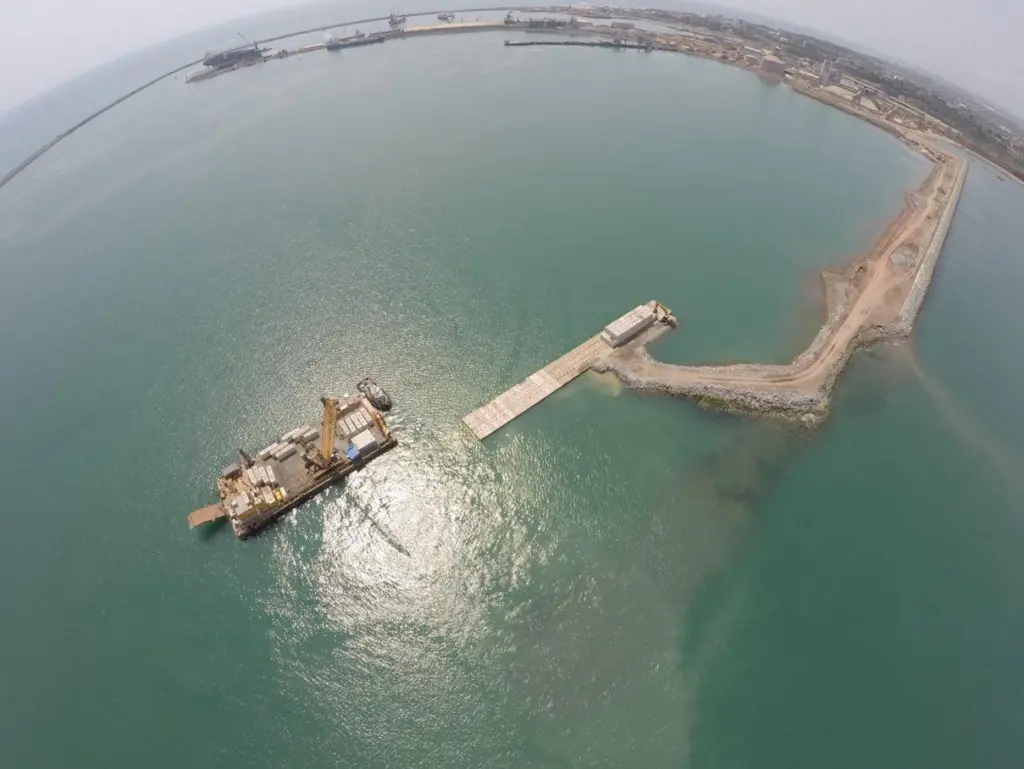
Scheduled for completion in 2018, the project includes the construction of four container berths along a 1.4 km extension to the existing MPS Terminal. A draft of 16 m will be dredged alongside the new berths which will enable larger containerships to berth. At the same time, a new 250 m wide entrance channel with a draft of 19 m will be dredged through the existing main breakwater. In addition, a second and larger turning circle will be dredged which should help to reduce the current port congestion in Tema.
Estimated to cost $1.5bn, the expansion works will increase Tema’s yearly container throughput capacity to 3.5m teu. The operation of the new container facilities will again be undertaken by MPS in exchange for a further 20-year concession to equip and operate the container terminal.
Takoradi’s challenge
Container throughput has been very much lower at Takoradi than at Tema. In 2015, Takoradi’s container traffic amounted to only 58,093 teu compared with 782,502 teu in Tema.
A lack of container terminal at Takoradi has deterred traffic, but proposals for the construction of a container terminal at Takoradi were included in a $250m port modernisation scheme announced by GPHA in 2004. However, these proposals were withdrawn following the discovery, in 2007, of oil and gas offshore in the Jubilee field in the Gulf of Guinea.
In 2009, GPHA announced that a $700m programme would be undertaken to make Takoradi ready to serve the country’s new oil and gas industry. The majority of the supply vessels serving the offshore rigs now operate from Takoradi.
In 2012, China Harbour Engineering Company began the first phase of a major port expansion programme at Takoradi. The main breakwater was extended and new berths constructed while the port basin was dredged to 16m. In a further phase, container facilities are planned which will enable Takoradi to accommodate containerships of up to 10,000 teu capacity.
Today, each West African country has its own container port for serving main line container shipping companies and there is no central hub port serving the region as a whole. This is largely due to the relatively low volumes of containers currently handled in the West African ports. Other factors include shipping congestion and insufficient water depths in the existing ports to accommodate the larger containerships coming into service.
At Tema, the extension of the MPS Container Terminal to allow it to handle an annual throughput of 3.5m teu could change the status quo. In addition to domestic traffic, this throughput capacity will enable Tema to handle substantial volumes of containers destined for the other West African countries.
As container traffic continues to rise, the need for a regional hub to serve the West African countries will become more pressing but there is likely to be strong competition from the neighbouring countries. However, Tema is strategically well located and will be fully equipped to handle large containerships, meaning that Ghana’s vision of becoming a regional hub port could well be realised.