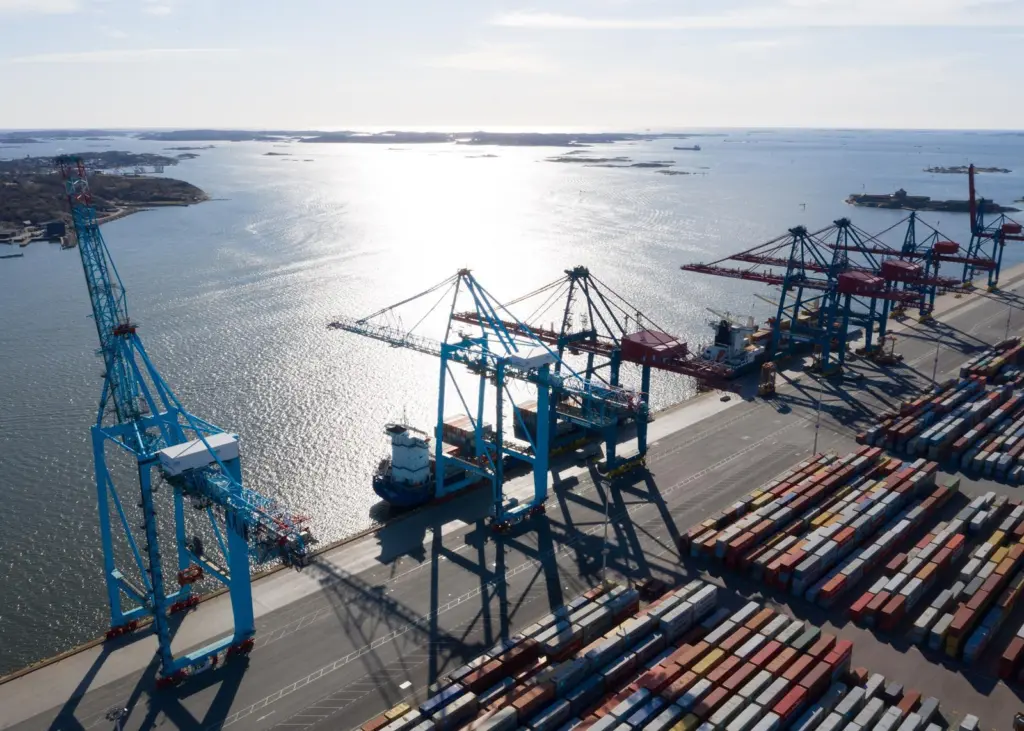
As a result of environmentally friendly initiatives and investments, ports around the world are targeting clean, emission-free operations. A notable example is APM Terminals Gothenburg, which has cut the rate of emissions by 90%. The company’s Green Gothenburg Gateway concept creates renewable energy, enabling all customers to receive fossil-free transport through the terminal at no extra cost.
APM Terminals Gothenburg has also announced that it will be making its container handling operations fossil-free. “All container handling equipment runs on HVO 100, all cranes and gates run on renewable electricity and biogas is used for heating,” says Cajsa Levén, marketing communication coordinator. “These actions reduce APM Terminals’ climate footprint in Gothenburg by approximately 90%. All customers are also offered fully climate-neutral cargo handling through APM Terminals’ Low Carbon Logistics programme. The programme is a way to reduce carbon dioxide emissions by investing in our own supply chain. This strengthens our contribution to the Swedish business sector’s competitiveness and climate work.”
Another initiative introduced by APM Terminals Gothenburg is an increase in the container terminal’s capacity. “A high container capacity is key to reducing climate impact,” explains Ms Levén. ”Vessels that can maintain normal speed minimise climate impact. The fast handling times at our terminal help vessels keep their timetables, without needing to run at extra high speeds and consume more fuel.”
A vessel that needs to travel 10% faster to recoup lost time increases its fuel consumption (hence its emissions) by 20%. “APM Terminals in Gothenburg therefore ensures that vessels that arrive late still depart on time,” says Ms Levén. “The most recent survey showed that 22% of vessels arrive later than scheduled; nevertheless, 97% leave the terminal within (or earlier than) the stipulated time. This is possible thanks to the capacity-enhancing investments and changes made by APM Terminals.”
Another important climate measure is to move freight transport from truck to train. APM Terminals Gothenburg is doubling rail volumes by 2022. Transporting goods by train not only offers economic advantages, but also reduces emissions by up to 98% compared to road transport.
From a zero-emission equipment angle, the Port of Valencia’s H2Ports project concentrates on testing heavy-duty, hydrogen fuel cell-powered port equipment. Two cargo terminals at the port (MSC Terminal Valencia and Valencia Terminal Europe) will trial prototype equipment of a container handling reach stacker and a terminal tug master for ro-ro operations.
Equipment Manufacturers Helping Ports?
Manufacturers of container handling equipment are helping ports achieve their goal. Arto Keskinen, SVP Kalmar Automation Solutions, says that Kalmar’s credentials in developing electrically powered equipment go back into the 1970s, and since then, the company has extended its offering with diesel-electric, hybrid and electrically-powered machines to help customers improve their productivity and reduce air emissions, noise and fuel consumption of their operations.
“Kalmar’s rail-mounted STS and yard crane offering has been electrically powered for decades, and we introduced the world’s first mains-powered RTG in 2002. Today, over 50% of Kalmar cargo handling equipment is already available with electric power sources,” Mr Keskinen outlines.
In December 2015, Kalmar introduced a fast-charging solution for electric-powered shuttle and straddle carriers that was extended to hybrid machines in June 2016. The Kalmar FastCharge solution is based on the same technology used in electric buses. “The charging station with a pantograph direct current charging system is located flexibly on the working route of the machines in the terminal,” explains Mr Keskinen.
“The machine has modern Lithium-ion (Li-ion) batteries which enable fast charging to be used. Charging happens during the idle time in the machine working cycle when it has stopped to wait for the container. Typical charging time in operation is 30 to 180 seconds, and with the maximum charging power of 600kW, full charge can be achieved in a few minutes.”
Electrification is one of the main trends in clean container handling. In May 2018, Kalmar announced its commitment to reduce emissions in cargo and material handling operations by fostering eco-efficient technologies. According to the commitment, Kalmar’s full offering will be available as electrically powered versions by 2021.
“In line with our eco-efficiency target, we introduced the Kalmar Ottawa Electric Terminal Tractor to the Americas market in May 2018,” says Lasse Eriksson, VP Technology, Kalmar. “The electric terminal tractor with a fully electric powertrain that produces zero emissions at source is designed for trailer-handling operations in dispersed warehouses, container terminals and other applications where short-distance highway travel is required.”
Kalmar continued on its electrification journey by introducing a fully electric version of the Kalmar Empty Container Handler. “The machine is designed to help customers reduce overall fuel costs and comply with increasingly strict airborne and noise emissions standards without compromising on performance,” explains Mr Eriksson.
As well as being environmentally sound, electrification and automation offer other significant advantages, such as for terminals operating Rubber-Tyred Gantry (RTG) cranes. “Hybrid, cable reel and busbar-based systems each have their own unique strengths,” says Mr Keskinen. “The choice of the crane electrification solution needs to be considered carefully while taking into account the automation level and development roadmap of the entire terminal.”
How Automation Can Help
Automation can benefit ports in a number of ways, with respect to costs, reduced operational time (saving the problem of operators moving to and from the cranes) and improved productivity of crane operators (the result of one operator controlling multiple RTGs remotely).
In 2018, Konecranes Lift Trucks introduced the Powered by Ecolifting concept to the market. This includes all the technical features developed on Konecranes’ lift trucks, granting a reduction in fuel consumption and noise level, which consequently contributes to issue less emissions in the air (carbon and noise emissions).
“With our Ecolifting solutions you can both save money and make better choices for the environment by using less fossil fuels without compromising on performance,” says Patrik Lundbäck, director and head of sales & distribution, BU Lift Trucks, Konecranes.
“The solutions that have been implemented are mainly three: Power Drive; Flow Drive; and Hybrid Drive, but there are others in the pipeline,” he confirms.
Taking the first of these solutions, Mr Lundbäck says that the Power Drive offers an affordable and convenient method of reducing emissions and costs. “With Power Drive at first, it is possible to take important steps in emission reduction, without major changes to the infrastructure or training of the staff. It is the most cost-efficient way to start reducing emissions and fuel expenses, thanks to a very short payback time. It saves on fuel and costs, reducing consumption by up to 15%.”
With a relatively small extra investment, Flow Drive has a drive line that offers up to 25% in reduction, combined with an improved working environment for the drivers.
“With a minimal financial investment, this solution brings concrete benefits to everyday operations,” Mr Lundbäck explains. “A precise, smooth ride, reduced noise and less cabin vibration and a significant increase in overall productivity.”
The third solution, Hybrid Drive, as Mr Lundbäck comments, is the one with a bigger impact in customer operations. “The difference with the diesel engine driven trucks is higher due to the fully electric propulsion and lifting. Leading the next generation of sustainable lift trucks, Hybrid Drive cuts down the fuel consumption up to 40%, providing benefits to business, users, processes and the environment. The evolution of the world’s first Hybrid Reach stacker grants benefits in terms of reduced emissions and cost efficiency, which are much more significant than the first two options, being also the bigger investment.”
Cost Reduction Benefits
Considering that environmentally friendly container handling products reduce fuel and noise consumption, one of the additional benefits is cost reduction.
“Less quantity of fuel will be used and therefore, purchase quantities will be reduced, turning into a main cost decrease per running hour,” says Mr Lundbäck, adding, “With our Ecolifting solutions, you can both save money and make better choices for the environment by using less fossil fuels without compromising on performance.”
The combination of factors such as technological inroads, emission-free equipment/machinery and a greater awareness/understanding of keeping the environment clean is pushing clean container handling further towards zero.
“Equipment with completely zero emissions will be a certainty in the future, for sure,” says Mr Lundbäck. “We will see a trend in which the terminals will turn into fully electric hubs.”
Mr Bernardo agrees that more ports are moving towards all-electric container terminals. “This is being studied in tandem with moving towards partial or full automation of cargo terminals – since the capital investment needed for both can be accomplished at the same time. More federal and state funding will be needed to help provide incentives so that container ports move toward electric equipment. Also, long-shore labour may be opposed to automation because it will reduce jobs for dock workers.”
Mr Eriksson adds a further comment here relating to costs. “It is important to note that electrification is not only about improving your green credentials, it can also mean a decrease in operational costs. Eco-efficiency is the future of cargo and material handling, with new and more advanced technologies helping us to do more with less.”
The executive offers a concluding summary too. “At Kalmar, eco-efficiency means systems efficiency, enabling continuous improvements with automation technologies and smart data gathering and analysis. It also means emissions efficiency – cutting atmospheric emissions with electrification, the latest driveline technologies, and better operator training. Finally, it also means resource efficiency, taking a proactive approach to maintenance to keep equipment operating optimally, delivering smart upgrades that help customers move more with less, and focusing on optimising our own operations as well as those of our suppliers.”
No Dreaming in California
Reducing emission levels of cargo handling equipment has been part of strategies
introduced by the Ports of Long Beach and Los Angeles. The Clean Air Action Plan not only lowers the pollution from equipment, but also vessels, trains and trucks. The outcome is a drop of more than 85% for particulate matter, a 50% reduction for nitrogen oxides and 95% less sulfur oxides. The end game of the plan is that the two ports’ fleets will be completely zero-emission by 2030.
The plan has seen the replacement and upgrades of older, diesel-powered equipment, with trials of modern zero-emission yard tractors and cranes. The Port of Los Angeles introduced a rule in 2008 that banned access for trucks built before 1989. A follow-up ban outlawed any trucks that did not meet the requirements of the 2007 emission standards. The process was taken a step further in 2018 with the rule that only trucks constructed in 2014 or after will qualify for sign-up in the Port Drayage Truck Registry.
The Northern Californian Port of Oakland has its own initiatives, such as using hybrid rubber-tyre gantry cranes at its Oakland International Container Terminal. “These hybrids use diesel engines and electric motors to reduce emissions,” explains Robert Bernardo, communications manager, Port of Oakland. “Also, several port tenants are beginning to test all-electric trucks for use in moving cargo containers within the yard.”
He explains further. “The main benefits of using these include lower carbon dioxide emissions, lower particulate matter pollution, less noise, less money spent on petroleum-based fuels, and less life-cycle costs for equipment (because of much lower maintenance and fuel costs for electric equipment).”