






Rubber rating
Tests prove the resilience of virgin rubber over cheaper recycled counterparts.

Tests undertaken by Trelleborg Marine Systems have proven why fenders containing high levels of recycled rubber are a poor substitute for the genuine virgin-rubber article, says Richard Hepworth, business unit president at Trelleborg.
Given the rising cost of natural rubber, there is a growing trend towards procuring low-cost, recycled alternatives. However up until now there has been very little test evidence to substantiate the benefits of using virgin over recycled rubber.
Trelleborg have initiated tests, says Mr Hepworth, because it is arguable whether port owners, operators and consultants are fully aware of the pitfalls of putting their trust in cheaper options and of taking PIANC-type approval for the product at face value.
“PIANC’s 2002 ‘Guidelines for the design of fender systems’, are intended to ensure that high standards of design and manufacture are maintained. However, the term ‘PIANC certification’ or ‘type approved’ is misleading because the organisation does not regulate the industry or enforce these standards.
“Indeed, we have conducted a series of tests on another supplier’s fenders that have been found to be lower quality and lower performance than claimed. In practice, the materials used to produce them do not meet the standards set out by PIANC’s 2002 guidelines and contain a high percentage of both recycled rubber and filler.
Short sell
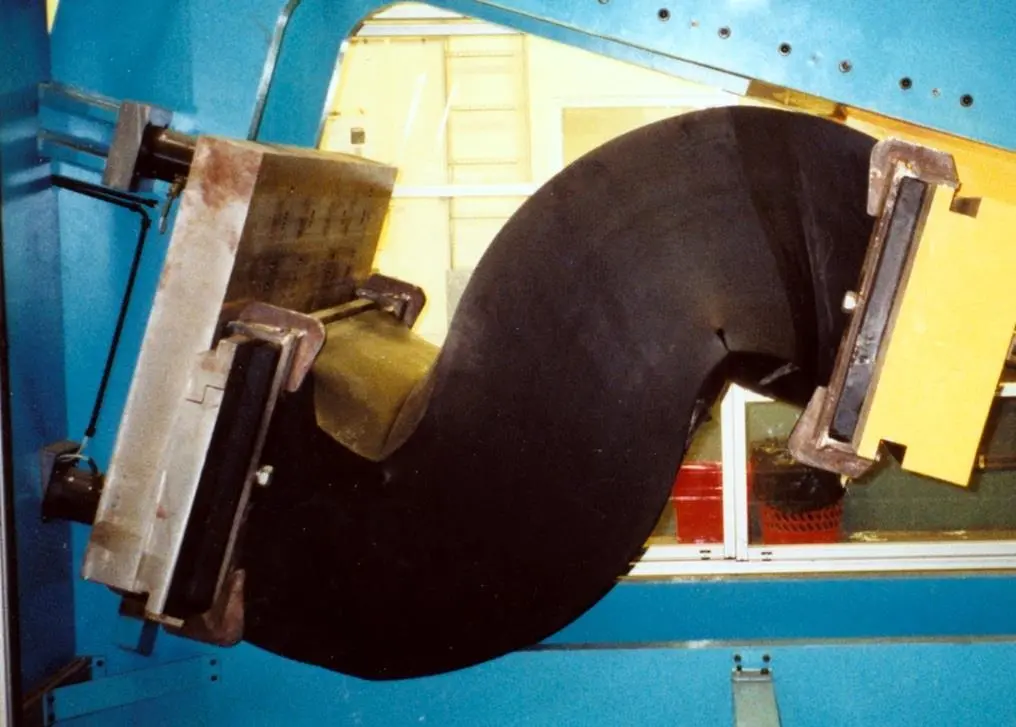
“In short, because the price of recycled rubber does not vary much over time, this is how some fender traders can undercut the manufacturers using virgin rubber and keep costs stable. On the other hand, reputable manufacturing companies use virgin rubber for its superior performance, and have to allow for the fluctuating prices of the raw materials.”
Mr Hepworth says since receiving the results from its recent market study, Trelleborg felt it was “time to put our money where our mouth is and actually demonstrate the differences between high quality and low quality fenders, which are often being represented as one and the same”.
To do this, Trelleborg took a fender made from virgin rubber, and compared it to one composed of recycled rubber. The properties of the two differed quite dramatically, as the panel shows.
The compression set test measures the ability of the rubber to return to its original state after prolonged compressive stress. The higher the compression set, the shorter the service life of the fenders. The compression set of the recycled rubber fender was higher than that of the virgin rubber, meaning that the low-cost option had a longer recovery time following compression.
Says Mr Hepworth: “The service life of a fender depends on the mechanical and physical properties of the rubber compound – usually, the higher the properties, the longer the service life. It is generally accepted, and proven, that rubber compounds with a higher percentage of recycled rubber have lower mechanical properties than compounds made with virgin rubber.
“The cost of fenders is often reduced by using a higher percentage of recycled rubber, and low cost non-reinforcing white filler in the formulation. We found that fenders with recycled rubber and filler are heavier (and denser) than virgin rubber fenders.
Heavy load
“This significant weight difference enables a user to spot whether a fender uses low-cost recycled materials, or is the genuine article, made with high-performance rubber compound, with the benefits of long life and superior resilience.”
Mr Hepworth says that manufacturers with in-house design and engineering capabilities are able to test their compounds in the laboratory and provide full scale testing on prototypes and finished products.
“It’s therefore imperative that port owners and specifiers understand the importance of not making procurement decisions purely based on up-front costs. The equipment will need to be replaced earlier, and in the long term, require heavier investment, not to mention the higher risks of failure during service life.
“Decision makers should be aware of these key differences and the varying quality on offer when buying on the basis of short-term cost savings. There is a need for the whole industry to come together to discuss changes to a culture that is causing unprecedented levels of downtime and putting ports at risk.”
Related Articles
 NEWS
NEWS
 CONTAINER & CARGO HANDLING
 OPERATIONS