


DESIGN OPTIONS STACK-UP
New design options continue to be added for RTGs and RMGs catering for diverse requirements. John Bensalhia investigates innovative product initiatives from leading manufacturers.
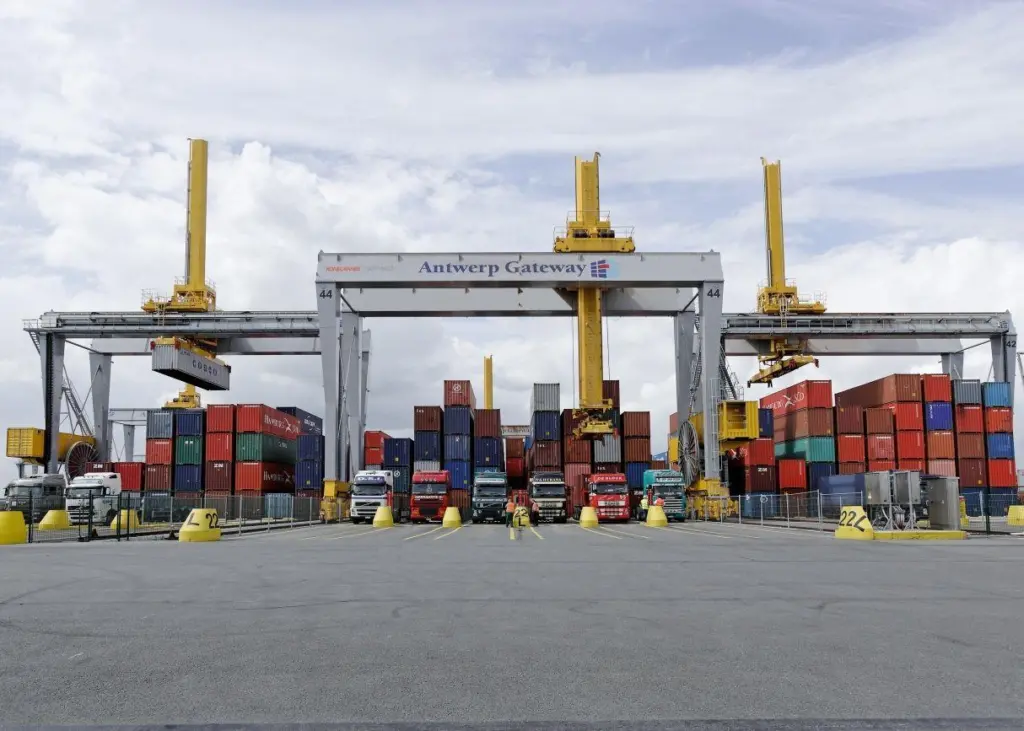
“Rubber Tyred Gantries (RTGs) and Rail Mounted Gantries (RMGs) bring increased effi ciency and stacking density to yard stacking operations when compared with straddle or reachstacker operations,” says Trevor O’Donoghue, Marketing Manager, Liebherr Container Cranes Ltd.
Marko Rasinen, Product Manager, RTGs, Kalmar, further notes that both solutions have their own unique features, benefits and disadvantages. “Overall, RMGs and RTGs allow customers to have a high stacking density without losing efficiency when stacking and horizontal transportation solutions are matched to the needs of the terminal. Both solutions are also available fully electric and help customers operate eco-efficiently.”
Rasinen says that the biggest benefit of RTGs is flexibility. Being rubber tyred, RTGs can be moved in the terminal to stacking areas where the operational requirements are paramount. He adds: “RTGs can be built with multiple power options of diesel power, hybrid and fully electric. Further, the purchase price of an RTG is lower than an RMG and it requires significantly less investment in terminal infrastructure.”
“RMGs are usually equipped with higher performance parametres for hoisting, trolley and gantry speeds, which offers higher productivities,” says Mikko Asikainen, Product Manager, RMGs, Kalmar. “The portal of an RMG can be built wider than an RTG, which is usually a maximum of 10 container rows wide. This makes an RMG a suitable machine, for example, for rail yard operation, where the crane can be built over multiple rail tracks and stacking rows,” he notes.
POWER PROVISION
In terms of efficiency and power levels for RMGs and RTGs, O’Donoghue says it depends on crane size and operation. “Some RMGs have faster hoist and gantry speeds than RTGs, which, in turn, requires higher input power. Depending on stack width, trolley speeds on RMG’s can also be higher.”
Rasinen explains that when it comes to diesel-powered equipment, much has been done to improve the energy efficiency of the cranes, introducing battery hybrid RTGs as well as RTGs with lower peak power requirements.
“Kalmar is investing heavily in optimising RTG control software to minimise the energy loss while controlling the movements of the crane,” he points out. “A good example of this is the Kalmar SmartPower RTG, equipped with an intelligent power management system, enabling a considerably smaller diesel engine and thus much lower energy consumption and emissions than with traditional RTGs.”
Kalmar’s selection of process automation solutions helps move containers more efficiently and with smaller environmental impact. “Solutions of the SmartPort product family are able to track containers and container handling equipment all the way from quay to the gate. Productivity, equipment utilisation rate and eco-efficiency are increased by optimising travel paths and waiting times by triggering dispatching and job instructions based on the location of container handling equipment,” says Asikainen.
“Typically, all yard cranes are designed for a lifetime of millions of container moves in accordance with relevant classifications, and this long lifetime is the main reasoning behind the ‘value for money’ aspect.”
LONGEVITY AND VALUE – BUT SAFETY FIRST
O’Donoghue explains that Liebherr yard stacking cranes are designed to deliver, “exceptional lifetime costs” to customers. The Liebherr drive system is based on maximum torque requirements not the average, so the machines are designed for longevity, with minimum maintenance and parts requirements.
In addition, simultaneous drive motion brings increased efficiency in container handling, allowing increased throughput. For Kalmar, the long lifetime of yard cranes is the main rationale supporting its value for money aims.
“We place special attention on the reliability of the design to minimise the downtime and need for unplanned spare part replacement needs,” says Asikainen. “This allows customers to save in operational costs during the lifetime of the equipment. Kalmar’s yard crane offering is available as a fully electric option. This can reduce the need for maintenance and thus result in lower cost of ownership compared to other options.”
Modern RMGs and RTGs are designed with safety and ease of use in mind. “Liebherr yard cranes come with many safety features,” explains O’Donoghue. “The utilisation of 3D profiling and laser scanners along with state-of-the-art positioning technologies mean safety features that prevent collisions with the stack, obstacles and with other cranes and equipment. The use of remote control and automation can remove the human element from the operational area, bringing increased safety. Controlled access to the crane and to operation of the crane adds an additional layer of safety.”
Kalmar’s yard stacking equipment has many features available to help the operator be more efficient without compromising on safety. “Everything starts from the ergonomics of the operator’s working environment, which makes a long work shift as comfortable as possible by giving good visibility to all the relevant aspects needed for operating the crane safely,” says Asikainen.
“Plus,” he says, “there are many assisting systems available to help the operator control the crane in a more efficient and safe manner. We offer driving aids like SmartRail, collision avoidance systems (SmartProfile) and gantry collision avoidance, camera systems (SmartView+) giving better visibility and improved lighting systems.”
Asikainen says that introducing automation provides the opportunity to increase safety by reducing the number of people who need to be physically present in the yard. “Controlling the cranes via a remote console means that operators can be taken out of the cabin and into a safer, more comfortable and more ergonomic working environment without compromising crane performance.”
“Our AutoRTG system is available with various levels of automation and supports the typical horizontal transport modes, such as terminal tractors and external road trucks, as well as straddle carriers,” adds Rasinen. “Kalmar can deliver new equipment that is fully automation ready and can also implement automation for RTGs on both Kalmar and thirdparty cranes as a retrofit project.”
Kalmar is investing in developing electric, diesel-electric and hybrid solutions for heavy cargo-handling equipment, with all cranes available as fully electric for the customers who are able to feed the cranes from the grid, and hybrid and latest engine technologies for the customers who cannot use the power grid.
“All Kalmar RMGs are electric with deceleration energy harvesting as standard feature,” says Asikainen. “Together with modern electric system components and energy-conscious control system the energy consumption is minimised.”
PROMISING OUTLOOK
The crane business is not totally immune to COVID-19, but manufacturers remain upbeat and positive. “We think 2021 is looking promising, but many customers are still, of course, rather careful when it comes to new terminal development projects,” says Rasinen.
He also notes: “The increase in automation is the future for terminals while they continuously improve the efficiency, safety and sustainability of operations. Equally, the importance of new eco-efficient technologies is increasing.”
While COVID-19 may delay some projects due to a cautious business environment, O’Donoghue feels a sense of optimism for the future exists. “Global container traffic is running at a high level and forecasts are for significant global GDP growth in 2021/2022,” he notes.
New orders on the move
In December 2020, a 34-strong fleet order of automated Konecranes Gottwald ARMG’s for DP World Antwerp Gateway was confirmed. The units will be delivered in phases, with the first batch due for delivery in Q2 2022, concluding with the final delivery in 2026.
Automation expansion was the motivation for choosing the units. The terminal’s current ASC (Automation Systems & Controls) concept is to be expanded, with the new ASC system order following Gottwald’s ARMG design concept (including a rigid guiding beam for container load control). The new ARMG’s are capable of stacking containers one-over-six, over nine container rows.
The move to mains power connections and hybrid technologies eliminates/ reduces emissions. “Liebherr drive systems are specifically designed to bring further benefits in terms of fuel consumption,” says O’Donoghue.
“(Electric) ERTGs and RMGs allow regenerated electricity to be supplied back to the grid, with the Liebherr Liduro Energy Storage able to store and reuse energy locally. The elimination of hydraulics on Liebherr yard cranes brings further environmental benefits and reduced maintenance.”
Konecranes Hybrid RTGs run on electrical power from a battery and diesel generator with power from the battery during normal use and parallel power drawn from battery and generator during peak use.
In December 2020, US railroad operator, Norfolk Southern Corporation confirmed two units (due for delivery in December 2021) will be used at the Landers Yard intermodal terminal, Chicago, with a further three for the Inman Yard intermodal terminal in Atlanta.
Also, ZPMC has confirmed two new rail-mounted RMGs for Vostochnaya Stevedoring Company, as part of a doubling of container area capacity. The new cranes serve 14-rows of container stacks and have a six-tier capacity.
Related Articles
 NEWS
NEWS
 CONTAINER & CARGO HANDLING
 OPERATIONS