Hamburg has taken up a characteristically individual position to the recession.
But this in itself isn’t new: in 2002 the port decided against being part of the deep-water JadeWeserPort project in Wilhelmshaven, and instead to develop competitive facilities for super-sized ships and supporting network – probably feeling that it would be better not to collaborate in undermining it’s own base.
However, it is not despite, but because of the worldwide slippage that the Port of Hamburg is still funnelling precious euros into development.
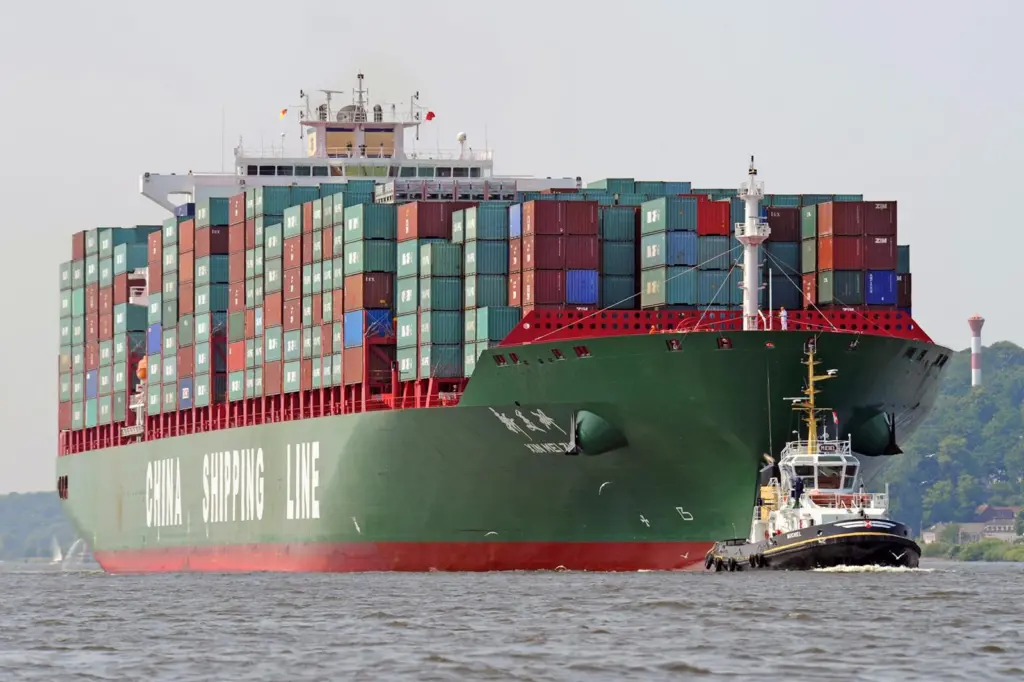
The port is shaping up plans to have the Lower and Outer Elbe navigation channels adapted to allow container ships with a draught of 14.5 metres (with the tide) to reach the port from the North Sea.
The rationale behind developing this stretch in the middle of a recession, according to the Hamburg senator for economics Axel Gedaschko, is simply that the economic crisis will actually encourage the use of particularly large ships.
He goes on to say that this is already a discernable trend. “On the main routes between Asia, Europe and America we are currently experiencing the decommissioning of ‘smaller’ ships as a direct reaction to lower freight volumes. To the extent possible, freight is being transferred to the large, state-of-the-art ships.
“This is exactly the reason why rapid implementation of the planned adaptation of the Elbe fairway is all the more urgent. This is about preventing a crisis; about a national duty and about the sustainability of Germany’s largest maritime port. We have to do whatever it takes.”
It can’t be avoided that behind this is also the looming development of JadeWeserPort, due to become operational 2010/11. The plans are that JWP will sit on a 120ha terminal area with 1,725m of quay, a 170ha logistics zone and a 700 metre turning area suitable for the largest container ships.
But overall, it is the fact that JWP has a direct approach channel with a water depth of 16.5 metres irrespective of tidal constraints, that lends it to the handling “the super-carriers of the future,” explains Lower Saxony’s Minister of Economics Walter Hirche, with a passion equal to that of his Hamburg counterpart.
However, Bengt van Beuningen of the Port of Hamburg sounds robust in the face of the threat, saying that the established port has a geographical advantage. “Hamburg offers the shortest distances in hinterland transport to our major market regions as the Eastern European states, Russia, Scandinavia.” Bearing this out there are around 200 container trains daily in and out of the port, and its link with the inland waterway network is growing as the number of container consignments being handled onward from Hamburg by inland waterway vessels increases.
It is this last point that makes for interest. Although the wild success of container transport in 2008 pushed the waterway hinterland transport up by 29% to 119,000 teu, it is worthwhile noting that despite the container’s fall from grace, Hamburg still notes a rise in the market share. While general waterway transport figures turned down by 1.6% in Germany as a whole, Hamburg’s rose by 1.5% on the previous year. And this is despite local ‘difficulties’ like sedimentation and water level drops on certain parts of the Elbe.
In fact, Hamburg’s Sebastian Doderer tells Port Strategy, the Elbe which runs from the port all the way into the Czech Republic, is now the subject of investment. It has, over the last few years, been put to work with the Czech Ports of Decin, Litomerice and Usti nad Labem being called at regularly. “Extension measures planned by both German and Czech governments will enhance the river’s capacity for the future,” he adds.
Further, the ‘cluster’ effect from a large, globally connected port has a positive effect on the inland ports along the rivers and the north German canal network, says the Hamburg port.
To return to the JadeWeserPort project at Wilhelmshaven, while it has sparked governmental debate, it is a bit late for the ports already caught in the coming squeeze.
But the nature of the competition is complicated – Roman Poersch, senior advisor for BMT Transport Solutions says that, for example, since the new port will be run by some of the same people who have an interest in Bremerhaven (Eurogate and APM own Eurogate Wilhelmshaven on a 70%-30% split) they will not want to see their other investments suffer.
Other places, like Kiel, are hoping that once on the map, the ships will continue to come in. The port is growing its Baltic connections through a recent – and unusual – link into the container handling of ferroalloys.
The aim is to turn round 10,000 teu – some of which will need sorting in the Ostuferhafen warehouses before rail loading – in the first year. So it may be that the ‘value added’ services will keep smaller ports running through the difficult times.
Although as BMT’s Mr Poersch says, the shipping lines are the ones who will ultimately decide where they go; but the larger ports can “exert some pull” if cargo is either destined for their region or they have some influence on the transport feeder chains that can be steered their way.