Despite worldwide financial stringency, coupled with investors and accountants scrutinising capital cost savings ever more closely, ports are not falling into the trap of short term easy, cheap solutions at the expense of later problems.
For a start, the long-standing debate about the virtues of buying new equipment versus used is largely on the side of the former. “Remember that new comes with much longer warranties”, says Martin Blaiklock, a financial consultant on infrastructure and energy projects. “With second-hand items, there could be some refurbishment and a manufacturer might add a warranty, but it will never be as comprehensive or long as a new warranty.”
Says Jeannie Beckett, principal of The Beckett Group: “The larger, more profitable ports and companies usually prefer to buy new, due to the fact that they can make sure the equipment first meets their specific specifications and because the equipment has the most current energy efficient/savings technology. Smaller ports will buy used equipment especially if they are entering a new product market such as breakbulk, heavylifts, etc.”
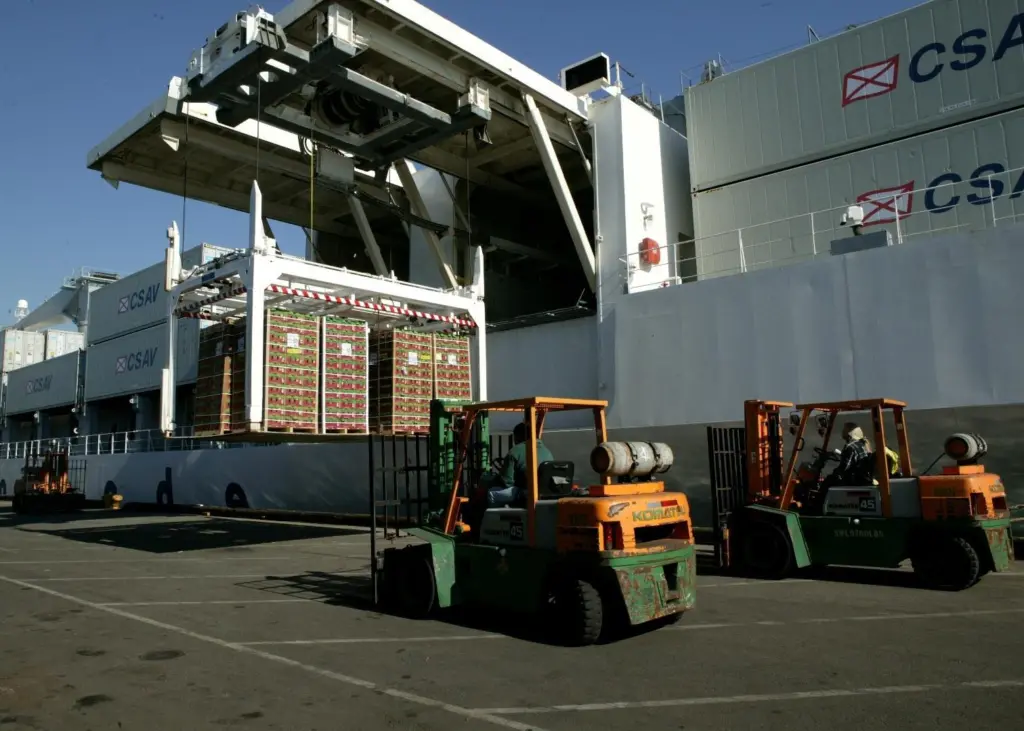
Large ports and operators agree. At the Port of Los Angeles (a tenant/landlord business model), Tim Clark, responsible for purchasing in the construction and maintenance division, says the emphasis is on new for the inventory of more than 700 vehicles and machines. “We almost always buy new, because of the inherent advantages. Only in exceptional cases do we go for used – we recently bought a barge for maintenance work around the terminals such as pile driving and this save us a couple of hundred thousand dollars. But when it comes to really important items we will go for new.”
Get what you pay for
Montreal Gateway Terminals chief executive Kevin Doherty says new is definitely preferable and brings out the analogy that is often applied to buying used private vehicles: “You are just buying someone else’s problems.” He also emphasises the need to keep meticulous maintenance records to make sure equipment stays up to scratch.
One reward for this has been the lease of gantry cranes to Quebec City, which are now 30 years old and still going strong.
In general, outright purchase is favoured over leasing. “Buying gives you a better deal,” says Mr Doherty. “With leasing you pay an interest rate.” Mr Blaiklock notes that smaller ports often plump for leasing when less costly equipment, such as RTGs, is involved.
“Leasing conditions vary according to tax changes,” he says. “Leasing is a tax-based system, whereas with new equipment you can claim depreciation.”
Says Ms Beckett: “Sometimes, in the US there are local economic development funds available for a buy, lease back option. Each piece of equipment purchase will be analysed by the financial people within the organisation to see which financing method is best.” If a port or operator issues bonds to pay for a number of projects, “they will probably throw the equipment into the terminal financing package.”
Tough negotiators
For the priciest items of all, cranes, ports universally are able to negotiate payment terms with the suppliers. And though it might seem obvious, the industry warns against repayment times that last longer than the written down, depreciated value of the cranes.
Industry insiders urge port managers to pay particular attention to negotiations on the most expensive capital items, as a wide range of repayment terms is available. “Remember that capital financing is a huge business in its own right,” says Mr Blaiklock. “As an example, GE Finance is bigger than GE manufacturing.”
Adds Ms Beckett: ”Since cranes last 20-30 years with only minimal capital maintenance, those that can afford to get the newest and best will try to go in that direction.”
The general depreciation timeline is 20 to 25 years for cranes, 10 years for vehicles and anything from 5-15 years for RTGs. They can last up to 20 years in exceptional cases. Montreal has a rotation policy after 15 years, while Los Angeles has a replacement policy of 10 years or 160,000 km for its on-road vehicles.
Purchasing policies vary between open, competitive bidding and selected tender. Los Angeles is bound by legal requirements to go out to public tender for almost all purchases, whereas Montreal is able to be selective. “Because of the nature of our business and the type of port, there are only a limited number of suppliers who can supply or needs,” says Mr Doherty.
Take your time
Adds Ms Beckett: “Timing is everything on getting a great price. There is no right or wrong way. It all depends on the market, the availability of the manufactures to meet your time requirements, the quality and experience others have had with a particular manufacturer, how many pieces of equipment are being purchased, the ability to get options for future purchases, if you currently have a piece of equipment that is working well for you and want additional pieces of that same model, how experienced your maintenance crew is, whether the equipment is going into a new facility or being added to a current facility, the rate of exchange, the economy, etc.
“Depending on the funding sources, I believe most ports/terminal operators will look for the best return on investment for their purchases.” Ms Beckett says some of the most important factors to be considered are initial cost outlay, anticipated upgrades during the life of the asset, estimates of annual maintenance costs, current technology and whether that technology is upgradeable.
Mr Blaiklock notes that ports consist of 80% fixed assets such as wharves and jetties and 20% of equipment. He says investors and operators look to governments and local authorities to provide the fixed assets at container ports, whereas specialised operators such as bulk and liquid terminals are often financed by mining and oil companies.
As they shell out cashflow on ever more expensive equipment, ports realise that their bottom line will be healthier if they take sensible, long-term decisions on purchasing.