If everyone wears the same hat, then no one stands out from the crowd. If every port has a special zone offering a package of operational, customs and fiscal benefits, what then? Are all ports equal or are some ports more equal than others?
Among announcements in the past few weeks, it’s been confirmed that two of India’s state-owned ports, Jawaharlal Nehru and Kandla, are to go down the special economic zone (SEZ) route in an attempt to boost cargo volumes and add to revenue. The Port of Kaohsiung has officially opened Anping Free Trade Port – this will be the seventh free trade zone (FTZ) in Taiwan alone.
And attention was drawn to the Chinese government’s FTZ pilot project in Shanghai, which is expected to extend to other ports, when the European Community Shipowners’ Associations protested at the fact that only Chinese-owned vessels are permitted to transport international cargo between Chinese ports. The Shanghai FTZ is planned to offer a package of benefits including a tax-free, tariff-free framework and currency liberalisation.
“If you start looking around, you will see them everywhere,” says Dean Davison, principle consultant at Ocean Shipping Consultants. “China is an obvious place where they are springing up – but Turkey is also proving to be popular, and so is the Caribbean. We hear of FTZ activities in the established northwest US ports, and we also hear of new developments in Africa.
“Essentially, I think the general principals are accepted to be the same – trying to entice more cargo in, increase trade and business, and encourage job creation. It doesn’t matter whether it’s an established economy or an emerging economy – they are all looking to do this. You could say you have to be in it to win it but if everyone has got one, do the advantages slightly diminish?”
Mr Davison says that in the end it is back to basic truths. “If every port brings in the biggest cranes and the biggest ships, then in theory they can all do the same. But I am sure service, prices, the local-level relationships that are built and the quality of facilities offered will dictate who goes where.”
Transhipment help
Providing advantages such as deferring customs duties and other charges can help a port to differentiate itself, particularly in a very competitive region, says Mr Davison. Equally, having a SEZ or FTZ can help a transhipment port, notoriously vulnerable to shipping lines hopping from hub to hub. “If you are handling transhipment cargo, that generally means you haven’t got local cargo to handle,” he says. “So if you can bring in cargo, do some manufacturing or added value work and then re-export the cargo, without any customs duties, this helps to boost cargo and anchor the services. The thing that will probably entice the shipping line is still going to be offering all the right services and performance – but this could be one of the additional value propositions.”
Jawaharlal Nehru Port, south Asia’s largest container hub, actually recorded an overall 2.3% fall in volumes last year. The drop was put down to labour and trailer-related issues, the impact of changes to India’s tariff policy, and the diversion of some cargo because of delays in JNP’s expansion. A fourth terminal is on the way and clearly if an SEZ can deliver higher volumes then they would be welcome.
But here’s a question that might not be easy to answer, in many cases. “The one thing that’s difficult to pinpoint is how much does a SEZ or FTZ actually bring in, in terms of additional cargo,” says Mr Davison. “Is it cargo that would have gone through the port anyway?”
Neil Davidson, senior analyst – ports and terminals, at Drewry says that while SEZs and FTZs have the same basic aim, few succeed and most don’t.
“People make the mistake of thinking that making somewhere a SEZ or FTZ is a magic wand,” he says. “The reality is that a whole lot of factors have to line up for success and if the port is already a successful one – high degree of connectivity, critical mass, etc. – that helps even more.
“I am always of the view that SEZs and FTZs are about much more than the port they are in or next to. Their success is driven by much higher level macro factors like the cost of labour, land and energy, and also the legal, commercial and political environment.”
Basic factors
He says that regardless of location there are certain basic factors that a free zone must possess in order to succeed. There may well be several free zones in the region already, providing competition for an existing or proposed facility. “The key point in this case is the degree to which the proposed facility can differentiate itself from others. The intention to concentrate on certain trades and activities is one positive feature, especially if the range of commodities targeted do not seem to be targeted by others in the region. Having simpler paperwork and less bureaucracy is another means of enhancing competitive advantage.”
His analysis came up with five parameters against which any new development or expansion can be measured: cargo base and shipping services; fiscal benefits and incentives; management/administration/marketing; price and quality of facilities and labour; and the wider business equation.
“The attractiveness of the free zone fiscal regime is vitally important, and is something largely determined by the zone’s governing state. Different countries offer different commercial advantages in these zones, some more attractive than others. Naturally, every free zone offers suspension of import duties and taxes on goods, although not all offer advantages such as freedom from corporation tax, investment incentives and the ability to repatriate profits and capital.”
Suspension of duties on goods offers cash flow benefits but the other incentives can offer cash savings – two very different things, he points out. Such savings can offset any possible extra costs coming from intermediate handling.
Political and commercial stability is also vital in ensuring confidence, says Mr Davidson. Investors will be wary if there is a feeling that the fiscal regime could be changed for the worse.
It’s also important to make comparisons – and that includes checking out the non-free zone competition. “Other ports may have good facilities available at attractive prices, and free zone status alone may not be enough to make cargo switch ports, unless all other things are equal. There may also be alternative means of deferring import duties under the customs legislation of a country, for example by bonding – so that some free zone type benefits can be gained anyway.”
Jafza remains the flagship
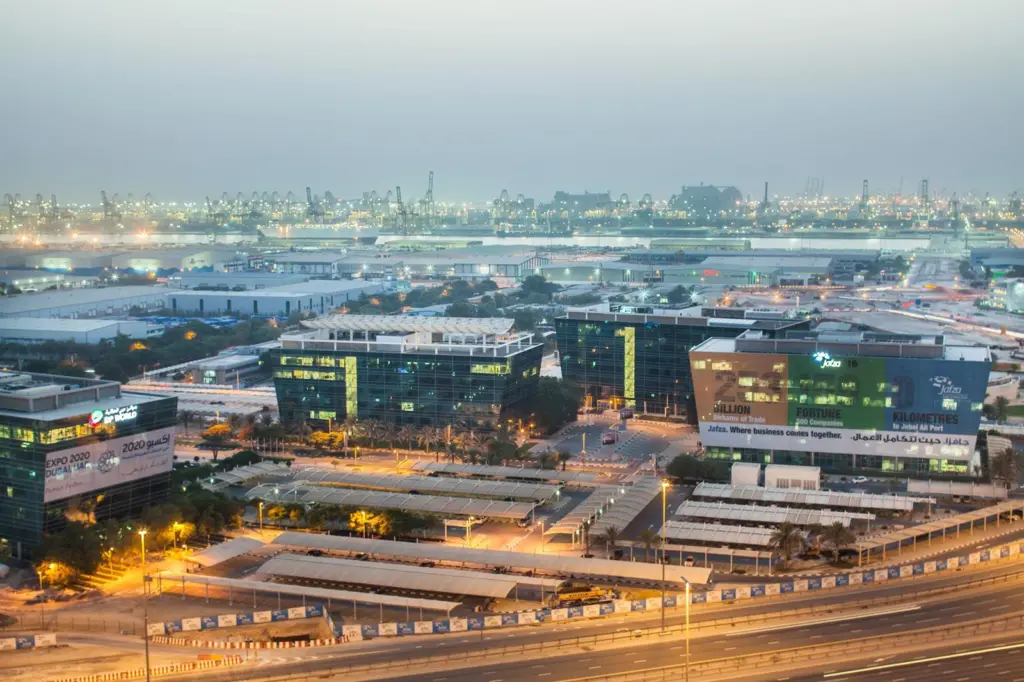
The world’s flagship in terms of FTZs and SEZs is generally recognised as Jebel Ali Free Zone (Jafza) – which just keeps on growing. “Jebel Ali is the one everyone tries to replicate. It is huge, phenomenal – the one that everyone looks to and aspires to,” says Dean Davison.
Jafza is spread over 57 sq km on both sides of the Sheikh Zayed Road – the north zone next to Jebel Ali Port, the south zone alongside Al Maktoum International Airport. More than 7,300 companies from 120 countries, including 120 of the Fortune Global 500 enterprises, currently operate out of Jafza. Oil & gas, automotive and IT are some of the biggest industry sectors represented.
Last year, total trade generated by Jafza-based companies amounted to $90.2bn. Jafza-based companies employ more than 135,000 people – roughly one in 16 of Dubai’s residents.
“There is ample space available for new companies, as Jafza offers a variety of solutions, from desk space to plots of land to completely custom-built warehouses and office facilities,” says a spokesman. “Recently Jafza has also marked out land for specialised zones, such as the Halal Zone, with infrastructure and facilities suitable for companies dealing in the production of Halal products.
“Jafza’s multimodal connectivity to a market of more than two billion consumers in the greater MENA region, through Jebel Ali Port, Dubai International and Al Maktoum International airports, an extensive road network and the upcoming Ittehad Rail network are among the key reasons global brands choose Jafza as their base of operations in the Middle East.”
A hassle-free business environment where companies focus on their growth is also important, he says. “Jafza’s success is built on its uncompromising focus on customer service. Its world-class infrastructure, facilities, products and services are all designed with the current and future needs of customers in mind. Another factor which gives Jafza the edge is the ability to quickly act upon opportunities.”
Jafza runs industry-specific forums to maintain communication with its customers and provide a platform for discussing global trends and opportunities.
It is also continuously investing in infrastructure. It has recently opened a 16-lane gate and a new flyover within the zone to ensure smoother traffic flow. A Dh2.5bn office complex and convention centre, Jafza One, is being developed and will include a four-star hotel.