
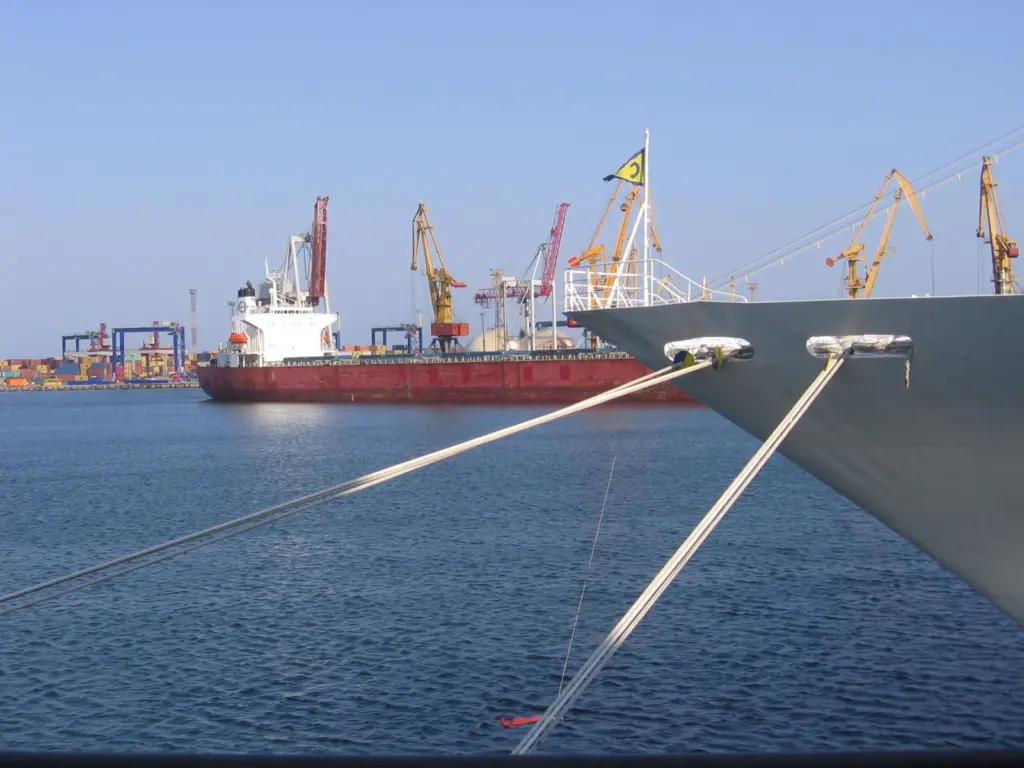
In the dry bulk shipping business, the grain trade is very much the little brother of coal and iron, at least in volume terms. But grain, being more valuable per tonne and more fragile than industrial bulks, is both attractive to terminal operators and requires more careful handling. Moreover, demand for international shipments from key origin regions continues to accelerate, prompting growing investment in new port facilities.
Record harvests and swelling demand from Asia have seen exports of grains from the Black Sea and South America boom in recent years, a trend aided by low cost inputs for producers and helpfully bearish ocean freight rates which have boosted their competitiveness against geographically better placed suppliers such as Australia. However, port and hinterland capacity has struggled to keep pace.
At the start of April, for example, bulk carrier operators and exporters were weighing up the costs of the lengthy delays suffered at terminals in Brazil. At the port of Santos alone almost 80 vessels were queuing to load grains, with the waiting time at one terminal stretching to 19 days in the first week of the month, according to Alphamar Agencia Maritima (AAM), a Brazilian bulk cargo port and agency specialist.
In Brazil, the main reason for delays has been the stark rise in exported maize and soybean volumes which have risen from a combined total of almost 55m tonnes in the 2011/12 season to an estimated 81m tonnes in 2016-17. Understandably, after such a steep rate of acceleration, port investors have been left playing catch-up.
Brazil’s grain terminals are not alone in struggling to deal with snowballing demand for elevator capacity during peak export seasons. After five years of rapid expansion, Black Sea exporters – Russia, Ukraine and Kazakhstan – now account for some 20% of global grain exports. Ukraine increased exports from 21.9m tonnes in 2012 to 40.3m tonnes last year, according to UkrAgroConsult. Russia increased its exports from 16.3m tonnes to 37.2m tonnes over the same period, while Kazakhstan’s exports rose from 5.6m tonnes to 8.8m tonnes. Although port capacity has been expanded, delays at terminals are common during the peak season.
South American and Black Sea exporters are also looking to further expand exports as demand from Asia and Africa is forecast to continue to grow. AAM believes Brazil’s exports of maize, soybeans and soybean meal could be boosted by a further 34m tonnes in the next ten years. However, for Brazil to realize its full export potential, studies by the Chamber of Transport estimate that upwards of $200bn of investment in transport infrastructure and superstructure will be required. Leandro Pierbattisti, Federation of Elevators Association of Argentina, says his country’s grain producers face similar port access issues. He says the government of Argentina is planning to make substantial investments in logistics including investing some $11bn on upgrading the sea port access system.
Making progress
Some progress is already being made at Brazil’s ports. Delays at the turn of the year at key export hubs such as Santos and Paranagua were far lower than in previous years, in part because of capacity upgrades and more in the pipeline. At Santos, for example, heavy investment by Tiplam saw two new berths open in January. Together, the berths are projected to add some five million tonnes of grains and four-and-a-half million tonnes of sugar capacity to the port’s total handling ability.
There are also designs under consideration for the channelisation of the Juruena, Teles Pires and Tapajós rivers. This would create a 1,000-mile industrial waterway which would allow soybeans and other crops from the Mato Grosso region to be containerised and transported by barge downstream all the way to the Atlantic, a development that would increase the need for river port facilities along the way. Other port projects under development include the expansion of the port Miritituba to take capacity to 32m tonnes of grain per year by 2026.
However, David Ross, general manager of AAM, tells Port Strategy that Brazil’s efforts to boost exports would only be realised if both port and hinterland capacity were expanded. In particular, he said that at present poor inland logistics systems was rendering many Brazilian exporters less competitive than rivals from the US, able to use relatively cheap rail and barge systems, or those in Argentina which benefit from being far closer to ports then their Brazilian peers.
“If we were able to rely more on rail and waterway transport, thus bringing the transhipment terminal closer to the origination areas, we would be able to reduce the overall FOB [Free On Board] price and in turn become more competitive in the international market,” says Mr Ross. “There are currently ongoing improvements to the current road systems along with a new rail concession called Ferrograo, which is expected to be awarded later this year.”
He also says a number of private investors are now looking at how to boost inland port capacity and the national barge fleet. “Without a reliable means to transport the cargo from transhipment terminals in Miritituba, the many private companies who have already invested in elevation assets or are currently investing in elevation assets in the ports of Santarem, Barcarena and Santana will not be able to realise their full capacity,” he adds.
“If our inland logistics do not improve it makes our grain exports more costly and less competitive in the global market.”
Building capacity
In the Black Sea, improving yields and limited growth in domestic consumption are also expected to lead to higher exports in the coming years. Leonid Kozachenko, Ukrainian People’s deputy, says Ukraine alone could double or triple its exports in the years ahead but some $65bn-70bn would need to be invested in production, hinterland access and ports to handle the extra cargo.
Elizaveta Malyshko, a grain analyst at UkrAgroConsult, adds that both Russia and Ukraine have expanded grain handling capacity significantly over 2010-17. The top Russian grain port is Novorossiysk, which currently loads more than one-third of export grains each year. Another third is accounted for by smaller ports in the Azov and Black Sea basins, followed by the ports of Kavkaz and Taman which each tranship 9%-10% of exports. “Also, there are a number of potential projects for building grain terminals in Russia’s Far East,” says Maksym Kharchenko, a logistics market analyst at UkrAgroConsult. “ These include a 10m tonne capacity per annum terminal in Zarubino and a project of Agrarian holding LLC Saho Company Group and Mitsui & Co for the construction of a 1.5m tonne capacity terminal in Vladivostok.”
In Ukraine, the main terminals used for grain exports are located at the ports of Mykolaiv, Chornomorsk, Yuzhny and Odesa. UkrAgroConsult estimates grain handling capacity at Ukrainian ports at around 64m tonnes per annum, a total that includes Crimean ports currently under Russian control after the region was annexed in 2014.
“As many as three large grain terminals were launched in 2016: COFCO in Mykolaiv with a capacity of 2.5m tonnes, Bunge with 1m tonnes, and Risoil in Chornomorsk with 2.2m tonnes capacity,” says Ms Malyshko. “To date, a few companies, including Allseeds, Cargill, Soufflé, NHC, Kernel, SFGCU, Mariupol and Berdyansk commercial sea ports have declared intent to build new grain-handling facilities in Ukraine’s sea ports.
“This year, Novotech-Terminal Company kicks off the implementation of its 3m tonnes capacity grain terminal project in Odesa. MetalsUkraine Company is also planning to construct a 4m tonnes capacity grain terminal in the same port.
“If all are implemented, the declared projects may add 29.6m tonnes of capacity to the theoretical grain handling capacity of Ukrainian ports by 2020. Some of these projects have not yet left the ‘paper stage’, but it can be stated already now that, if the projects under construction are realised, there will be enough capacities toward 2020 for servicing the highest forecast grain export volumes.”
Indeed, adds Ms Malyshko, if all the current new port development plans in Russia and Ukraine became reality, demand for new capacity would recede unless production and export expansion beyond current forecasts were recede. “Most likely, after the commissioning of these facilities, interest in building transhipment capacities will begin to fade,” she says. “In the future, it will be more likely to expand existing capacities than to build new facilities.”