





BATTLING COVID HEADWINDS
For the cruise sector COVID-19 is a catastrophe. It has effectively stopped the industry in its tracks and big questions remain about how and when it will be able to get back to work
The cruise industry is big business. Globally, the number of passengers has grown year-on-year by an average of 7.5 per cent since 2000 with the industry body Cruise Lines International Association (CLIA) reporting a total of 28.5 million passengers in 2018. No surprise that for many ports the cruise industry is a vital component of revenue and ship calls.
The North American segment, which includes the Caribbean region, currently accounts for a market share of 49.9 per cent – equivalent to more than 14.2 million passengers.
But then the COVID-19 pandemic struck and the entire industry went into lockdown with all cruise vessels laid up in diverse locations. The key question is, of course, when will the industry re-open for business?
For North America, the end of July 2020 marked the first US-based cruise ship setting sail since March. UnCruise Adventures, a small expedition cruise line specialising in what it calls “intimate sailings” left on a round-trip from Juneau with 37 passengers (out of a total capacity of 60) and 30 crew. Four additional sailings are planned, if the initial trip is successful.
Social distancing measures are being maintained at all times, additional health checks are undertaken, and selfservice buffets are no longer offered. Operators are generally cautiously optimistic of seeing additional sailings.
WHAT ABOUT THE HEARTLAND?
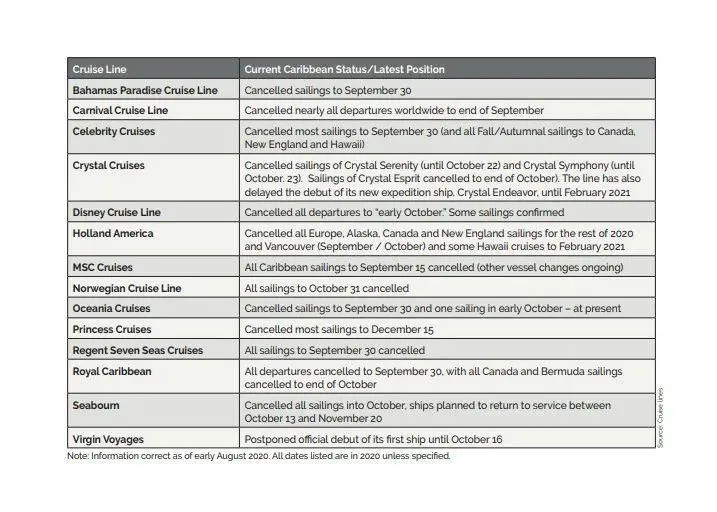
So, what about the Caribbean region – the traditional heartland of cruise operations? Well, Port Strategy contacted a range of operators who service this region and while there remains a clear desire not to be named, the overall position of these service providers can be outlined based on the feedback obtained.
Table 1 summarises the current position of a range of different operators. The Caribbean region is faring no better or worse than other regions where cruise vessels operate allied to North America.
The extent of the damage to the respective businesses of cruise ship operators is plain to see – it is no exaggeration to say that COVID-19 represents the biggest challenge the industry has faced to-date.
Equally, it is a big challenge for both the homeports and destination ports at which cruise lines call in terms of front-line port activities and the wider economic impact delivered by cruise passengers.
It varies from case-to-case but it is clear that with a number of the island economies in the Caribbean heavily dependent on cruise related business these cruise centres are being hit hard with fundamental structural damage expected.
Nevertheless, the lack of cruise ship sailings and port calls does not mean there has not been any positive activity in the sector or confidence expressed in the future.
Notably, Royal Caribbean Group, with its new name adopted from July 30, 2020, has acquired the remaining 33 per cent of ultra-luxury brand Silversea Cruises, following on from its original buy-in.
The Silversea fleet currently comprises eight vessels, with a total capacity of 2,450 occupants and a total of 300 berths confirmed. Five more ships are scheduled to be delivered in the next four years.
Richard Fain, Chief Executive Officer, Royal Caribbean Group, is in no doubt about the value of the investment. He notes: “Silversea is the crown jewel and the acknowledged leader in luxury and expedition cruising – two key markets that are poised for growth.”
He adds: “Uniting our two companies presents an extraordinary opportunity to expand vacation options for guests and create revenue in strategic growth areas.”
PORT PAIN WIDESPREAD
Such bright spots are, however, not the norm particularly from a port perspective. Moses Kirkconnell, Tourism Minister, Cayman Islands, reports that the Cayman Islands will be closed to cruise ships through to September 2020, if not longer. “I don’t think that we’re going to see cruise vessels back in Grand Cayman in the third quarter or fourth quarter, to be quite honest,” he confirmed in July 2020.
The Cayman Islands was one of the first cruise port locations to close to cruise ships in February 2020. The port of George Town appears in western Caribbean schedules, with calls from Carnival, Royal Caribbean Group, MSC Cruises, Princess Cruises, Norwegian, Celebrity Cruises and Disney Cruise Line.
In the Bahamas, the Nassau Cruise Port is expecting to close out 2020 with just 38 per cent of the activity recorded in 2019, although this is still dependent on securing 635,000 cruise passengers in Q4 2020.
In a cruise webinar at the end of July 2020, Mike Maura, Chief Executive Officer, Nassau Cruise Port, stated he expected to see 1.47 million arrivals for 2020. “Through midMarch we had already handled 835,000 cruise passengers. We didn’t anticipate any cruise passengers from April 1st until September 30th. We believe that it will be the fourth quarter of 2020 when cruise ships return,” he said.
Maura also does not expect a full rebound next year. “In 2021, we are still considerably less than 2019 numbers at about 2.6 million. These are just forecasts, our best guess in terms of what we see happening,” he explains.
He further highlights his belief that the cruise industry may have to consider a phased reopening, a scenario that he expects to play out in The Bahamas.
“In phase one we see a conservative return to the market where cruise lines reach out to excursions and tour operators asking about health and safety protocols. You have to bring confidence to the industry that you are doing everything reasonably required to protect yourself and your customer,” Maura underlines.
Barbados is a major homeport and cruise destination in the Eastern Caribbean and has traditionally enjoyed good support from UK, European and North American cruise passengers but with COVID-19 now getting a grip in the eastern Caribbean this is another cruise centre that does not expect to see the return of comprehensive cruise operations soon.
Equally, it is a prime example of how this reality is day by day eating away at economic fundamentals. The Central Bank of Barbados is predicting a record double-digit decline of up to 13 per cent in economic activity this year. Significantly, the Bank reports that the overall decline, reported as of early May, has been driven largely by the sharp reduction in tourism and related activities during the second half of March. Tourism contracted by 16.2 per cent, the result of a 17.9 per cent decline in long-stay visitors and 11.5 per cent in cruise passengers during the period.
WHAT NEXT?
The base reality is that the impact of COVID-19 already means that the number of people able, or prepared, to book a luxury cruise will be much more limited, while convincing ships’ crew to return after a lengthy repatriation process will also be a challenge.
The major concern for the cruise business everywhere is the fear of COVID-19 continuing to exert its influence. And the signs are not good. At the start of August, one suspected case was detected.
Norwegian cruise operator, Hurtigruten, has confirmed 36 crew members aboard the Roald Amundsen tested positive for COVID-19, along with five passengers. All planned expedition cruises are cancelled until further notice.
The outlook for the cruise sector – in the Caribbean and elsewhere – personifies the prevailing situation in many sectors of industry business. There is no realistic prospect over the short-term of returning to the way things were prior to COVID-19.
Related Articles
 BULK HANDLING
 BULK HANDLING
 BULK HANDLING