


Oakland Port reports cleaner electricity supply
The Port of Oakland has reported 84% renewable and zero-carbon electricity, helping meet ambitious emissions reduction targets
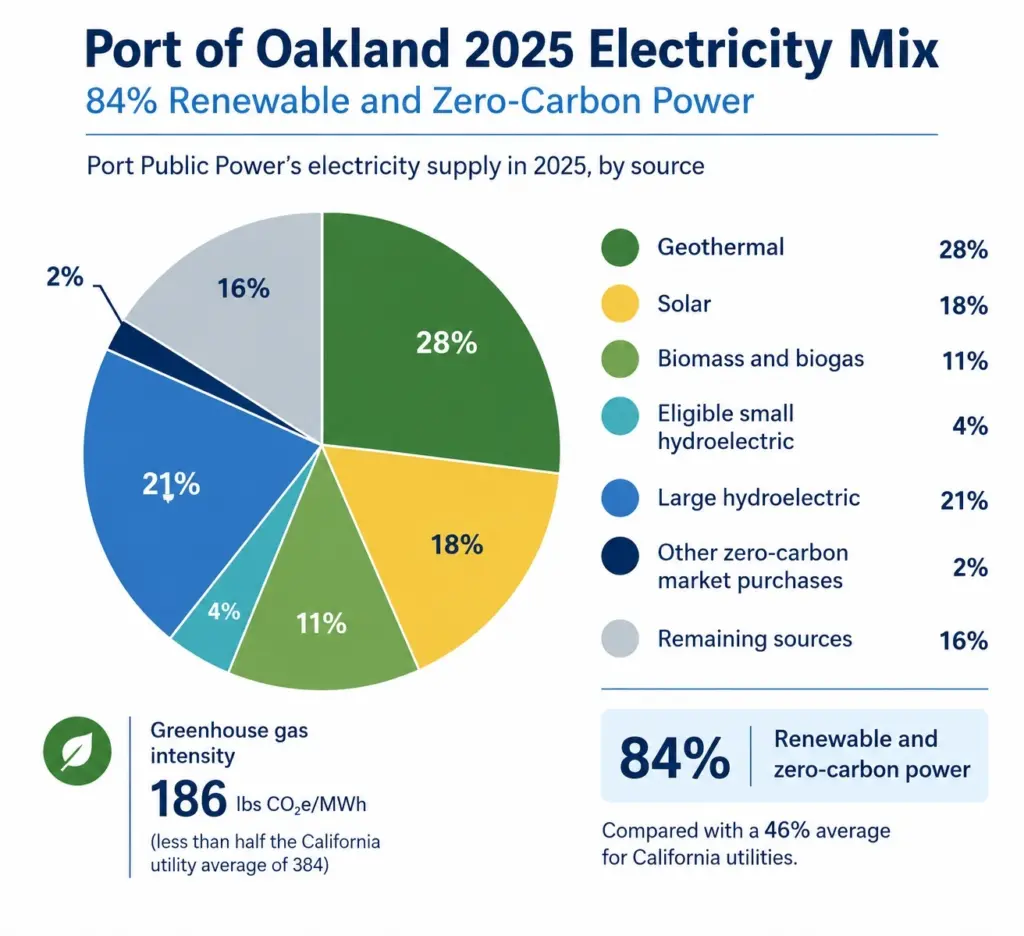
The Port of Oakland has announced that 84% of the electricity supplied to its tenants and facilities in 2025 came from renewable and zero-carbon sources, strengthening its efforts to reduce emissions as port operations increasingly transition to electric power.
The Port’s board of commissioners approved its annual Power Source Disclosure Report and Power Content Label for submission to the California Energy Commission at its meeting on 22 October. The figures also show that the electricity supply generated less than half the greenhouse gas emissions of the average California utility.
Andre Basler, director of utilities at the Port of Oakland, said: “Every year, more of the port runs on electricity, and our job is to make sure that electricity is clean, reliable and affordable. Delivering 84% renewable and zero carbon power means that as our tenants electrify their trucks, equipment, and operations, they are moving onto one of the cleanest power supplies in California.”
Renewable resources accounted for 61% of Port Public Power’s electricity supply, compared with the statewide utility average of 46%. Geothermal energy was the largest renewable contributor, followed by solar, biomass and biogas, and eligible small hydroelectric power.
A further 21% came from large hydroelectric power, with other zero-carbon market purchases bringing the combined renewable and zero-carbon share to 84%.
The electricity supply recorded greenhouse gas intensity of 186 pounds (about 84 kg) of carbon dioxide equivalent per megawatt-hour, compared with 384 pounds (about 174 kg) for the California average.
The port expects electricity demand to increase four- to five-fold over the next five years as tenants electrify their operations, potentially reaching 100 megawatts.
To prepare, the port is upgrading electrical infrastructure and investing in energy storage. In 2025, its board approved a 20-year agreement providing four megawatts of battery storage capacity at a facility in San Bernardino County.
The initiatives support California’s target of achieving 100% clean electricity by 2045.
Related Articles
 ENERGY & TECHNOLOGY GREENPORT
 ENERGY & TECHNOLOGY GREENPORT
 ENERGY & TECHNOLOGY GREENPORT