


Bremen strengthens sustainability commitments
bremenports has outlined climate targets, emissions reductions and environmental initiatives in its latest report covering port operations
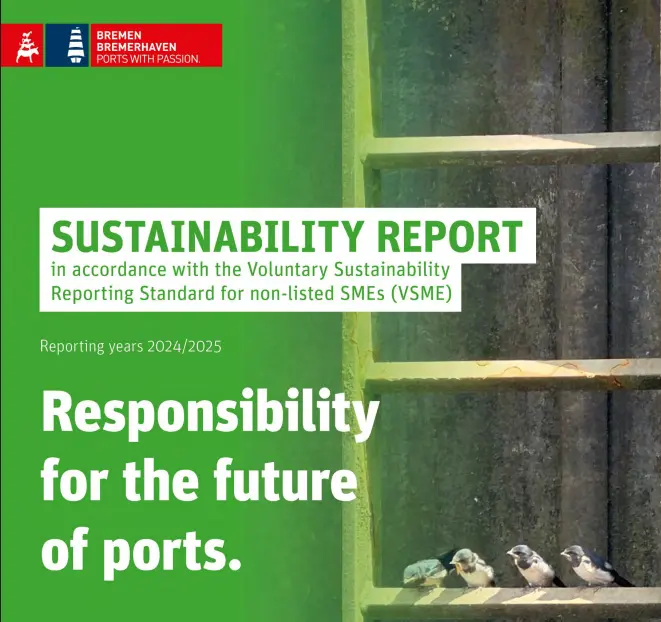
Bremen’s port management company bremenports has set out its sustainability priorities, including climate adaptation, emissions reductions and environmental protection, in its 2026 Sustainability Report covering the 2024 and 2025 financial years.
The report, entitled ‘Responsibility for the Ports of Tomorrow’, marks the company’s first adoption of the European Voluntary Sustainability Reporting Standard for SMEs. It covers bremenports and the special funds for the ports and fishing port under its management.
Managing director Robert Howe said: “Sustainability is not an additional issue for us, but a fundamental principle guiding the development of the Ports of Bremen. Our aim is to ensure that the ports remain economically strong, environmentally responsible and socially balanced.”
The new reporting framework introduces a double materiality assessment, examining both the environmental and social impacts of port activities and the potential effects of climate change on port infrastructure and operations. Rising water levels, storm surges, extreme rainfall and heat are identified as growing challenges requiring climate protection and adaptation measures to be integrated into infrastructure planning and maintenance.
For the first time, bremenports has also reported comprehensive Scope 3 emissions. These indirect emissions reached approximately 509,000 tonnes of CO3 equivalent in 2025, largely associated with long-term leased assets. Direct Scope 1 emissions totalled 1,516 tonnes, while market-based Scope 2 emissions amounted to 93 tonnes.
The company aims to eliminate fossil fuel-based Scope 1 and 2 emissions by 2035 and reduce Scope 3 emissions by at least 20% against 2025 levels.
Environmental initiatives also include biodiversity protection and sustainable dredged material management. Around 1,700 hectares of ecological compensation areas have been established, while 84,500 cubic metres of non-hazardous dredged material were recovered or reused in 2025, supporting construction and infrastructure projects.
Related Articles
 ENERGY & TECHNOLOGY
 ENERGY & TECHNOLOGY
 ENERGY & TECHNOLOGY