


Belle of the ball
India offers great potential for investors but are ports still waiting for their Prince to come as delays dog privatisation efforts? S.N. Srikanth investigates
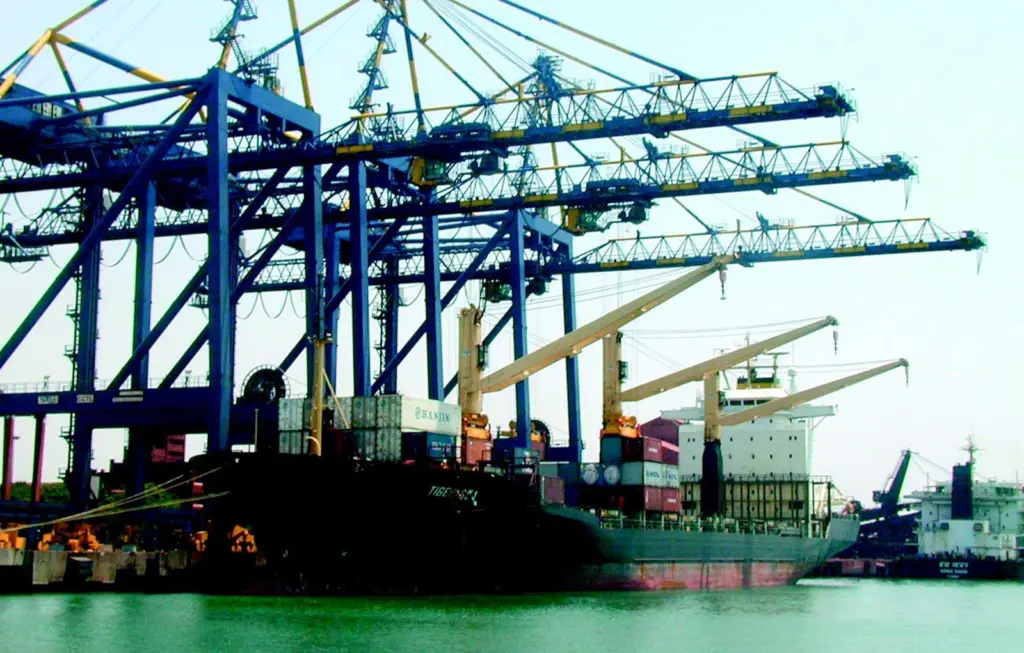
The elephant is learning to dance. It’s awkward, it’s clumsy and it’s slow, but world take note: India is on the move. After decades of sluggish economic performance that never quite seemed representative of its potential, India today is clocking a gross domestic product growth of well over 8% a year. Restraints on foreign trade are being steadily relaxed and privatisation of stateowned enterprises is very much in.
The consulting firm McKinsey & Company forecasts that the country will be the fourth largest economy in the world by 2025. What makes India particularly exciting is its population of over a billion, with an increasingly prosperous middle class. All that translates into one huge market – and bundles of cargo for the country’s ports.
Indian ports now handle a little over 500m tonnes a year. This quantity may double in the next decade, with container traffic, which is a mere 5m teu today, expected to grow sixfold in the same period.
However, it is widely believed that if red tape and bureaucracy, for which India continues to be notorious, are reduced, the growth could be explosive, rivalling that of China.
But India’s government-run ports are poorly equipped to handle such growth. Their infrastructure is inadequate, equipment often antiquated and administrative machinery inefficient. Port authorities lack sufficient autonomy and are compelled to depend on the government for far too many decisions. Mainline vessels prefer to collect transhipped Indian containers at Colombo, Singapore or Dubai rather than call at Indian ports. Imports and exports are hence costlier.
That is changing, though. The Government of India’s National Maritime Development Programme envisages an investment of $14bn in the country’s 12 ports under federal control (or “major” ports, as they are called in India) over the next 10 years. Private investment, says the federal government, will account for 65% of this figure, which does not include investments in ports controlled by regional governments.
Port privatisation efforts in India effectively began in the late 1990s when P&O Ports set up the Nhava Sheva International Container Terminal at Jawaharlal Nehru Port in Mumbai (not to be confused with Mumbai Port). NSICT has performed very well indeed and now handles close to 1.5m teu a year. Interestingly, NSICT’s success has spurred the adjacent government-run terminal to similar performance.
39Other container terminals at federal ports which have been developed with private participation by international majors are at Tuticorin (PSA), Chennai (P&O Ports), Cochin (DP World), Jawaharlal Nehru (APM Terminals) and Kandla (Voltri). In most cases, international operators have opted for joint ventures with Indian partners who hold minority stakes. All existing private operators seem determined to stay and expand their operations in India.
Investments have ranged from $25m in Tuticorin to $500m by DP World in Cochin. Privatisation efforts, for which the bid process has now started, include additional container terminals at Chennai, Mumbai and Tuticorin.
In addition to the 12 federal ports, India has some 185 ports under the control of its 10 maritime states. The majority of these “ports” are simply not functional. The western Indian state of Gujarat is an exception, with over $3bn in private funds now committed to port projects. Mundra in Gujarat, a greenfield venture by an Indian entrepreneur, Gautam Adani and now owned by P&O Ports, has attracted considerable attention as a small but efficient operation.
India has opted for the landlord port model when privatising, with assets created by private investors typically on Build Operate Transfer basis on 30-50 year concessions. The bid process is reasonably transparent, especially at federal ports and revenue share for the port authority is the preferred bid parameter. Optimism in the country’s future and existing tariffs that generously allowed for inefficiencies inherent in government-operated terminals have encouraged bidders to offer very high revenue shares. The APMContainer Corporation of India combine won the concession at Jawaharlal Nehru in Mumbai with a bid of 35.50% of revenue for the port authority, while Voltri in partnership with India’s ABG Heavy Engineering has committed an incredible 48.99% in Kandla.
Tariffs at federal ports are subject to ceilings. This is seen by some as inappropriate in a free market. There is no mechanism in place to regulate tariffs at state government ports.
Port privatisation efforts in India have been subject to excruciating delays. Coalition governments in Delhi rely heavily on often elusive consensus in decision making. The present ruling coalition depends on the support of over 20 political parties, including the communists who prop up the government from the outside. Pro free market Prime Minister Manmohan Singh does constant battle with his leftist coalition partners but somehow manages to maintain a tenuous edge. India’s judiciary, though independent, has in the past been rather liberal with interim injunctions and sympathetic to labour unions challenging privatisation, but is now less inclined to intervene in the process.
The lack of a clear government policy on security has also not helped matters. Hutchison Port Holdings, who has partnered with the Indian engineering giant Larsen & Toubro to bid for container terminals at Chennai and Mumbai ports, has neither been granted nor denied security clearance after nearly a year. As a result, the projects themselves have been delayed, an unforgivable luxury for a country desperately trying to achieve its ambition of becoming an economic superpower.
But none of this has particularly shaken investor confidence in India as the rising star.
Economic reforms initiated in the world’s largest democracy in the recent past are considered irreversible. It is believed that the country’s political stability and cautious approach to change make India’s growth highly sustainable. The gold rush to Indian ports has definitely begun and the elephant may yet do a tango after all.