



Aqabas changing fortunes
APM Terminals helping hand has lifted throughput at Jordans primary port.
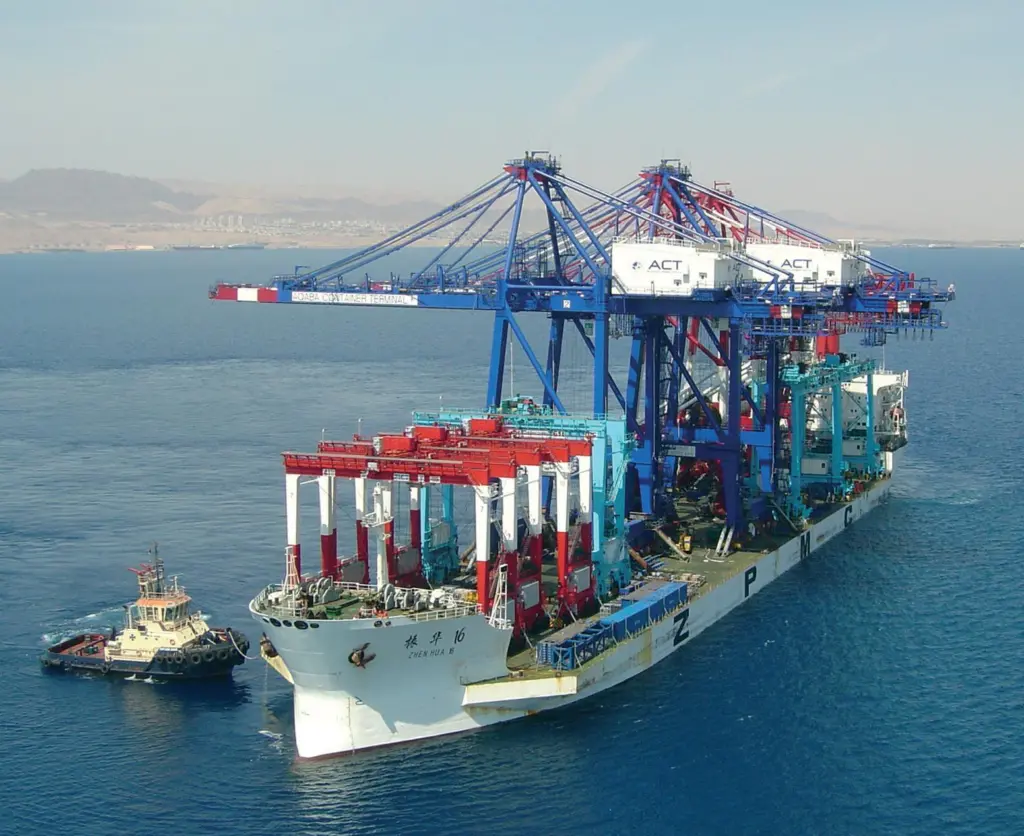
APM Terminals and Aqaba Development Corporation have put together a joint venture company to manage Aqaba Container Terminal (ACT) in Jordan for a period of 25 years.The terminal is to be expanded at a cost of $2.4m in three phases, which will encompass physical expansion as well as the acquisition of new equipment.
In 2005, when 463 vessels called, ACT registered throughput of 392,000 teu, which was much better than the minimum 10% hike that chief executive Patricio Junior had predicted for last year. Indeed, traffic has been on the up and up since APM Terminals signed an initial two-year contract in 2004, when 301,000 teu was handled, increasing to 358,000 teu the following year. For 2006, Mr Junior noted ACT was currently “enjoying healthy growth”.
The current positive situation is all the more remarkable given that in 2004 vessels could often wait more than a week at anchorage,while productivity was a derisory seven moves-per-crane-hour. The result was that shipping lines only made calls using their smallest possible feeder vessels and charged substantial congestion surcharges.
“Today,” comments Mr Junior proudly, “vessels are able to berth on arrival and we are in a position to offer fixed weekly windows. Because of this, we are once again seeing mother vessels calling at Aqaba and all the congestion surcharges have been cancelled. The direct saving for Jordanian shippers has been enormous.”
Mr Junior’s approach on going into Aqaba was to immediately assess what needed fixing and then got on with implementing change.Priority was given to the introduction of a new management and operations structure. This involved adopting best practice from various APM Terminals facilities around the world, covering everything from introducing ship planning to looking at safety protocols.
“We also backed up new procedures with all the proper tools and we invested in everything from specialised software to gantry cranes. But the most important development came from the staff: we invested a lot of time and resources in training and it definitely paid dividends. I am particularly proud of the way our people have developed,”he says.
He also gives a nod to the backing ACT has received from Aqaba Development Corporation (ADC), acknowledging the close support that had come from chairman and chief executive Imad Fakhoury. He also stresses how ADC is becoming a model for public/ private partnerships.
Productivity boosts at the terminal have been phenomenal, with terminal average nowadays being 28 moves-per-crane-hour, an increase of 21 moves since APM Terminals assumed management responsibilities. As to how fast a vessel can be turned around, Mr Junior insists that this depends on its size, how it is stowed and also on the box exchange involved.He adds that ACT currently offers some of the best turnround times of any port in the region and is on a par with accepted international standards.
ACT has traditionally been a straddle carrier-based operation, but the idea is to gradually introduce RTGs throughout the stacking yard, with a mixed operation involving both for the next five years. Mr Junior acknowledges that the company has had to work hard at optimising efficiencies in the storage areas. The infrastructure is being gradually rebuilt and upgraded to allow ever larger number of RTGs to be introduced.
Three new units were introduced in at the end of 2005, followed by a further three in September.Five more are scheduled for delivery in mid-October 2006. ACT will therefore be fully equipped with 12 RTGs.Currently,the terminal has 540 metres of berthing line, which should have been extended by a further 480 metres to the south by 2010, followed by a 200 metre extension to the north by 2020. As from October, five quayside gantry cranes were in place, the existing complement of three having been reinforced by two new postpanamax units.
Finally,while Aqaba has long been touted as a natural gateway to Iraq,Mr Junior points out that the location of the terminal at the junction of so many of the region’s states means it has yet to develop its true potential not just as Jordan’s leading port, but also for countries throughout the Levant and Fertile Crescent.