![GreenPort[PortStrategy]](https://www.portstrategy.com/greenport/wp-content/uploads/sites/4/2026/09/GreenPortPortStrategy.svg)

Growth strategies go west
San Francisco and Prince Rupert use economics and natural advantages to get ahead, by Martin Rushmere
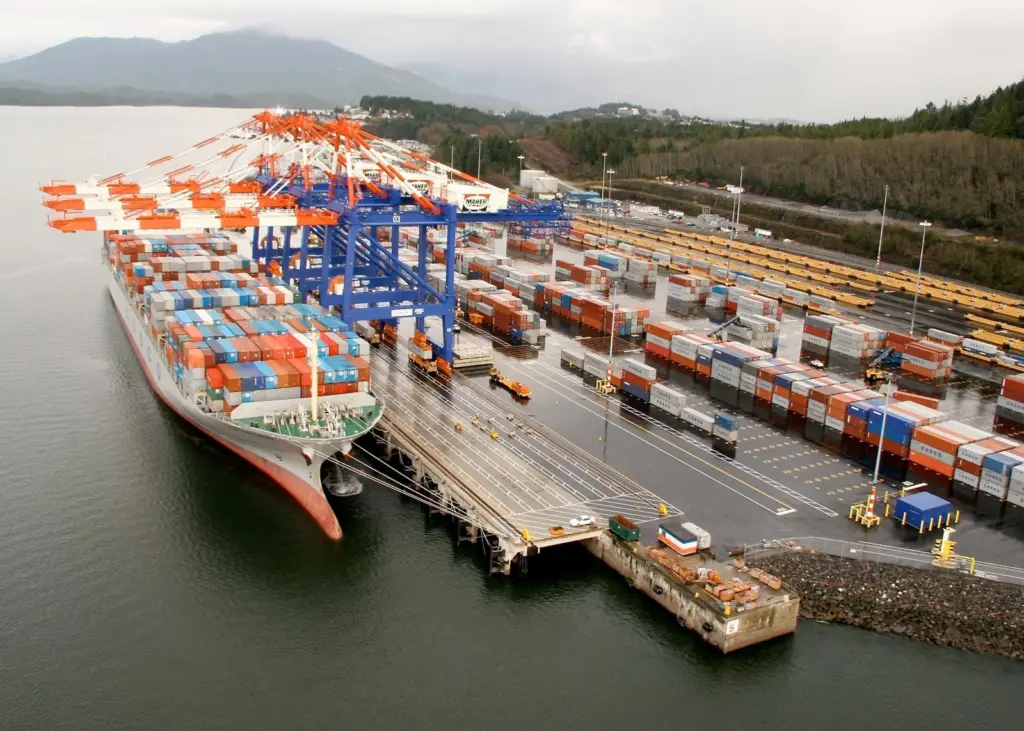
Two Western Seaboard ports in North America are in the throes of new projects to pump up business.
San Francisco is bravely trying to rebuild itself as a major port, after almost 10 years in the doldrums during which traffic switched to Oakland and other nearby ports. The port has largely given up on container cargo and is looking more at bulk and break bulk.
Pier 96, a former container terminal used by Cosco and Evergreen, has been put out to tender for redevelopment as a bulk export terminal, with four proposals and expressions of interest being submitted.
In 2008, the port sent out a Request for Proposals, but got very little response because of the world crash.
Officials are more hopeful this time. “Kinder Morgan Terminals is the outstanding bid,” says Maritime Marketing Manager Jim Maloney. “The idea is to ship out iron ore from Nevada, Utah and possibly New Mexico.” Predictably, the main destination is China. Between 1.5m and 3m tonnes a year are planned, depending on the rail facilities.
“We will have to rejig the pier and drive sheetpiles in to stabilise it”, says Mr Maloney. Work could start as early as the fourth quarter of 2012, but early 2013 is a more likely date. Total cost will be about $70m.
The ship draught will stay at 12.1 metres, but the real prize is to get to 15.2 metres. This is probably some way off and will be part of a second phase of development.
With the shallower draught, between 40,000 and 50,000 tonnes can still be loaded.
A loop track is being designed, with rail cars unloading to a covered conveyor from covered storage of about 100,000 tonnes, at a rate of 3,000 tonnes an hour.
“We have 25 acres of vacant land nearby, which is a huge help and which can also possibly be used later for bulk such as grain and soda ash. But iron ore is the real driver.”
A public-private partnership is envisaged for the arrangement with Kinder Morgan, with the company providing the finance and the port providing the land and infrastructure.
Federal grants are being sought to help pay for the project. “Applications for TIGER Three grants (Transportation Investment Generating Economic Recovery – the stimulus money to get the economy back on its feet after the 2008 crash) are being called for in October,” says Mr Maloney, “and we will be looking for $15m.”
An especially difficult part of any construction project in San Francisco is getting eco-agreements from local authorities and pressure groups. Mr Maloney says that so far there has been cooperation from all sides, with planners making sure that everyone is happy before going ahead.
The port is only a bit player today in the city’s economic life. Total cargo volumes in 2010 were 760,000 tonnes compared with 2.3m tonnes in 2004. Total ship calls were 39 last year as against 224 in 2004.
Further north, at Prince Rupert port in the far north of British Columbia, 50 km from the Alaska border, planning for Phase Two of the Fairview container terminal is still being undertaken. When originally proposed, the 61 hectare, 1.5m teu facility, costing $600m, was intended to be a seamless addition after the first phase was finished in 2007 – with construction complete in 2012.
But permits, political difficulties, the world recession and financing methods have pushed back the start of work to late 2012. “We are at the environmental assessment stage and also we are meeting with Maher Terminals (the operator) about expanding and revising the use agreement,” says port spokesman Michael Gurney.
The existing terminal covers 24 hectares and has a capacity of 500,000 teu a year. Volumes in 2010 have risen significantly, with July loaded containers 33% up on the same month the year before (exports up 90%) and the total number of loaded containers for the year more than 16% up on 2010.
Shipping lines are being attracted to the port for two reasons (Cosco and Hanjin have begun services in the last three months). “We are the closest to the Asian market and have a simple operation – direct ship to rail transfer,” says Mr Gurney. There are seven on-dock rail tracks for loading on to doublestack wagons.
Situated in a very sparsely populated area, the port does not have to worry about local distribution and has not had to bother about heavy vehicles and, most of all, chassis parking, ownership and distribution. Maher Terminals aims to have 85% of every shipment cargo shipped off within 72 hours.
With Chicago 94-96 hours away by Canadian National Rail, the US heartland has also become the heart of the port and accounts for more than 70% of container imports. So important has it become that CN has linked it to the expansion of an “intermodal logistics park” near Chicago, to be finished by the time the Fairview Phase Two is up and running.
Expansion is also under way at the main bulk export terminal at Ridley island, operated by the federal government’s Ridley Terminals International. The capacity of the coal terminal will be doubled to 24m tonnes a year with the addition of a third stacker and increasing the 55-hectare site by 14 hectares. A potash facility is also being discussed, but this needs to go through intense environmental debates.
Prince Rupert has been getting so much attention in the last year that US officials are becoming concerned that business is being taken away from its ports, notably those in California. The head of the Federal Maritime Commission, Richard Lidinsky, says an investigation will be made into whether the port has been getting government subsidies.
“We are confident that there has been no untoward influence in our success,” says Mr Gurney. “We take great pains to stay at arm’s length from the federal government.”
Related Articles
 NORTH AMERICA
 CONCESSIONS & INVESTMENTS