![GreenPort[PortStrategy]](https://www.portstrategy.com/greenport/wp-content/uploads/sites/4/2026/09/GreenPortPortStrategy.svg)





Shipping nears a tipping point on emissions
Shipping’s push for marine decarbonisation is accelerating, with new data revealing a tipping point between fleet readiness, port infrastructure and alternative fuel availability.
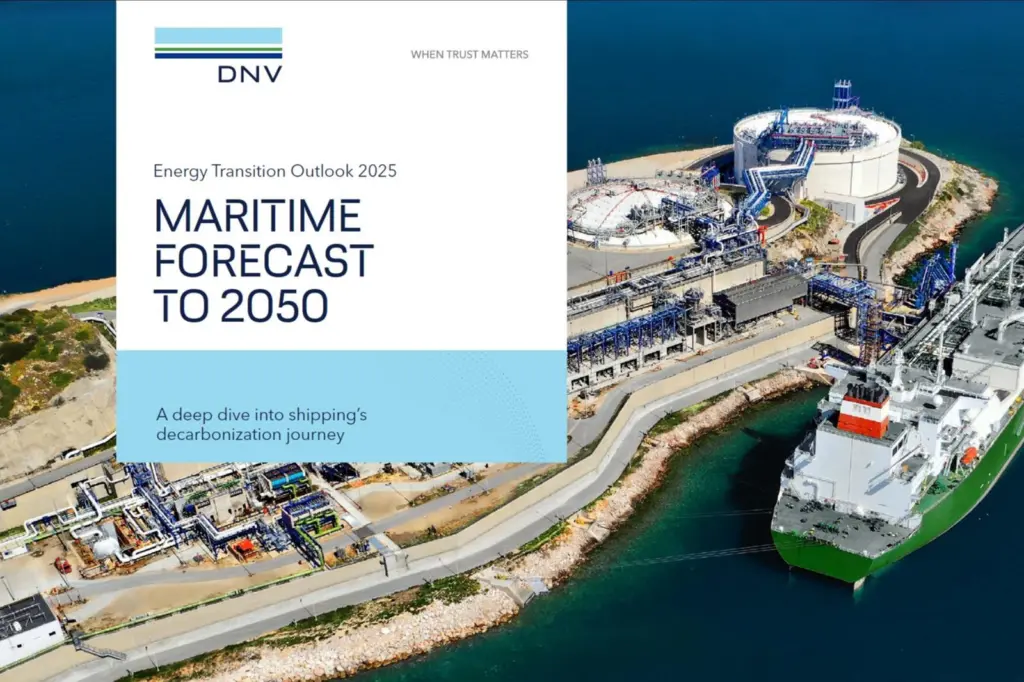
DNV’s latest Maritime Forecast to 2050 report warns that with the number of alternative-fuel-capable vessels set to nearly double by 2028, fleets could begin consuming up to 50 million tonnes of low-GHG fuels annually, far exceeding today’s consumption of just 1 Mtoe.
The widening gap underscores the urgent need for producers and infrastructure developers to scale up fuel supply and carbon capture capabilities.
“The stage is set for the next phase of the maritime energy transition,” said Knut Ørbeck-Nilssen, CEO of DNV Maritime.
“The IMO’s Net-Zero Framework has imperfections and greater clarity is urgently needed around how the collected money will be spent.”
Readiness-supply gap
DNV’s report highlights solutions to bridge the readiness-supply gap.
Leveraging existing port infrastructure for biodiesel and bio-LNG could accelerate alternative fuel adoption, while onboard carbon capture could remove up to 75 million tonnes of CO₂ annually if just 20 major ports deploy offloading systems.
Such measures could offset demand for 25 Mtoe of low-GHG fuels, helping achieve the IMO’s 2030 target.
Energy-efficiency measures on newbuilds and growing interest in wind-assisted propulsion also feature prominently. Yet experts stress that integration is vital.
“These solutions are still operating in silos,” said lead author of the report, Eirik Ovrum.
“To deliver impact, they need to be integrated into fleet strategies, supported by infrastructure and recognised in compliance frameworks.”
DNV concludes that early preparation and multi-pathway planning are essential as the industry navigates regulatory shifts and ramps up investment in marine decarbonisation.
Related Articles
 PRODUCTS & SERVICES GREENPORT
 EUROPE GREENPORT
 REGULATION & POLICY GREENPORT