![GreenPort[PortStrategy]](https://www.portstrategy.com/greenport/wp-content/uploads/sites/4/2026/09/GreenPortPortStrategy.svg)

BA CONCESSIONS EXTENDED
Armageddon, or the end of the current concession road at least, almost came for the threecontainer terminals that operate out of Puerto Nuevo, in Buenos Aires. Rob Ward investigates.
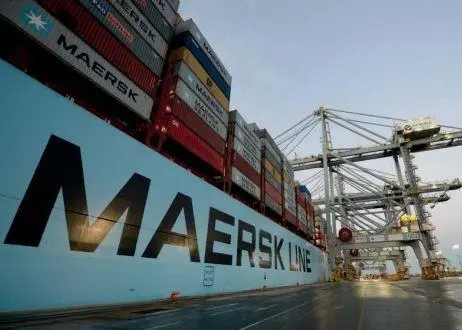
The seemingly simple decision by Maersk Line to switch its North Europe Samba service from Terminales Rio de la Plata (TRP) to Terminal 4, operated by its sister company APM Terminals led to an eruption of protests followed by a high-level game of poker between Maersk Line, TRP and the AGP (Administracion General de Puertos, which oversees all the ports in Buenos Aires on behalf of the Argentine government).
In a week of high drama involving those three parties, plus dockers’ unions in Buenos Aires, the Argentine government and DP World (majority shareholder of TRP, along with local shareholder with considerable political influence, the Roman family), the Danish shipping company eventually changed its mind to retain the status quo and not cause any further issues or involvement with the “Casa Rosa” (the Pink House where the Argentine government sits).
At the 11th hour, Maersk Line agreed to stay at TRP, protecting stevedores’ jobs that would have been lost, and that seemingly ensured the AGP to grant T-4 and TRP a twoyear extension to May 2022, for the existing terminal concessions. The exact position is still a little unclear with BACTSA as it has already used up some of the contract extension time allotted and under the terms of their original contract it should only be allowed a 12-month final extension. “It will be interesting to see how they resolve that matter,” confirmed a rival port terminal manager.
RAILROADED
A Buenos Aires-based consultant with links to several of the box terminals operating in the Argentine port city said that Maersk Line should never have allowed itself to be “railroaded” into such a deal if it did not fit its own liner shipping plans – and especially if the medium and long term problem had not been resolved.
“They (Maersk Line) have given in to extreme pressure from AGP, the government and both the management and unions at TRP,” he told Port Strategy, on condition of anonymity. “With the economic recession in Argentina volumes had been falling at all the terminals (just 920,000 TEU through Puerto Nuevo in 2019, about 50 per cent of total Argentina throughput, and down from 968,000 TEU in 2018) and T-4 had space for Maersk Line to switch its Samba service and was perfectly entitled to do so.
However, with a left-wing government elected a few months ago the shipping line had to be seen to be doing something to support the unions and protect jobs. “The immediate problem has now been solved but the medium and long term issues of operating in a cramped area surrounded by a bustling city, has just been kicked down the road for another two years,” the local industry specialist confirmed.
The stakes were very high for all sides as the clock ticked towards a Friday, May 15 deadline that would have seen an immediate end to the 25 years plus concessions of both TRP and T-4, if Maersk Line had maintained its decision and insisted on the Samba service switch. Six hundred dockers jobs were also at stake, said TRP and the unions.
This is because the terminal would then have been left with just one coastal service, the Mercosur Service from Log-In Logistica (with CMA CGM’s Mercosul Line as a partner), the last remaining Brazilian owned carrier, which would be unlikely to stay without any deep-sea callers, say sources.
In that worst case scenario, AGP would have taken control of the berthing at both terminals – along with innocent bystander BACTSA (owned and operated by Hutchison Port Holdings) in Terminal 5 – until a new tender document could be released for a $1.9 billion complete re-development of the Puerto Nuevo site (see Musical Chairs in Buenos Aires, April 2020).
NEW PLAN AWAITED
The last plan was scrapped by new President Alberto Fernandez, who was elected with a mandate from the powerful trade unions in Argentina and it has not yet been time-tabled for resuscitation.
During the interim period the three port terminals would have lost their concessionaire status and become, instead, licensees. AGP would have had control over which ships were berthed at what terminals, with unions calling for an equal spread of ships and cargo to all four terminals. This included Exolgan, which might also lose out with such an arrangement as its current share of the Buenos Aires total throughput is more than 40 per cent, much higher than the 25 per cent it could have expected.
Earlier Fempinra (the Federation of Argentine shipping, port and shipyard workers) had issued a strongly worded demand from its Finance Secretary Roberto Coria (who is also Secretary General for the Argentine Union of Crane drivers), to both Jose Beni, general secretary at AGP, and Rodrigo Luchinsky, president of the monopolies watchdog, the National Commission for Defence of Competition (CNDC).
The Federation was demanding “the necessary measures to prevent the progressive concentration and anti-competitive actions,” and were made against a background of the Coronavirus pandemic and the imminent expiration of the concessions. As a result, it wanted “an interim system lasting until the next tender, where the cargo that enters, is distributed equally, not only to Puerto Nuevo but also to Exolgan (Port Dock Sud) that, is receiving a multiplicity of cargo in its commercial alliance with T4-APM Terminals, Grupo Maersk ”
The union is arguing, incorrectly, that Maersk Line and MSC, via their two terminals, are operating a duopoly to the detriment of shippers and port users across Buenos Aires port facilities. Evergreen and other Asian shipping lines have tended to call at BACTSA, Terminal 5, although the ONE group of carriers has recently switched to Exolgan.
“We need these changes for Argentine foreign trade, for the stability of jobs and regional economies and for it not to be destroyed in monopolistic hands by corporate greed as has been pointed out the President of the Nation,” added the union.
SOWING THE SEEDS VIA HAMBURG SUD
The seeds for the TRP vs. Maersk Line clash were probably sown when the Danish outfit took over Hamburg Sud in 2018, historically always a strong player in the East Coast of South America trade lanes, and started amassing servicers at T-4, which today has 78 per cent of cargo handled provided by its own group. A third brand is also included, Alianca Navegacao, the Brazilian flag cabotage (Brazil) and Gran Cabotage (Brazil and Mercosur, including Argentina and Uruguay) carrier.
Patrick Campbell, the president of Centronave, which represents various shipping groups in Argentina, told Port Strategy that the company had been involved in trying to find a compromise and was relieved that “in the end it had to be Maersk’s decision and now we can get back to business and battle the many other problems in Argentina”.
Puerto Nuevo handles around 50 per cent of all Argentina’s containerised cargo shipments. Yet because of the explosive political scenarios in Buenos Aires most parties are reluctant to provide exact container throughput on a terminal by terminal basis, but various sources have confirmed that Exolgan in 2019 had 43 per cent of the market (around 688,000 TEU), Terminal 4 had 20 per cent (320,000 TEU), Bactsa 19 per cent and TRP 18 per cent.
Since then TRP’s share has fallen to around 15 per cent and T-4 has gained some market share as overall port throughput has slumped by around 20 per cent during the first four months of 2020.
Resistance and monopoly
When the announcement for the switch was made back in March various sources in the Argentine capital warned Port Strategy: “The dockers’ unions will not like that, so expect some resistance.” This definitely occurred from the unions and its continuing power was bolstered by the backing of several politicians.
Management at TRP had been aligned throughout the stand-off with its workforce in fighting the proposed terminal switch, claiming such a move by Maersk Line was helping to set up a monopolistic situation, with the Danish operator ensuring all of its group services were in T-4.
The “monopoly” cry has been made despite containers also being moved at Terminal 5 (operated by Hutchison Port Holdings) in Puerto Nuevo, and also from Exolgan (where MSC’s stevedoring and investment arm Terminal Investment Limited is the main shareholder) at Dock Sud, which is only six miles away.
Shippers in the Buenos Aires conurbation (which covers some 15 million people out of Argentina’s 45 million total population) could also use the growing out of town facilities at Terminal Zarate (60 miles away) and TecPlata (some 34 miles by road and 27 nautical miles sailing distance).
Related Articles
 SOUTH AMERICA
 SOUTH AMERICA
 SOUTH AMERICA