![GreenPort[PortStrategy]](https://www.portstrategy.com/greenport/wp-content/uploads/sites/4/2026/09/GreenPortPortStrategy.svg)





BATTERY POWER ON THE RISE
The list of ports investing in electrical energy storage is rising dramatically. It is an evolving technology with expanding options, Stevie Knight investigates.
Once considered impractical, batteries are now on course for price parity with automotive combustion engines in the next two years. This signals a wider trend line – even the far-slower, and necessarily more expensive maritime market is seeing an eruption of multi-megawatt solutions.
Port management bodies have “become more interested in long-term investment in green technology” explains Anthony Price, Managing Director, Swanbarton, a UK-based energy equipment and solutions company.
However, he adds: “It’s now more about how we actually make this stuff work for them.” That in itself is quite a call – because when it comes to ports, batteries are being asked to answer a rather large challenge.
On the one hand, a swathe of facilities are beginning to take advantage of various renewable energy streams. However, as Price’s colleague Clive Tomlinson says, “These do not always produce to order. There are always times when the sun does not shine, or the wind does not blow.”
DRAMATIC AND DYNAMIC INCREASES
At the same time, the drive for cleaner handling equipment is likely to cause both dramatic and dynamic increases in electrical load. As the Port of Rotterdam notes: “We need to maintain the balance between the generation and the consumption of electric power – even though both parts of this equation are becoming increasingly difficult to predict.”
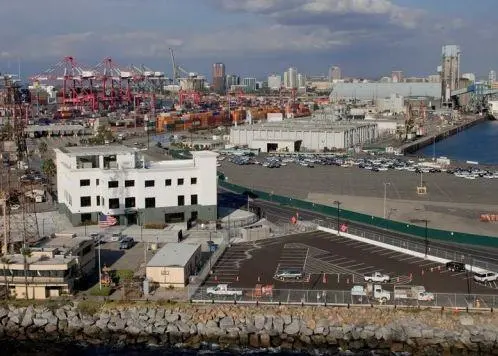
Importantly, making sure there’s enough capacity in the grid, either for direct supply or renewables backup, can be an expensive business. So, some are turning to battery solutions to fill in the gaps. At the Port of Long Beach (POLB), a microgrid project includes a 300kW solar installation: energy storage and local sunshine promise to reduce pressure on the utility supply, benefitting both port and community by lowering peak costs and increasing infrastructure longevity.
But these batteries – developed by Schneider Electric – also have another role: the larger 746kWh stationary installation will protect the port’s critical response Joint Command and Control Centre. The other 567kWh mobile unit has a more varied remit, as during widespread outages the mobile battery can be towed out to stormwater pump stations and refrigerated container yards.
The scale of battery installations is also likely to increase in the next decade. By then, Long Beach “may be using four times more electricity than it is today”, says Christine Houston, Sustainable Practices Manager, POLB adding: “We think microgrids will eventually support all the marine terminals.”
BALANCING ACT
Establishing the right battery-based energy solution is inherently a technical and financial balancing act. Tomlinson points out that, “batteries are still expensive” so there is a need to carve out appropriate applications and, as Houston explains, the port “has to find the sweet spot between what we can build and what would be useful”.
All this requires treating the battery as part of the whole system, not an ‘add-on’. As Brent Perry, CEO, Sterling PlanB Energy Systems (SPBES), notes: “At first, the questions around energy storage were focused on simple functionality and safety. Now, customers are demanding that battery providers are part of an integration package or a system.”
It can be a cost-effective choice, says Perry. One particular location – originally quoted US$350m for new grid links – installed a battery to cover backup redundancy, servicing downtime and non-fluctuating, high-quality power suitable for a laboratory, for a tiny fraction of the price. He further adds that this, “Allows shuffling energy from one place to another depending on demand”.
However, it is not just electrical distribution than needs consideration. For example, the location of POLB’s emergency command station was settled mainly because the building already tied together various power and communications connections.
However, energy storage can also present considerable, apparently unrelated challenges: according to Perry, one island-based installation demanded hurricane-proof housing “so we had to get into building regulations too”.
WHERE TO START?
For ports starting in this area, Tomlinson explains bill reduction is one of the first areas of focus. “You can make use of cheaper night-time tariffs, and grid companies will often pay you for turning your demand up or down when they snap their fingers.
Houston additionally explains that, “if you can shed loads when signalled by the utility company, it improves reliability, especially during peak periods”. Cold ironing – shore power – is probably the next application that springs to mind, “but very, very few facilities have the energy consistently available or even at all without risking blackouts in the local community”, says Perry.
Containerised batteries could provide the answer – one option being floating them on a fleet of barges to the ship’s side: “You can effectively offer a microgrid on a short-term lease every time a ship arrives,” says Perry. Interestingly, SBPES’ CanPower is a ‘cartridge’ system, so the cells can be swapped out, avoiding the investment necessary for batteries large enough to service full daily cycles.
CLEVER CUTS COST
Still, the investment calculation can be complicated. It is not just the power density (how hard it can punch) or the energy capacity (storage capability) that defines the investment. It is also lifetime and utilisation.
As Perry points out, a battery is a flexible unit able to yield a few times its rated power, if only for brief periods. So, if there’s an emergency back-up requirement, it’s possible to increase the draw as long as this has a defined, short-term constraint. That, in turn, allows more applications to be brought within the battery’s remit, although it needs intelligent handling.
This subject is being directly addressed by the Port Energy Systems Optimisation (PESO) project, funded by Innovate UK. Firstly, the business case has been assisted by a dual-chemistry solution. “Lead-acid technology is great, it is environmentally sound, recyclable and it is cheap,” says Tomlinson and adds: “It’s good for long, slow charge and discharge, but it’s not so useful for sudden high rate cycling.”
Therefore, the battery brings together Yuasa’s lithium-ion cells as well as its standard ENL chemistry. However, commercial viability means “hanging as much from it as possible,” from making the most of local renewables to smooth out the loads and even vessel recharging. That requires “fine-tuning the batteries to act like a storage tank… so it can serve a wide range of purposes,” says Price.
Tomlinson explains that all of this “can pull in different directions”. Therefore, the PESO team, with funding from Innovate UK, is developing a smart AI system that reviews the loads from minute to minute and makes the most economical use of the battery’s capacities.
Notably, Simon Powell, Operations Director of PESO organising body Marine South East, underlines how, “control technology is storage agnostic; the AI can be applied to different chemistries, so we are not wedded to a lithium and lead hybrid”.
This 250kWh capacity is initially “pilot sized” adds Powell, citing an application at the port of Portsmouth, UK in conjunction with the port’s solar installations. “But,” he notes, “we’ve been working with Yuasa, so it is designed for scaling up.”
“We are exploring possible activities: workboats, patrol craft and even domestic electric ferries,” adds Tomlinson. “Maybe even charging cross-channel-size ferries later on.”
Battery power for terminal operations
Some energy storage installations are going the whole way and becoming independent of the grid. In Los Angeles, Pasha Stevedoring is collaborating on the Green Omni Terminal which features a 3MW photovoltaic installation on top of a warehouse, charging two “very big batteries” totalling around 2MWh, says Chris Cannon, Director of Environmental Management, Port of Los Angeles.
The amount of power is needed to support all the terminal’s handling kit, including yard tractors, heavy-duty forklifts and longer-range drayage trucks. Moreover, this microgrid “will allow operations to continue even if there’s a widespread power outage.” And “that is valuable for the region in any emergency,” Cannon explains.
The Omni terminal is not the largest of operations in Los Angeles, but the concept is expected to grow. “Our plan is that all the terminals will be electrified in 10 years,” says Cannon, and while there’s an array of approaches under investigation, “the other terminals are watching the battery developments very closely”.
The move toward decarbonisation is likely to change power generation modes even further, but it is difficult to predict what’s ahead – bio-gas, LNG, ammonia, renewable hydrogen and fuel cells are all in the frame – and it may well depend on what’s cost effective or easily available in any given location.
Given this, batteries provide “the ideal network” says Price. Flexible energy in ports offers a very diverse picture, but it does endorse one definite thing for sure – change. Price summarises the current position well: “We are now only limited by the scale of our imagination.”
Related Articles
 EUROPE
 TERMINAL OPERATIONS
 TERMINAL OPERATIONS