



Jurong cements multipurpose aspirations
Jurong Port has officially commenced operations of its Combi Terminal, which is tailored to the requirements of multipurpose vessels.
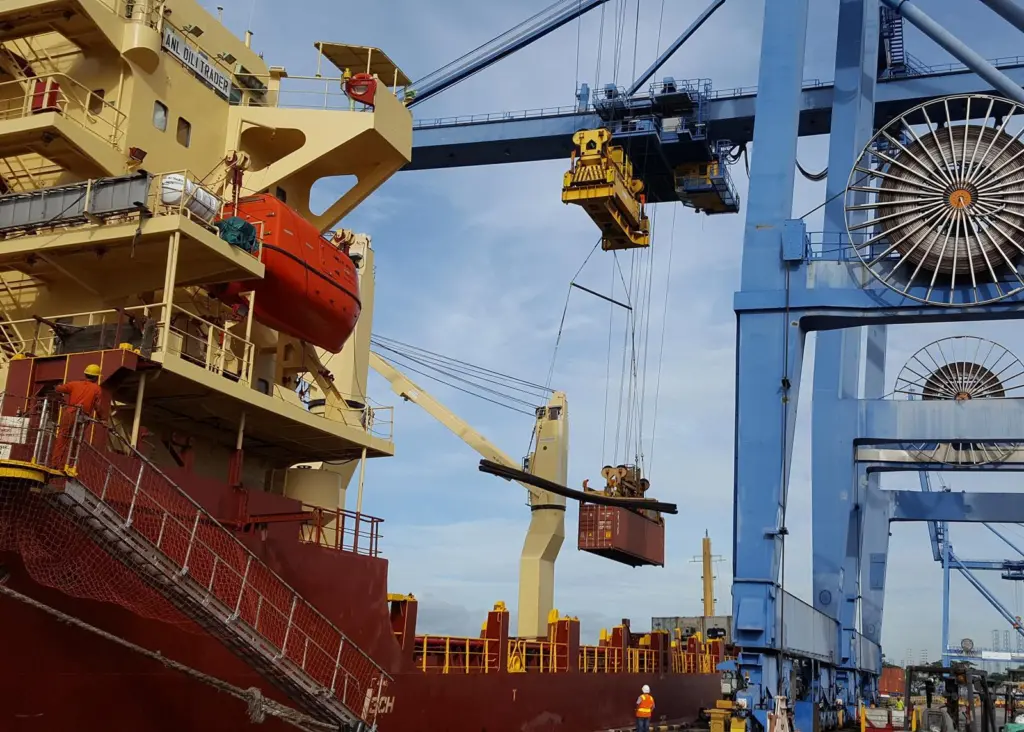
The new terminal is a one-stop terminal for vessels carrying a combination of containers and general cargo.
This means multipurpose vessels do not need to call at separate terminals or berths to deal with different cargo types. Instead, they can berth at the Combi Terminal and move containers and cargo using quay cranes.
Ooi Boon Hoe, chief executive officer of Jurong Port, said: “The establishment of our Combi Terminal is a significant milestone for Jurong Port to become a world-class multipurpose port operator and a one-stop solution provider integrating berth planning, cargo handling, storage and supporting services.”
He continued: “With the terminal, our customers that carry diverse cargo types on their vessels enjoy the flexibility of shortened ship turnaround time.”
The terminal occupies a total of 6.6 hectares and comprises of three dedicated deep-water berths which are 575m in length.
It is equipped with quay cranes that have been adapted to handle general cargo as well as containers, mobile harbour cranes can also be deployed for the handling of heavy lift cargo.
The first three anchor customers of the Combi terminal were Pilbara Express Lines, ANL and ENG Lee Shipping.
The official launch was officiated by Dr Koh Poh Koon, minister of state for the Ministry of Trade and Industry and National Development on August 5, 2016.
Law Chung Ming, group director of transport and logistics for International Enterprise Singapore, which has been working with the terminal, said: “The Combi Terminal adds to Singapore’s position as a premier transhipment hub.”
He continued: “With this, the new route to the Port of Dampier will expand Singapore’s hinterland for transhipment to the Pilbara region in Australia, enhancing business connectivity, opining up more trade and investment opportunities for companies.”
Related Articles
 EQUIPMENT
 PORT & TERMINAL NEWS
 PORT & TERMINAL NEWS