



Looking for the luxury market
Felicity Landon reports on Saudi Arabias first privately developed container terminal
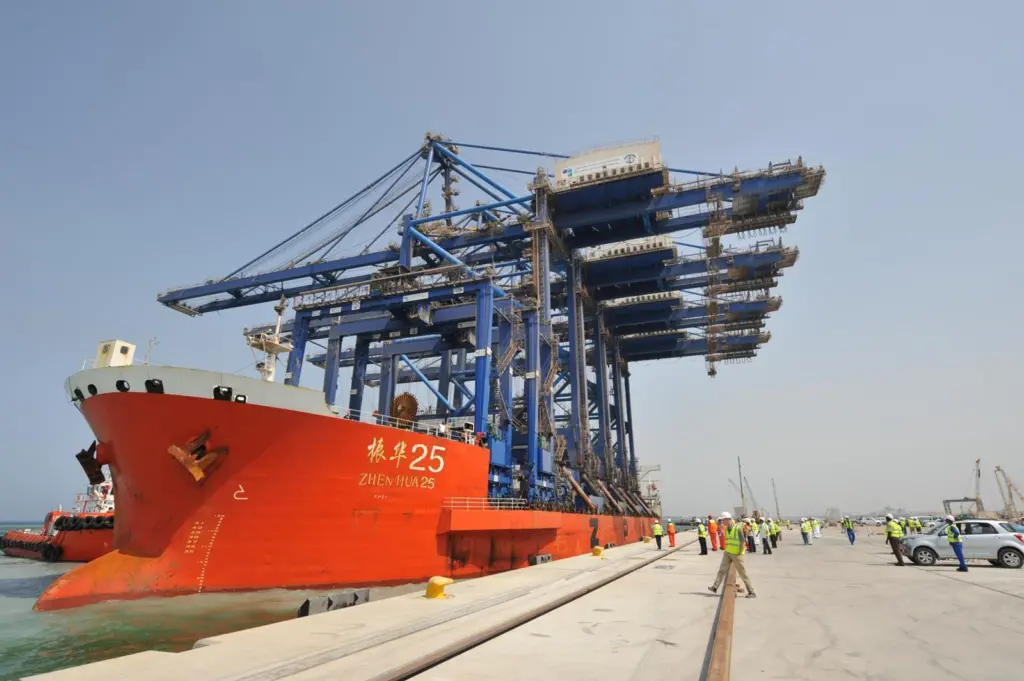
With nearly $500m spent so far, the new Red Sea Gateway Terminal (RSGT) hasn’t come cheap. But the operators of Jeddah’s newest port facility, opening for business in October or November this year, are clear: this facility is for the discerning customer.
RSGT was planned in 2006 and construction started in 2007. The picture has altered a little since then, of course, but RSGT chief operating officer Lye Seng Tan is far from discouraged and, indeed, says Jeddah can look forward to an upturn in volumes next year.
“When RSGT was started, Jeddah was facing severe congestion and the world was booming – then the end of 2008 came along and now the world has changed,” Mr Tan says to Port Strategy. “Of course, Saudi Arabia and Jeddah can’t be unscarred. In the first six months of this year, there was a 12% drop in containers through Jeddah compared to 2007.
“But there is a silver lining. Local gateway cargo continues to be strong – up 5%-6% in the first six months. It is only transhipment that has plunged.”
He adds: “In the second quarter we saw an improvement in volumes and we expect further improvement in the third and fourth quarters.”
From 1.8m teu in 2003, container throughput at Jeddah showed an average 11% increase a year between 2004 and 2008. Last year throughput was up 19% to 3.3m teu – 1.8m teu of gateway cargo and 1.5m teu of transhipment traffic. The port was suffering congestion problems right through to the third quarter of 2008.
Mr Tan, who joined RSGT last year from PSA International, says the port is expected to record an 8% drop in container volumes by the end of 2009, “which compared to some other areas is, I think, a good number”.
“And going forward, next year we will see some single digit growth in Jeddah.”
Clearly, such growth would be very welcome – RSGT will add up to 1.8m teu capacity to Jeddah, and there will be plenty of competition from other new developments in the region.
However, Mr Tan says: “We are looking to target very specific businesses. We have designed the terminal and facilities and infrastructure for specific customers. We are looking at big vessels, high productivity and fast turnround time, and special services. If you compare us to the hotel sector, we will be the luxury end.
“In a nutshell, RSGT won’t just compete but we have our eye on a certain sector, the luxury five-star companies which demand good services for the fifth generation 10,000-12,000 teu class vessels. These vessels require high productivity, bigger cranes and a deeper channel and we can provide that.”
Putting all this in place has obviously been very expensive, he says. RSGT is a subsidiary of Saudi Industrial Services Company (SISCO), and the project is notable for being the first privately funded investment of its kind in the country.
Mr Tan says others will follow: “Traditionally infrastructure projects have been mainly undertaken by the Saudi Arabian government. But this is changing. Even now the government is looking at airport construction projects and bringing in private investors,” he says. “Overall there is a trend towards such privatisations and infrastructure projects and eventually this will spread to other sectors such as communication.”
He says it is absolutely right that a facility such as RSGT should be privately funded. “A container terminal is purely a logistics business. There should not be any government regulatory function – it isn’t like the coastguard or pilots.”
RSGT will have a 1,052 metre long quay with depth alongside of 18 metres, a dedicated approach channel and separate feeder berth. Eight super post-panamax ship-to-shore cranes with twin-lift capacity for 40ft containers have been supplied by ZPMC, which is also supplying a fleet of 24 rubber-tyred gantry (RTG) cranes. Each RTG can handle 40-foot boxes and move them over seven storage rows from shipboard to truck suspended under their 24.4 metre gantries at a lift height of 18.4 metres.
Other equipment will include a reachstacker capable of stacking 45-foot boxes five-high and an empty handler stacking seven-high, as well as cornerless trailers from Dutch trailer specialist Buiscar Cargo Solutions.
The new terminal will initially employ about 200 people. Mr Tan says the first vessel will be handled in October or November but isn’t going to give away any details.
“Of course we are looking at one big vessel but we are not revealing the shipping line because of confidentiality,” he says, adding: “We want to show the liner community what we can do.”
RSGT has been in talks with potential users for the past two years, says Mr Tan, “and we are zeroing in to sign a couple of lines”. But he isn’t expecting a sudden rush to maximum capacity.
“We are a start-up terminal so we have to do it on a step by step basis. We can’t just jump in and handle 1m teu – I don’t think that is possible. So maybe we look at lower volumes. Maybe in a year’s time we will be handling half a million teu.”
What is important, he says, is that the vessels will be big: “Jeddah isn’t an intra-region facility – it is already a natural main trading hub. The Red Sea is a natural waterway and the container terminal is part of this trade and logistics.
“Our geographical advantages are very important. We have a natural hinterland for cargo and we have a lot of synergies with the Tusdeer Bonded and Re-export Zone. Our investments are attracting other private investment in logistics.”
Jeddah has grown rapidly over the past two decades, making it the centre of business and finance in Saudi Arabia as well as an important industrial and commercial centre, says RSGT.
Mr Tan predicts that oil prices will pick up again in 2010 and says: “Our terminal will be strategically placed, energising the shipping lines in terms of fuel pricing.”
On the wider front, the whole of the Middle East region is “moving up”, he says, with Qatar and Bahrain in particular developing fast. Major logistics players are looking to invest in the region – “but it does take time, because everyone is fighting for a piece of the cake. The major logistics players can’t go into everywhere at the same time.”
In ten years time, the region will have seen a complete change, Mr Tan predicts. He expects to see more intra-Red Sea traffic, connecting with north and east Africa. “Politically there are problems but it is just a matter of time until things get better.”
RSGT could invest and expand further but any expansion would depend on negotiations with the port authority and, critically, overall demand, he says.
“We would have to look carefully – over-supply could affect prices. But most important now is that RSGT has to open and start running.”
In summary? “Our strategy is to look at very specific customers and services,” says Mr Tan. “This will be the latest state-of-the-art terminal. We are on the same platform as Shanghai or Singapore.”
Related Articles
 NEWS
NEWS
 CONTAINER & CARGO HANDLING
 OPERATIONS