

NAVAL TECHNOLOGY SHIELDS THE WATERFRONT
Sophisticated electronics, signal processing, unmanned underwater vehicle (UUV) and command and control technology developed for naval applications are all being used to makes ports and harbours safer, as David Foxwell writes.
Many of the companies providing US ports with security technology have been working with the US Navy for years, and have now turned their attention to the commercial market. Take for example SAIC, which recently provided the authorities in Greece with a complex and highly sophisticated command, control, communications, coordination and intelligence system for the port of Piraeus – and other ports – during the 2004 Olympic Games.
SAIC has been working with the US Navy to provide underwater security systems to protect its fleet of Trident nuclear powered ballistic missile submarines since the mid-1908s. The company’s marketing manager, Gary Hicks, said he believed that, until 9/11, most ports “were really pretty open on the water, ” said Hicks, “but most of the larger ones now realise they need to enhance their situational awareness.”
“Not all ports can afford underwater security systems, but for some – such as cruise or LNG terminals – the need is obvious, and we provide vulnerability assessments and analyse life-cycle costs for a lot of ports of that type, ” said Hicks. To meet this need SAIC has developed a range of underwater security systems for ports and harbours including an ‘acoustic fence’ with built-in alarms that floats on the surface around a potential target such as a cruise ship, looking downwards to detect divers. During the Olympics, Hicks explained, SAIC provided “kilometers” of acoustic fencing, along with diver detection sonars for key points.
In October, Benthos, which specialises in Remotely Operated Vehicles (ROVs) and Coda Octopus announced that they had signed a Letter of Intent to develop and market ROVs that integrate the Benthos Stingray ROV and the Echoscope II sonar, and announced the product would be targeted at the port and harbour security market, ” noting that the Stingray is an inspection class ROV designed to be easily configured for numerous tasks, and can be deployed and recovered by one person. “With its cameras, lights and ancillary sensors, the Stingray provides the perfect tool for underwater video inspection, ” noted the company.
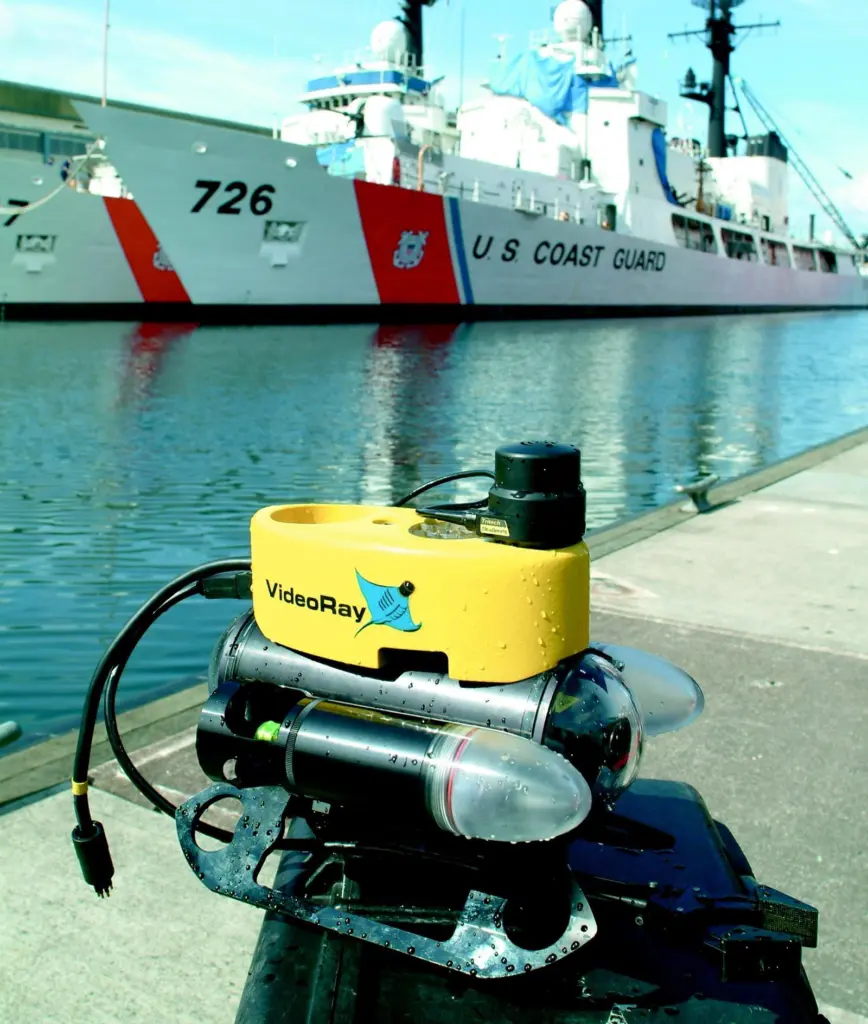
Earlier, Benthos had announced the completion of sea acceptance testing by the Canada Customs and Revenue Agency (CCRA) of a Stingray ROV that the agency ordered to use in harbour and port security operations, and another ROV company, VideoRay, was recently awarded a contract to supply the US Coast Guard with ‘miniROVs’ that will also be used to provide surveillance in ports and harbours, the mini-ROVs being part of a package of equipment that includes a short baseline (SBL) positioning system, an acoustic navigation system. Its software will enable the mini-ROVs to inspect ship hulls and other structures, and display starboard, port, and bottom views of the vessel.
More sophisticated still are proposals by some companies to use modified versions of Unmanned Underwater Vehicles (UUVs) to carry out routine harbour surveillance and inspection work. UUVs equipped with high resolution, multi-beam sonars could be deployed to conduct surveillance in ports and harbours on an almost continuous basis, without requiring much operator support, thus reducing manning and costs.
REMUS UUVs developed by Hydroid Inc in the US were used by the US military during the war against Iraq to ensure that mines that might have been laid in ports like Umm Qasr were detected and neutralized.
Meanwhile, companies outside the US that specialise in defence electronics are also competing to win work from the port and harbour market, a new type of high performance swimmer detection system called Cerberus and developed by QinetiQ in the UK, being one example.
Related Articles
 DIGITAL
 OPERATIONS
 PORT & TERMINAL NEWS