![PortStrategy[GreenPort]](https://www.portstrategy.com/wp-content/uploads/2026/09/PortStrategyGreenPort.svg)






Electric domination
New electric cargo handling systems.
SECTOR ANALYSIS: NEW PRODUCT LAUNCHES
Increasing numbers of terminals are opting to electrify their cargo operations as they face growing pressure to reduce their CO2 emissions.
The target of net zero emissions by 2050, meeting Environmental, Social and Governance (ESG) requirements and regional regulations such as the 2021 EU Green Deal target of 90 per cent emissions reductions for EU port cities by 2050, means that decarbonising cargo handling systems is a greater priority than ever.
While there are challenges to overcome, including infrastructure, charging and training, port operators can reap benefits including achieving greater energy efficiency, a decrease in maintenance costs and a boost in productivity.
As the following table shows, over the last 12 months manufacturers have launched diverse new electric-powered port cargo handling equipment. Some are going further and developing hydrogen-fuelled solutions, leading to more cross-industry collaboration, as companies develop and pilot new solutions.
NEW MODELS, R&D, TRIALS, COLLABORATION, VALUE-ADDED FUNCTIONS
FORKLIFT TRUCKS: ADVANCES BUT CHALLENGES REMAIN
Forklift truck electrification is advancing, but there are still challenges to overcome. Rob Maris, Product Strategy Manager, Big Trucks, Hyster Europe explains: “While electrification of higher capacity lift trucks is moving forward, it is not yet the right solution for every application. The initial cost of electric lift trucks along with the infrastructure and charging upgrades required can often delay adoption. And for the largest trucks, battery and hydrogen fuel cell technology simply isn’t there yet.” Hyster has launched alternative fuel options to help as businesses move towards electrification. But despite challenges, more electric options are entering the sector, with operators set to gain from reduced operational costs, as figures by Carer highlight below.
Carer Electric Forklift truck solutions: Last year, the company announced that its Carer Industrial Electric Forklift was a new solution available for ports. It has lift capacities of up to 66,000lbs, with a 48-inch load centre. Carer projects that total monthly operating costs for electric forklifts include a reduction of around 40 per cent for repair and maintenance, and a decrease of approximately 88 per cent for energy consumption.
Linde Material Handling: In April this year, Linde’s X and E electric forklift truck models were expanded to include those with a load capacity range from 3.5 to 5 tons. The new trucks feature high-performance synchronous reluctance motors; in the X models these are additionally equipped with permanent magnets. Linde says that in conjunction with the thermal management system for the power modules installed on the drive axle, the energy performance of the motors is improved by up to five per cent.
Taylor Machine Works: Taylor Machine Works, Inc has launched a battery electric forklift truck. The 36,000-lb. capacity ZH-360L Heavy Lift Truck is powered by permanent magnet synchronous electric motors and NMC batteries. It features an advanced E-Axle that uses regenerative braking to assist with battery recharge during operation. The forklift truck can operate uninterrupted through an average duty-cycle 8-hour shift, with recharge time taking 1.5 hours. See also Equipment News this issue.
REACHSTACKERS: OPTIONS GROWING
New e-reachstacker products have ramped up. And as detailed below, there is a focus on not only operational sustainability but also sustainable construction. Furthermore, the sector is also looking to the future with hydrogen – Hyster is planning a pilot of a fuel-cell powered Reachstacker at the Port of Valencia as part of the European Horizon 2020 programme and H2Ports project.
Camblift: Founded in 2019, Sweden-headquartered Camblift has launched its first product – a reachstacker that is available with an electric or diesel driveline. It has a reach depth of three to four rows and a lifting capacity of 46, 000kg. Its stacking height is five to six containers high. Carl-Olof Eckerbom, CEO, Camblift says that the reachstacker will enable a “high output in a sustainable and reliable way”.
Kalmar: Kalmar has launched what it calls the “world’s most sustainable” reachstacker. By constructing the electric reachstacker with 47 per cent SSAB Zero steel, which is made from recycled steel and produced using fossil-free electricity and biogas, Kalmar has been able to significantly reduce the levels of embedded carbon in the product. The company is also introducing a new emission-reducing counterweight made from unprocessed naturally heavy material to replace the standard cast-iron counterweight.
SANY: SANY is introducing its electrically driven port machinery, including reach stackers, in Europe this year. The port equipment has previously been available in Asia and has been adapted to European standards and operator habits. The company also offers a hybrid reach stacker, with its two drive types (combustion engine and simple hydro-pneumatic drive) contributing to a 20 per cent reduction in emissions.
RUBBER TYRED GANTRIES (RTGs): AHEAD OF THE GAME
RTGs are ahead of the game when it comes to electrification, with an increasing number of new or retrofit eRTG solutions being offered. As WSP’s April 2023 report, Port Electrification for Container Operations and Vessels, says: “Once electrification is part of the stakeholders’ strategy, implementation can begin with well-established equipment options, such as eRTGs, which are increasingly being adopted worldwide.” The below details new options and a move to hydrogen.
Conductix-Wampfler: Conductix-Wampfler has launched an ECOBatteryPack for RTGs. It consists of a medium-sized Li-Ion battery system that drives all crane operations and a small size diesel genset that charges the battery. For more on this see Port Strategy May 2023 issue.
Konecranes: Konecranes has launched a new RTG that runs off Lithium-ion battery power. The company singles out how the Battery RTG provides the eco-efficiency of all-electric operation while “cutting the strings” of cable reel and busbar infrastructure in the yard. This is because the battery RTG works either with a charging station or with manual plug-in to the mains for charging and is connected to the harbour mains via regular underground cables, enabling the RTG to be adopted easily by brownfield container terminals without major yard adjustments. The technology can also be retrofitted to any brand of RTG. The battery room is equipped with air conditioning for heating or cooling as outside temperature dictates, keeping an optimum temperature inside the battery room for efficient battery performance. The design life of the battery pack is eight years.
Mi-Jack: Mi-Jack has selected US Hybrid, a subsidiary of Ideanomics, to convert the fuel source of an RTG from diesel to hydrogen. The company will source a hydrogen fuel cell system from Hyundai Motor Corp and locally manufacture core components including the hydrogen storage tanks and cooling systems. Mi-Jack will install the hydrogen propulsion kit into the RTG crane at its Illinois facility.
STRADDLE CARRIERS: TESTS AND LAUNCHES
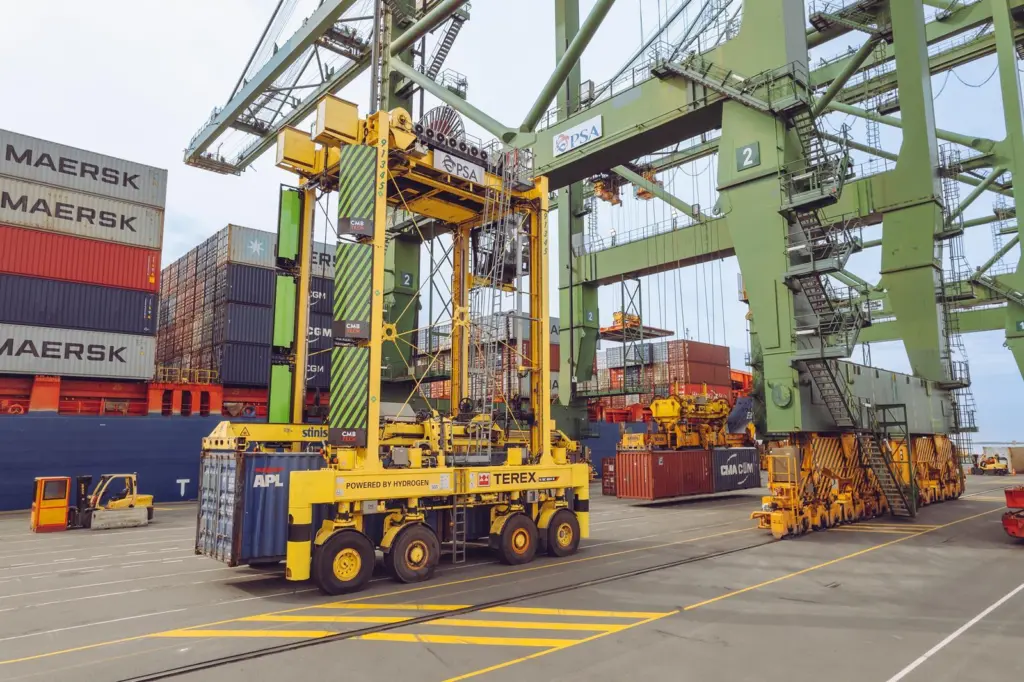
Straddle carriers are a key focus when it comes to lowering emissions as they are one of the major sources of CO2 emissions in container terminals. Francis De Ruytter, Regional Head of Sustainability, Mediterranean and the Americas, PSA Europe, says: “Straddle carriers are crucial in maintaining highly productive operations at our terminals, but at the same time they are responsible for approximately 90 per cent of our direct emissions in Belgium.” PSA Antwerp and partners have launched a hydrogen dual fuel straddle carrier (see below).
CMB.TECH: The world’s first hydrogen dual fuel straddle carrier is being tested at the Port of Antwerp following a joint venture between MSC PSA Europe Terminal, PSA Antwerp and Antwerp Terminal Services (ATS). Antwerp-based CMB.TECH, which is specialised in developing and building hydrogen and ammonia-powered applications, was responsible for integrating the technology and the related expertise to design and build this first prototype, in collaboration with ATS and equipment manufacturers. The dual fuel technology is able to replace 70 per cent of diesel consumption with hydrogen, with the goal of 100 per cent hydrogen power.
Kalmar: Kalmar has launched its Electric Straddle Carrier Charge Family. This includes: the Kalmar electric straddle carrier, capable of up to four hours of continuous operation with a charging time of 45–50 minutes and the Kalmar electric straddle carrier with high-power battery capable of up to 50 minutes of continuous operation with a charging time of five to six minutes using FastCharge technology. There are two different charging options: a standard CCS charging interface compatible with any commercial charging station, or optional FastCharge technology where the onboard battery is charged via a pantograph at a FastCharge charging station. Also included is the Kalmar Charge Optimiser software, which automatically assigns charging tasks to ensure high utilisation of charging points, the Kalmar One Fleet Optimiser software, which handles job scheduling and dispatching, and the Kalmar Insight Energy Module.
Konecranes: Konecranes’ Noell Battery Straddle Carrier, launched in June 2022, comes with automated charging stations and can handle containers 1-over-3 high with twin-lift capability. Konecranes has chosen an “out of operation” charging strategy following comprehensive analysis and simulations.
Related Articles
 CONTAINER & CARGO HANDLING
 CONTAINER & CARGO HANDLING
 EQUIPMENT