![PortStrategy[GreenPort]](https://www.portstrategy.com/wp-content/uploads/2026/09/PortStrategyGreenPort.svg)


CMA CGM: Ecologically Thinking
“Think Ecologic” is the key message of the environmental programme being introduced by Marseille-based shipping line CMA CGM for both its shipping and shore-based activities
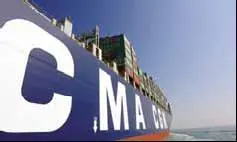
A commitment to the environment is high on the business agenda of CMA CGM – the world’s third largest container shipping line. This commitment is underlined by Jacques Saadé, CMA CGM’s President, who explains: “When it comes to protecting the environment, especially the marine environment, I expect our performance in this area to be something we can all be proud of. This is why we have defined a very strict environmental strategy, which I am asking all staff members, both sea-going and sedentary, to support. In this regard, CMA CGM has to set an example in all aspects of its business, not just in its financial performance. This is a genuine commitment that we are all making together.” The company’s strategy covers four main areas:
1. Fighting climate change
2. Protecting the marine environment
3. Offering eco-friendly solutions to the Group’s customers
4. Developing an environmentally aware culture
Fighting climate change
The Group has embarked on a policy to acquire new vessels incorporating the very latest technologies to protect the environment. They will be delivered between 2009 and 2012 and will incorporate the following innovations: An electronic injection system for the engine Since November 2008 with the delivery of CMA CGM Vela (11,000 TEU), all of the Group’s new vessels are being equipped with an electronic injection system for the engine, significantly reducing consumption of fuel (by 3%) and oil (by 25%). A twisted leading edge rudder Since 2009 with the delivery of CMA CGM Thalassa, new vessels of more than 8,000 TEU are being equipped with a twisted leading endge rudder. Its leading edge is orientated to optimize the flow of water, considerably reducing energy consumption and CO2 emissions. A Pre-Swirl Stator All 13,000 TEU vessels ordered by the Group, the first of which arrives in 2009, will be fitted with this ingenious new device. The Pre-Swirl Stator alters the inflow angles to the propeller to maximize propulsion efficiency. Together with the twisted leading edge rudder it optimizes a ship’s hydrodynamics to cut fuel consumption and greenhouse gas emissions by 2% to 4%. Optimized hull design An optimized hull design improving the hydrodynamics of the vessel, as well as the equipment required to connect to a port’s electricity supply during operations. Low sulphur fuel To reduce sulphur oxide emissions, the CMA CGM Group has also chosen a low sulphur fuel of a much better quality to that stipulated by the regulations, with a sulphur content estimated at 2.7% (even less in certain regions) instead of 4.5%. Eco-speed Lastly, the Group has in place a program to reduce the speed of its vessels: Eco-speed.
Preventing pollution at sea
In order to significantly limit the consequences for the environment of an incident at sea, the CMA CGM Group decided to modify its new vessels at the design stage by locating the fuel tanks at the centre of the vessel. All new ships are also being fitted with a homogeniser to reduce the build-up of hydrocarbon sludge and an extra decanting tank. There are also additional tanks for treating bilge, engine and grey water. All equipment on deck is electric, so as to eliminate the problem of hydraulic fluid leaks. The Group has also broken new ground by equipping its future vessels with a new pollution prevention technique called the Fast Oil Recovery System. Developed by JLMD, this system enables hydrocarbons to be rapidly recovered at any time without going through the hull. Each tank is fitted with connecting pipes so that hot water can be injected in and hydrocarbons extracted. Initially developed for petrol tankers, the technique has been adapted for container ships thanks to joint efforts by the JLMD Ecologic Group and the CMA CGM Group’s New Building Department. The world’s first containership to be equipped with the Fast Oil Recover System was the CMA CGM Andromeda (11,400 TEU), delivered to the Group in South Korea on 18 March 2009.
Eco-friendly coatings
even before it became law, the CMA CGM Group had already decided in 1999 to use an antifouling coating that did not use TBT on the hulls of its vessels. Since then, older vessels have been systematically repainted with the TBT-free coating when they come into the yard for careening. The Group was also one of the first to test a new generation of silicon-based antifouling paint on the CMA CGM Manet (2,200 TEU) and the CMA CGM Bizet (6,627 TEU).
Ballast water management
To protect marine and coastal ecosystems in compliance with the IMO’s 2004 International Convention, a ballast management plan is in operation on all CMA CGM Group’s vessels. Exchanges are made out to sea in deep water at least 200 miles from the coast. To improve controls, CMA CGM continues to examine new ways of treating ballast water. As part of the worldwide effort to protect cetaceans, particularly the North Atlantic Right Whale, CMA CGM ships reduce their speed by 10 knots when entering certain areas along the east coast of the United States.
Reducing waste and garbage
Exceeding even the demands of the Marpol Convention, and following the example set by CMA CGM Tosca (8,500 TEU), the Group is committed to an innovative, ecological and exemplary approach dubbed the “green ship”. This initiative involves four key actions:
1. recycle all garbage
2. abolish incinerators in favour of new generation compactors
3. Forbid the discharge of waste overboard (other than biodegradable food waste)
4. Make the most of recycling channels on shore
Developing an eco-friendly container fleet
For a number of years, innovative, ecofriendly containers have been introduced into the Group’s container fleet.
Bamboo floors
In 2005, CMA CGM was the first to develop and invest in bamboo-floored containers. The brainchild of a joint project between the Group and one of its key customers, these innovative units have a dual purpose: to limit the use of rare tropical wood species, while improving technical performance. From a modest start of 400 TEU in 2005, the Group’s fleet passed the 80,000 TEU mark in 2009 – nearly 10% of containers owned by the Group.
Low energy reefers
In the reefer sector, the Group continues to monitor the latest developments. The aim is always to identify the most eco-friendly solution for reducing energy consumption and CO2 emissions. In January 2009, the Group invested in 2000 reefers fitted with low energy motors which reduce electricity and fuel consumption by up to three times (Les Reefers basse consummation). This latest generation of containers is being deployed on the Group’s French West Indies line for transporting bananas, saving many tonnes of fuel per trip.
Light Steel containers
In September 2008, the Group entered a new phase with the introduction of a fleet of the fi rst Light Steel containers. They are manufactured from extremely strong High Tensile steel which saves 550kg of the high-cube container’s tare weight, without compromising its structural qualities. When employed on a 10,000 TEU vessel, these containers save up to two tonnes of fuel per day, which represents three to six tonnes of CO2 emissions.
Promoting intermodal transport
CMA RAIL, a subsidiary of the CMA CGM Group is developing intermodal services as an extension of its maritime route network. With 110,000 TEU transported in 2008 in Europe alone by CMA RAIL (up 22% on the previous year), the Group is continuing to expand its activities in the rail freight market in Europe, China and Algeria. Discussions are underway in Morocco and India. In China, CMA CGM has invested in 18 terminals as part of a joint venture with the Chinese railway company, as a way of extending the Group’s rail container transport strategy between ports and the big economic centres inland. Trains started running in 2008 and the first terminals enter operation this year. River container transport is one of the cleanest and most economic solutions, whilst also avoiding the chronic traffic congestion encountered on major roads. River Shuttle Containers (RSC), a subsidiary of the CMA CGM Group which transported over 65,000 TEU in 2008, is the leading river transport company in France. The Group has also established numerous feeders. These deploy smaller boats navigating between the main ports and the satellite ports, effectively reducing the number of big trucks on the road that would have been required to supply the mother-ships.
An environmentally aware culture
CMA CGM has set out to develop a culture of environmental awareness through training, staff accountability and the promotion of sound eco-friendly practices. Many everyday awareness initiatives have been put in place at Head Office and in all the agencies. Daily actions include recycling paper, toners, ink cartridges, light bulbs, batteries and mobile phones. Printers are set to print on both sides by default, considerably reducing the amount of paper each person uses. At the Group’s Head Office, significant savings are being made from fluorescent tube lighting (T5 standard), cutting consumption by 16%. Tinted double glazing limits thermal exchange and specially designed windows reduce heat loss, all of which serve to reduce energy use. Exhibitions on the Group’s actions are regularly held and films are shown. A major campaign to highlight good practice at work was launched at the beginning of April and concerns all the Group’s 650 agencies. Then there are training sessions for staff members organised by “FIRST”, the internal university located at the Group’s Head Office, and by the video training system Videotel for sea-going personnel.
A Head Office for the future
Environmental considerations have been given top priority by the CMA CGM Group in the construction of its future Head Office in Marseilles. The new tower, designed by the architect Zaha Hadid, incorporates numerous eco-friendly concepts, including among other things:
• Improved insulation thanks to a “double skin” façade
• A chilled beam air-conditioning system combining comfort and low consumption
• The optimization of natural light; and the integration of low energy facilities and equipment Last but not least, as a natural extension to the environmental policy, Marseilles’ tramway will be extended to facilitate access to the new Head Office and limit the amount of traffic on the roads.
Related Articles
 ALTERNATIVE FUELS GREENPORT
 NEWS
NEWS