![PortStrategy[GreenPort]](https://www.portstrategy.com/wp-content/uploads/2026/09/PortStrategyGreenPort.svg)


Developing the Danube Green Corridor
The aim of the Danube Green Corridor project is to analyze how car logistics from South- East Europe, can combine different transport modes while reducing costs and cutting the negative effects on the environment*
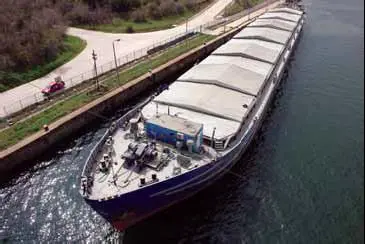
The European Union has been traditionally a leader in the car manufacturing sector. To be competitive, most of car manufacturers have relocated some of their plants to new EU member states. The total investment of component manufacturers and car manufacturers in the new member states from Central & South East Europe (C&SEE) is estimated at up to 2.4 billion Euros and an additional 2 billion Euros are expected over the next five years. This investment has completely reshaped the freight transport and logistic chain within the sector, risking a high level of congestion. Such congestion could come with a financial price tag (such as higher product prices) while also leading to social and environmental repercussions – if rapid and effective actions are not taken. In the last few years, extensive research has been undertaken on the integration of the Danube waterway in future transport corridors. These include:
1. INTERIM Project
(INtegration in the intermodal goods Transport of non EU states: Rail, Inland/coastal waterway Modes).
This is an ongoing project, aimed at enhancing co-operation in the CADSES area by the improvement of administrative, economic and transport structures related to spatial planning and development in general; and intermodal transport planning and operations specifically, integration of intermodal transport issues into spatial planning and regional development concepts and the Joint use of IT-based planning and information tools.
2. COLD Study
(Container Liner Service Danube)
COLD was centered on the elaboration of a report to provide comprehensive and detailed information regarding the feasibility and prospects of container liner services between Austria (Krems) and the Black Sea (Constanta), to prepare the establishment of container liner services through a consortium of private actors. The study showed that “with the 75% capacity utilisation deemed realistic, for the route Krems – Constanta via Danube the basic costs amount to around !231 per TEU or !427 per 40 ft container, much less than the reference value for the railway route Krems- Rotterdam (!340 / TEU or !670 / 40 ft.)”. The study for the Europe – Asia link (Krems – Shanghai) showed that “transportation time in import (direction Shanghai – Krems) is three days longer, but in export (direction Krems – Shanghai) one day shorter. Furthermore, costs for imports are higher by 4% for a 40ft container and the same for a 20ft one, while export costs are 12% and 13% lower for 20ft and 40ft containers respectively”.
3. MUTAND project
(Multimodal Transport on the Danube River)
MUTAND had as its main objective the establishment of regular Ro-Ro lines between South-East Europe and Germany, Austria and Hungary. The project was investigating possible ports of call for Ro-Ro ships (Ro-Ro terminals) in former Yugoslavian countries. To achieve this, it took into account the market orientated service, the optimized use of inland waterways and new transport concepts for the relatively fast utilisation of the strategic advantages presented by inland waterway facilities. With the analysis of the Passau-Belgrade- Passau Ro-Ro liner service, the study came to the conclusion that Ro-Ro has a lower initial capital investment. This is why it gets preferred – in the short and medium term – compared with container transport. The preliminary cost analysis for the Ro- Ro service on the route Belgrade-Passau- Belgrade indicated that larger vessels are more efficient than smaller ones. The comparison of transport costs and the time by road and combined transport using the Ro-Ro vessel showed that one can obtain smaller costs by using Ro-Ro services with only one day longer transport time.
4. CREATING Project
(Concepts to Reduce Environmental impact and Attain optimal Transport performance by Inland NaviGation)
CREATING was aimed at the stimulation of waterborne transport in an economical way, by giving new impulses to inland navigation.
This included the integration of logistics chain with modern technology in the field of inland navigation and the design of state of the art ships in terms of economics, safety and environment, presenting the owners with the opportunity to obtain ships that fulfill the highest requirements regarding hydrodynamics, engines and safety. The results of the study included the commissioning of a tanker vessel “Victoria” in collaboration with BP Shipping, with on the shipping route between Rotterdam and Antwerp. The expected results were looking at a reduction in NOx emissions by 86%, Particulate Matter by 96%, Fuel Consumption by 5%, CO2 by 5% and SOx by 99.5%. Other results led to the design of:
– An inland vessel fitted with advanced loading and unloading equipment and a special propulsion system
– A dedicated inland reefer;
– A large Ro-Ro vessel with a shallow draught dedicated to navigate on the Danube;
– A chemical carrier designed as a small tanker to transport special products. The project was focused also on the environmental impact of present inland vessels and their emissions and in finding solutions on how to improve this. As a synthesis of the results of the projects mentioned above, a number of infrastructure weaknesses were identified, such as the large fluctuation of the draft, aspects related to the available height of the bridges, the lack of connectivity to other modes of transport and poor services. But all studies have underlined the huge potential for the development of transport on the Danube).
EU initiative
On October 18th 2007 the European Commission adopted a series of initiatives aimed at making freight transport in the EU more efficient and sustainable. This new package of measures consists of proposals regarding logistics, a rail network giving priority to freight, and European ports, as well as two documents on the barrier-free European maritime transport area and the motorways of the sea. The simultaneous adoption of all these measures gives a strong signal demonstrating the close links between logistics and the various modes of transport. The common objective of these initiatives is to promote innovative infrastructure technologies and practices, develop means of transport, improve freight management, facilitate the construction of freight transport chains, simplify administrative procedures and enhance quality throughout the logistic chain. In the paragraph 2.5 of the freight logistics Action Plan, the Green Transport Corridors for freight have been defined.
Green corridors
The concept of green transport corridors is defined as an integrated transport system where short sea shipping, rail, IWW and road complement each other in order to accommodate rising traffic volumes while promoting environmental sustainability and energy efficiency. According to the vision of the Commission this corridors should be equipped with adequate transhipment facilities at strategic locations and with supply points initially for bio-fuels and later for other forms of green propulsion. Following the ideas presented in the document of the Commission, a consortium of Universities and research institutions coordinated by the BSUN – Center for Advanced Engineering Sciences of “Ovidius” University of Constantza has initiated a regional coordinated action in order to define a tailored concept for one of the most dynamic industries of the Central & South-East Europe (C&SEE) – car manufacturing sector. The aim of the Danube Green Corridor project is to analyze the freight traffic among the car component plants, car manufacturing plants and car distributors from South-East Europe in order to introduce innovative solutions to render freight transport more sustainable and to define a “Green Corridor” that optimally combines the different transport modes whilst demonstrating the potential of reducing costs and negative effects on the environment, including greenhouse gas emissions. The objectives:
• To identify the key players among transport operators, infrastructure managers, car component shippers, car manufacturers and dealers interested on the development of a dedicated freight transport corridor centred on corridor VII (Danube);
• Identification of common concerns, best practices in order to achieve economic efficiency, social acceptance and environmental sustainability;
• The definition of a potential green corridor dedicated to car manufacturing in Central and South – East Europe with the evaluation of the possible characteristics and expected energy and environmental performances;
• Preparation of tree R&D proposals for the analysis of the feasibility of optimally combining rail, road and waterborne transport along corridor VII (Danube) to create freight logistics chain dedicated to car manufacturing sector;
• The evaluation of “green propulsion” technologies, alternative fuels and IT&C technologies for the integration of different modes of transport as part of the future “green corridor”
*This article was written by Eden Mamut, Laurentiu Oancea, Rita Avram, of the Black Sea Universities Network – Center for Advanced Engineering Sciences, “Ovidius” University of Constantza, Romania. emamut@univ-ovidius.ro
Related Articles
 ALTERNATIVE FUELS GREENPORT
 NEWS
NEWS